The amyloidoses comprise a collection of disorders in which proteins, some native and some mutated, are deposited in tissues. These proteins self-assemble themselves to form an ordered fibrillar matrix termed amyloid. Currently, more than 20 different proteins have been identified, the most common with as many as 100 different mutations per protein. Despite these figures, the conditions that arise clinically are not that common. This undoubtedly results in a number of such individuals not being identified, or typically only when it is too late to effect a cure.
This article describes the features, diagnosis and treatments for the different types of amyloid that affect the heart.
Cardiovascular magnetic resonance (CMR) is a safe and accurate imaging modality, with an established role in current cardiology practice. It is becoming essential for cardiologists in other non-imaging sub-specialities to acquire a working knowledge of the potential of CMR in both structural and in ischaemic heart disease. In the current specialist registrar training environment, however, it is difficult to gain that expertise unless wholly committed to an imaging career.
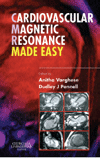
Editors: Varghese A, Pennell D Publisher: Churchill Livingstone Elsevier, 2008 ISBN 978-0-443-10301-8Price £19.99
This book affords the opportunity to derive a comprehensive overview of this highly technical field in a concise and yet easy-to-read format. Edited by Dr Anitha Varghese and Professor Dudley Pennell, from the Royal Brompton Hospital in London, one of the world’s foremost clinical and academic CMR departments, it also draws upon the experience of a number of international experts.
The first chapter, written by Dr Varghese, introduces the reader to the principles of CMR. It sets the tone of the book with sufficient technical information to introduce the reader to the basics of magnetic resonance imaging with an exhaustive description of the indications for CMR and the associated level of evidence for the assessment of different cardiac pathologies. It serves well as a reference and has well-annotated figures for a visual appreciation of the technique.
All the chapters are well-designed – ischaemic heart disease, heart failure and cardiomyopathy, valvular heart disease, cardiac masses, pericardial disease and myocarditis, the aorta, adult congenital heart disease, and magnetic resonance angiography are all covered sufficiently to give the reader a full overview of the potential of CMR. There is a separate chapter on CMR angiography with an honest caveat on the limitations of the technique compared to invasive angiography, aside from the determination of an anomalous coronary circulation. It would have been helpful to describe the role of CMR angiography in enhancing the diagnosis of vulnerable atherosclerotic plaque, although this indication is largely an academic one at present and not yet in regular clinical practice. The book finishes with a simple description of the common artefacts seen with CMR and how to avoid them in routine practice, again with excellent images presented which are easy to interpret.
In summary, this book is an excellent read and delivers to the reader a full appreciation of the full potential of CMR. It is well written by experts in the field and the quality of the images presented are superb. CMR is truly made easy by Varghese and Pennell and is a worthy addition to this series.
A 52-year-old man presented to the emergency department with increasingly frequent anginal chest pain. He had had an anterior ST elevation myocardial infarction two years previously, for which he received thrombolysis. He was an ex-smoker, hypercholestrolaemic and had a family history of ischaemic heart disease. During stress electrocardiography, he developed chest pain at nine minutes of a standard Bruce protocol, but no significant ST changes.
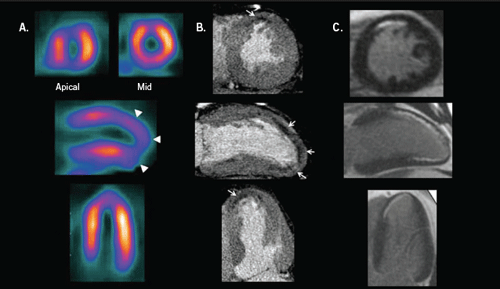
A computed tomography (CT) coronary angiogram (CTA) was performed, as the patient was not keen on an invasive angiogram, and demonstrated sub-endocardial hypoattenuation at rest in the anterior wall, apex and apical inferior walls (figure 1B). It was not clear if there was any reversible ischaemia so a myocardial perfusion scintigraphy (SPECT) was performed, and demonstrated a partial thickness infarction involving the anterior wall, apex and apical inferior wall (figure 1A). A research cardiac magnetic resonance (CMR) scan demonstrated late Gadolinium enhancement in the same territories as the other two studies (figure 1C).
Figure 1. A. Myocardial perfusion scintigraphy (SPECT) scan demonstrating a partial thickness infarction involving the anterior wall, apex and apical inferior wall; B. computed tomography angiogram (CTA) demonstrating sub-endothelial hypoattenuation at rest in the anterior wall, apex and apical inferior walls; C. cardiac magnetic resonance (CMR) scan showing late Gadolinium enhancement in the same territories
Recent advances in non-invasive imaging have resulted in the ability to assess myocardial infarction with multiple modalities. Each technique relies on a different methodology for the assessment of irreversible myocardial injury. For SPECT, a comparison of images obtained at rest and during hyperaemic stress demonstrates the absence or delayed uptake of a radioisotope, while CMR detects infarction by the delayed clearance of a paramagnetic contrast agent. CTA may detect infarction by either reduced first-pass perfusion or via delayed clearance of iodinated contrast. Given these inherent differences, the relative strengths and weakness of these techniques for the detection of myocardial injury are likely to be clinically important.
Teaching and learning the three-dimensional anatomy of the heart can be challenging. The use of the hand to model structures in the heart has proven useful. In this article a more comprehensive model of the heart using a gloved hand is proposed.
Introduction
The teaching and learning of the three-dimensional (3-D) anatomy of the heart, and especially the coronary arteries and the interpretation of cardiac angiogram radiographs of patients, is challenging to most students.1,2 Studying the anatomy of the heart using specific shapes of the hand during bedside teaching in hospitals and demonstrations of the gross anatomy can be useful.3,4 Harvey appears to have been the first to introduce the concept of using hands to depict the 3-D anatomy of the heart (in the 1950s).5 A 3-D anatomy hand model representing the liver organ has also been developed.4
One hand model,3 which showed the three major arteries of the heart, mimicked the commonly used arteriographic viewing positions by rotation of the hand. A more detailed model,1 which used both left and right hands, demonstrated the 3-D anatomy of the six major arteries of the heart. Duytschaever et al.6 used the left-handed model to demonstrate the structures on the walls of the right atrium. In this report, a more comprehensive hand model of the heart is proposed.
The proposed hand model of the heart
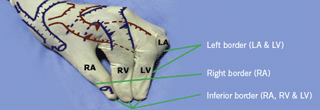
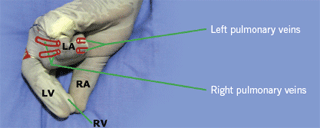
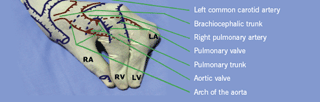
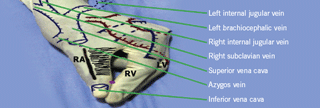
Figure 1. Anterior view: borders along the anterior surface of the heartFigure 2. Posterior view: the left atrium and pulmonary veins
The proposed hand model of the heart illustrates up to 60 features about the heart, (figures 1 and 2). These include the chambers, coronary vessels, venous drainage, valves of the heart and the great vessels of the mediastinum.
In this model, a specific position of the left hand was used. The anterior surface of the heart is ‘constructed’ with the tips of the middle finger and the thumb, grasping the palmar and dorsal surfaces of the index finger tip respectively. The ‘ring’ finger is positioned such that, its proximal interphalangeal joint can be seen, while its distal interphalangeal joint is hidden behind the proximal interphalangeal joint of the middle finger, as shown in figure 1. The fifth digit is completely obscured by the ring finger. The thumb, index finger, middle finger and the last two fingers represent the right atrium, right ventricle, left ventricle and left atrium, respectively. The tips of the thumb, index finger and middle fingers form the inferior or diaphragmatic surface of the heart.
The proximal phalanx of the index finger should be anterior to the proximal phalanx of the middle finger. This will highlight the fact that the superior part of the right ventricle is anterior to the superior part of the left ventricle. This places the aortic valve to the right and posterior of the pulmonary valve, while keeping the inferior part of the left ventricle to the left of the inferior part of the right ventricle.
The posterior surface of the heart can be demonstrated in a similar position. The forearm is maximally supinated, until the finger tips of the thumb, index and middle fingers are pointing superiorly, the elbow flexed and the wrist held straight. The metacarpophalangeal and interphalangeal joints of the ‘ring’ finger and last digit need to be strongly flexed, until they are at right angles (figure 2). The ‘ring’ finger and fifth digit represent the left atrium and by strongly flexing them, enables the left atrium to ‘appear’ between the right atrium and left ventricle, while yet in the upper half of the posterior surface of the heart.
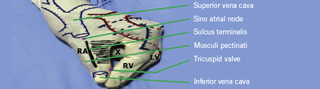
Figure 3. Anterolateral view: the structures of the right atrium. The fossa ovalis is indicated by an ‘X’
The right atrium is represented by the thumb (figure 3). The following anatomical structures can be labelled: the free wall, terminal crest, auricle, septal surface, tricuspid valve, opening of the coronary sinus, sinoatrial node and the orifices of the caval veins. A small circular piece of paper (about 2 cm2), held between the palmar surface of the interphalangeal joint of the thumb (right atrium) and the postero-lateral surface of the middle phalanx of the ring finger (left atrium) can represent the interatrial septum, on which the fossa ovalis lies.
The triangle of Koch is an area of surgical importance in which the atrioventricular node and its branches are found.6 The triangle of Koch lies between the antero-medial margin of the opening of the coronary sinus, the tendon of Todaro and the septal cusp of the tricuspid valve.6 The fossa ovalis lies just superior to the tendon of Todaro, so the triangle of Koch can be described as lying between the mark for the opening of the coronary sinus, the small circular paper (fossa ovalis) and the mark for the tricuspid valve.
The heart hand model by Duytschaever et al.6 represented most of the structures of the right atrium using the left hand. The proposed hand model has the advantage of showing the other chambers of the heart in relation to the right atrium, albeit on a smaller area of the hand than in the model by Duytschaever et al.6
Figure 4. Anterior view: great arteries of the mediastinumFigure 5. Anterolateral view: great veins of the mediastinum
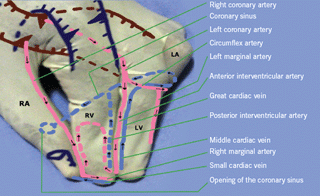
The great arteries and veins of the mediastinum are not represented, but can be drawn on the dorsal surface of the metacarpals, as shown in figures 4 and 5. Several coronary arteries and veins, with their branches and tributaries, can be marked out on the proposed model of the heart as shown in figure 6. The 3-D conceptualisation of flow of blood through the heart can be emphasised by marking the direction of the flow of blood with arrows.
Implications of teaching the three-dimensional perspective
Figure 6. Anterior view: the blood supply of the heart
The practical application of this model is best done by students working in pairs. The model created by the hand of one student represents the correct anatomical configuration of the heart in the body of the observer, i.e. the second student, when facing each other. This also encourages students to interact, and to assist the weaker student in consolidating his or her knowledge.
The main strength of this hand model is that it provides a spatial framework for the relations of the anatomic structures of the heart. The left hand preserves the attitudinally correct anatomical configuration of the surfaces and borders of the heart, in relation to the anterior and posterior walls, superior and inferior surfaces and right and left borders. The majority of people are right handed, which enables the student to use the right hand to write on the left hand (with the heart model). However, the right hand can successfully represent the attitudinally correct anatomical configuration of the surfaces and borders of the dextrocordis heart organ.
Limitations
The hand model is meant to provide an approximation of the 3-D layout of the heart, but has some limitations. The upper right border of the right atrium is tilted more towards the right side and the lower right border of the right atrium tilts towards the left. The tilting is caused by poor representation of the transverse cross-section areas of the chambers by the thumb, index and middle fingers. The fingers are leaner than the chambers of the heart and this can be partially solved by separating the finger tips (which represent the inferior surface) by 3 cm from each other. The inferior surface of the heart has a transverse section diameter of 8–9 cm7 and separating the three fingers with 3 cm from each other will approximate the transverse dimension of the normal heart. The most difficult blood vessel to illustrate is the course of the posterior interventricular branch of the right coronary artery (right dominance). The normal course of this artery is to pass through the right anterior atrioventricular groove and then through the posterior interventricular groove. The artery in the hand model passes through the right anterior atrioventricular groove and then crosses the posterior surface of the right ventricle to reach the posterior interventricular groove. Notwithstanding the limitations of the hand model, it provides a readily available 3-D learning aid to the gross anatomy of the heart.
Conclusions
Hand models are virtually free of cost and can be ‘handy’ teaching aids for instructors who have poor quick drawing abilities. The knowledge gained from using the hand model can be easily applied in the clinical setting,3,4 e.g. the clinician can place his or her hand on the chest or upper abdomen of the patient to gain the correct 3-D perspective of the heart. Students may also use their hands during formal anatomy assessments, to represent the heart and to aid their recall of the anatomy of the heart4.
Acknowledgements This paper was helpfully reviewed by members of the Department of Human Biology of the University of Cape Town, before submission for publication.
Conflict of interest
None declared.
References
Sos TA, Kligfield PD, Sniderman KW. A method for understanding three-dimensional coronary anatomy. JAMA 1980;243:252–4.
Edvinsson L, Mackenzie E, McCulloch J (eds). Cerebral blood flow and metabolism. New York: Raven Press, 1993;1–683.
Spring DA, Thomsen JH. A model for teaching coronary artery anatomy. JAMA 1973;225:56.
Gangata H.A 3-dimensional anatomy model of the liver organ using a gloved hand. Liver International Journal 2008;28:532–3.
Hurst JW. The approach to the patient. In: Hurst JW, Logue BW. The heart, arteries and veins. New York: McGraw-Hill Book Co Inc, 1969;44–47. Quoted in: Spring DA, Thomsen JH. A model for teaching coronary artery anatomy. JAMA 1973;225:56.
Duytschaever M, Ho SY, Devos D, Tavernier R. The left hand as a model for the right atrium: a simple teaching tool. Europace 2006;8(4):245–50.
Standring S. Gray’s anatomy. 39th Ed. London: Churchill Livingstone, 2007;995–1027.
The cardiovocal syndrome was first described by Otner, a Viennese physician, in 1897.1 It refers to a clinical syndrome of hoarseness due to dysfunction of the left recurrent laryngeal nerve, caused by cardiac diseases. Here, we describe a case of Otner’s syndrome following the second revision of mitral valve replacement.
Case report
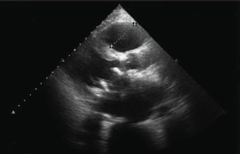
Figure 1. Echocardiogram showing dilated left atrium
A female patient was admitted to our unit after the second repair of her mitral valve, with breathlessness and hoarseness about 10 days after the operation. Prior to the last revision she was in left ventricular failure due to severe paravalvular mitral regurgitation and, despite severe pulmonary hypertension and dilated left atrium (figure 1), she did not have any vocal symptoms prior to the operation. Ear, nose and throat examination revealed left vocal cord palsy with normal pharynx and larynx. During her stay her voice steadily improved.
Discussion
Cases have been reported showing an improvement of voice hoarseness after repair of the leaking prosthetic valve.2 However, in our case, hoarseness occurred after the repair. Although hoarseness of voice is common after endotracheal intubations, it tends to occur in the immediate post-operative stage and should resolve within three to five days. In our case it started much later.
Slow compression of nerves might lead to a compensatory mechanism maintaining some function of the nerve until a late stage. We propose that the sudden change in the pressure on the nerve by the enlarged pulmonary artery and/or left atrium caused a temporary nerve dysfunction, probably due to some oedema of the myelin sheath with complete recovery afterwards.
The left recurrent laryngeal nerve branches off the left vagus nerve, as it crosses the arch of the aorta. Then it hooks around the ligamentum arteriosum medial to the arch and ascends in the groove between the trachea and oesophagus, to enter the larynx behind the cricoid cartilage. Not surprisingly, this long course around the aortic arch makes it more frequently involved than the right nerve in various pathologies. A unilateral lesion causes paralysis of the ipsilateral larynx and lower sphincter of the pharynx. The vocal cord becomes immobile and lies near the midline. The compensatory mechanism is so efficient that the voice may remain, or soon return to normal.
Conflict of interest None declared.
References
Otner N. Recuurens Lahmung bei Mitralstenose. Vienna: Klin Wechenschi 1897;10:753–5.
Silvia ZM, Fermin LB, Manuel AV. Paralysis of left recurrent laryngeal nerve palsy secondary to mitral periprosthesis insufficiency. Rev Esp Cardiol 1997;50:902–03.
You are not logged in
You need to be a member to print this page.
Find out more about our membership benefits


 Editors: Varghese A, Pennell D