

Rate-related left-bundle branch block (LBBB) is an uncommon conduction abnormality that can mimic ventricular tachycardia or myocardial ischaemia, and in prolonged cases may contribute to cardiomyopathy.
We describe the case of a 49-year-old woman with a previous history of mitral valve annuloplasty, anomalous pulmonary vein correction, and atrial fibrillation ablation who presented with recurrent palpitations and exertional chest pain. Despite normal echocardiograms and negative investigations for ischaemia, initially; a subsequent repeat exercise-tolerance test in 2024 revealed tachycardia-induced LBBB.
Tachycardia-induced LBBB may cause haemodynamic instability, chest pain (‘painful LBBB syndrome’), or long-term ventricular dysfunction. Early recognition is important for avoiding misdiagnosis as ventricular tachycardia or acute coronary syndrome. Clinical management focuses on rate control, exclusion of coronary disease, and the use of implantable cardiac device therapy in refractory or cardiomyopathic cases.
This case highlights the diagnostic challenges in patients with recurrent tachycardia-induced LBBB, the importance of excluding coronary artery disease, and the role of timely electrophysiology assessment to guide long-term management.
Background
Rate-related left-bundle branch block (LBBB) is a rare, but significant, clinical entity. It may mimic ventricular tachycardia or acute ischaemia and is often associated with haemodynamic compromise, and, in prolonged cases, may lead to the development of cardiomyopathy. Recognition of this pattern is essential for appropriate diagnosis and intervention.
Case presentation
A 49-year-old woman presented to us for the first time in 2013 with recurrent palpitations. She had a long history of palpitations since childhood, previously attributed to mitral regurgitation. Past medical history included asthma, hypertension, and hypercholesterolaemia.
Previously, she had undergone mitral valve annuloplasty, correction of an anomalous right superior pulmonary vein, and atrial fibrillation ablation at a tertiary cardiac centre in 2012. At her follow-up appointment, she described ongoing palpitations and occasional dizziness. Ambulatory electrocardiogram (ECG) (figure 1) and echocardiography were reassuring, and an implantable loop recorder demonstrated supraventricular ectopics. She was commenced on bisoprolol and flecainide, with partial symptom improvement.

In 2018, an exercise-tolerance test (ETT) was performed due to exertional symptoms, but this was inconclusive. An invasive coronary angiography revealed mild plaque disease in the left circumflex artery. She was commenced on aspirin and atorvastatin, with later addition of ranolazine. Serial echocardiography showed normal biventricular function and no significant valve disease.
Over the following years, she reported exertional chest pain and dyspnoea. Anti-anginal therapy was optimised with bisoprolol and isosorbide mononitrate. Tilt-table testing, computed tomography (CT) coronary angiography, and myocardial perfusion imaging were all unremarkable.
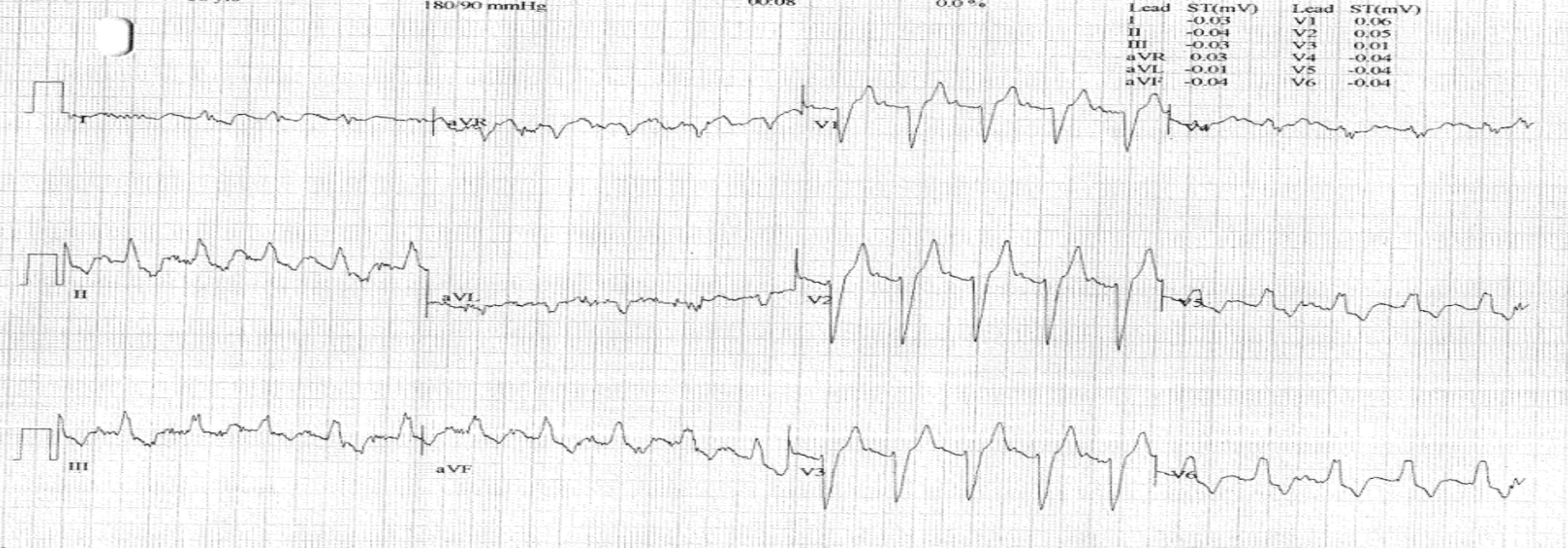
In 2024, repeat ETT demonstrated tachycardia-induced LBBB (figure 2). At the time of the original submission, the patient had been referred for an electrophysiology (EP) study; however, the EP study has not yet taken place due to delays in scheduling.
Investigations
- Ambulatory ECG: supraventricular ectopics
- Loop recorder: supraventricular ectopics only
- Echocardiography: preserved biventricular function throughout
- Coronary angiography (2018): mild left circumflex artery stenosis
- Tilt-table test: negative
- CT coronary angiography and myocardial perfusion scan: normal
- ETT (2018): inconclusive
- ETT (2024): tachycardia-induced LBBB.
Differential diagnosis
- Coronary artery disease with ischaemia
- Supraventricular tachycardia with aberrancy
- Ventricular tachycardia
- Rate-related LBBB.
Treatment
The patient was treated with bisoprolol, flecainide, aspirin, atorvastatin, ranolazine, and isosorbide mononitrate. Medical therapy was tailored for symptom relief and risk-factor modification. She is awaiting EP review to assess the need for pacing, or other advanced interventions.
Outcome and follow-up
Patient’s perspective
| “I have had palpitations for many years, but recently they started interfering with my daily activities. It is reassuring to know the cause has been identified, and I am hopeful that further treatment will help me return to normal life.” |
The patient continues to experience exertional palpitations and chest discomfort, but remains stable at rest. She is under regular follow-up and pending EP assessment at a regional centre.
Discussion
Rate-dependent LBBB occurs when conduction block in the left-bundle branch appears or resolves according to heart rate. Proposed mechanisms include phase-dependent block, acceleration-dependent block within the His–Purkinje system, and retrograde concealment.1
This phenomenon is clinically important because it can mimic ventricular tachycardia or myocardial infarction, and may be associated with impaired left ventricular systolic function.2 The rate at which LBBB appears is typically higher than the rate at which it resolves, reflecting hysteresis.3
Episodic LBBB has been described with tachyarrhythmia, bradyarrhythmia, anaesthesia, pulmonary embolism, trauma, and after cardiac surgery.4 Transient T-wave inversions (‘cardiac memory’) may accompany episodes and predict recurrence.5
Symptomatic tachycardia-induced LBBB can cause chest pain (painful LBBB syndrome),6 syncope,4 haemodynamic compromise,7 and prolonged episodes may result in the development of cardiomyopathy.8 It is important to rule out obstructive coronary artery disease either with CT coronary angiogram or invasive coronary angiography.9,10
The clinical management focuses on rate control, risk-factor management, and implantable cardiac device therapies in selected cases. Cardiac resynchronisation therapy (CRT) is recommended in patients with symptomatic heart failure, LBBB and severe left ventricular (LV) systolic dysfunction (LV ejection fraction [LVEF] ≤35%).11 In LBBB-induced cardiomyopathy, reducing time in block with rate control may reverse dysfunction.8,12 For refractory painful LBBB, pacing strategies including His-bundle pacing or left-bundle branch pacing are emerging options.13
In this patient, recurrent symptomatic tachycardia-induced LBBB was confirmed after years of non-diagnostic testing. Preserved LV function and absence of obstructive coronary artery disease (CAD) suggest a favourable prognosis, but close follow-up remains essential.
Key messages
- Rate-related left-bundle branch block (LBBB) is an uncommon but important cause of wide-QRS morphology
- It may mimic ventricular tachycardia or acute ischaemia
- Prolonged LBBB can lead to cardiomyopathy
- Coronary angiography is essential to exclude ischaemic heart disease
- Management includes rate control, risk-factor optimisation, and pacing in selected cases
- Timely electrophysiology referral should be considered in recurrent or symptomatic cases
Conflicts of interest
None declared.
Funding
None.
Patient consent
Written informed consent was obtained from the patient for publication of this case report and any accompanying images.
References
1. Josephson ME. Clinical Cardiac Electrophysiology: Techniques and Interpretations. 3rd edition. Philadelphia: Lippincott Williams & Wilkins, 2002.
2. Stein R, Ho M, Oliveira CM et al. Exercise-induced left bundle branch block: prevalence and prognosis. Arq Bras Cardiol 2011;97:26–32. https://doi.org/10.1590/s0066-782×2011005000054
3. Seibolt L, Maestas C, Lazkani M, Fatima U, Loli A, Chesser M. Rate-related left bundle branch block and cardiac memory in a patient with bradycardia: case report and literature review. Clin Cardiol 2018;41:1097–102. https://doi.org/10.1002/clc.22997
4. Bazoukis G, Tsimos K, Korantzopoulos P. Episodic left bundle branch block: a comprehensive review of the literature. Ann Noninvasive Electrocardiol 2016;21:117–25. https://doi.org/10.1111/anec.12361
5. Patibandla S, Monzidelis C, Buddhavarapu S et al. Rate-related left bundle branch block and cardiac memory in a patient without ischaemic heart disease. J Am Coll Cardiol 2019;9(suppl 1):2936. https://doi.org/10.1016/S0735-1097(19)33542-9
6. Tan NY, Witt CM, Oh JK, Cha YM. Left bundle branch block: current and future perspectives. Circ Arrhythm Electrophysiol 2020;13:e008239. https://doi.org/10.1161/CIRCEP.119.008239
7. Fisher JD. Profound independent effects of left bundle branch block and heart rate during supraventricular tachycardia. J Interv Card Electrophysiol 2005;12:223–5. https://doi.org/10.1007/s10840-005-0301-6
8. Siroky GP, Huynh H, Bisht D et al. Rate-related left bundle branch block-induced cardiomyopathy. EP Lab Digest 2020;20(9). Available from: https://www.hmpgloballearningnetwork.com/site/eplab/rate-related-left-bundle-branch-block-induced-cardiomyopathy
9. Hamilton MD, Ezeh E, Suliman M, Saylor J, Thompson E. Stress test-induced left bundle branch block. Cureus 2021;13:e17384. https://doi.org/10.7759/cureus.17384
10. Grady TA, Chiu AC, Snader CE et al. Prognostic significance of exercise-induced left bundle-branch block. JAMA 1998;279:153–6. https://doi.org/10.1001/jama.279.2.153
11. Lau EW, Bonnemeier H, Baldauf B. Left bundle branch block-Innocent bystander, silent menace, or both. Heart Rhythm 2025;22:e229–e236. https://doi.org/10.1016/j.hrthm.2024.12.038
12. Takigawa M, Yamada T, Yoshida Y et al. Demonstration of reversible complete left bundle branch block following tachycardia-induced cardiomyopathy. Europace 2012;14:915–17. https://doi.org/10.1093/europace/eur394
13. Sroubek J, Tugal D, Zimetbaum PJ, Shvilkin A, Buxton AE. Treatment of painful left bundle branch block syndrome with cardiac resynchronization therapy or right-ventricular pacing. HeartRhythm Case Rep 2019;5:321–4. http://doi.org/10.1016/j.hrcr.2019.03.005


