

Hypertension is the leading modifiable cardiovascular risk factor worldwide.1 Effective and inexpensive treatments are available, yet blood pressure control remains suboptimal in many countries.2 In Sweden, as in many other healthcare systems, hypertension management is largely delivered through primary care. This creates a major challenge, as the increasing number of patients with hypertension places additional pressure on a primary care already strained by workforce shortages and the growing healthcare needs of an ageing population.
Why hypertension care in primary care needs redesign
Traditional hypertension care is often based on regular physician-led follow-up visits for all patients, regardless of their cardiovascular risk profile. While this approach is understandable from a historical perspective, it is increasingly difficult to sustain. Primary care physicians must simultaneously manage multimorbidity, mental health problems, preventive care, and acute illnesses. As consultation time is finite, primary care physicians often struggle to provide the intensity of follow-up recommended by contemporary hypertension guidelines.3 Consequently, hypertension follow-up may become fragmented, delayed, or deprioritised.
The question we asked ourselves was simple: can hypertension care be organised differently without compromising quality or patient safety? More specifically, can we reserve physician resources for patients at the highest risk while empowering lower-risk patients to take a more active role in their own care? These questions formed the basis for the project, Sustainable Hypertension Management in Primary Care in Sweden (SHIP-CARE).4
The Swedish challenge: many patients, limited resources
The development of SHIP-CARE was strongly influenced by the realities of Swedish primary care. Hypertension affects a substantial proportion of the adult population and becomes increasingly common with age. At the same time, many Swedish primary care centres experience shortages of general practitioners. Although recent national initiatives have highlighted the importance of improving blood pressure control, relatively little guidance exists on how this can be achieved within existing resource constraints.
Patients with hypertension have different cardiovascular risk profiles and different follow-up needs. However, follow-up is often not tailored accordingly and patients with different risk profiles may receive similar care. We believed that a more sustainable approach would involve matching healthcare resources to cardiovascular risk. High-risk patients would continue to receive structured physician follow-up, whereas lower-risk patients could be supported through nurse-led care, home blood pressure monitoring, and digital communication. The rapid expansion of digital healthcare tools during and after the COVID-19 pandemic has created new opportunities to test such a model.
Development of the SHIP-CARE model
The SHIP-CARE model is based on four core principles (figure 1). First, care is stratified according to cardiovascular risk. Patients are assessed using established cardiovascular risk assessment tools to identify those who require more intensive follow-up. Second, care is team-based. Hypertension management does not always require direct physician involvement at every stage. Instead, trained nurses can play a central role in patient education, monitoring and follow-up while collaborating closely with responsible physicians, illustrating a task-sharing approach. Third, patients are empowered to participate actively in their own care. Hypertension education and home blood pressure monitoring provides valuable information while helping patients better understand their condition, engage more actively in their treatment, and gain confidence in managing hypertension.5 Fourth, the model is designed to fit into routine clinical practice rather than function as a stand-alone research programme, with sustainability considered from the outset. Accordingly, the intervention combines cardiovascular risk stratification, home blood pressure monitoring, nurse-led follow-up, digital communication, and educational support for both patients and healthcare professionals. The ambition is not simply to improve blood pressure values but to create a model that healthcare centres can realistically sustain over time.
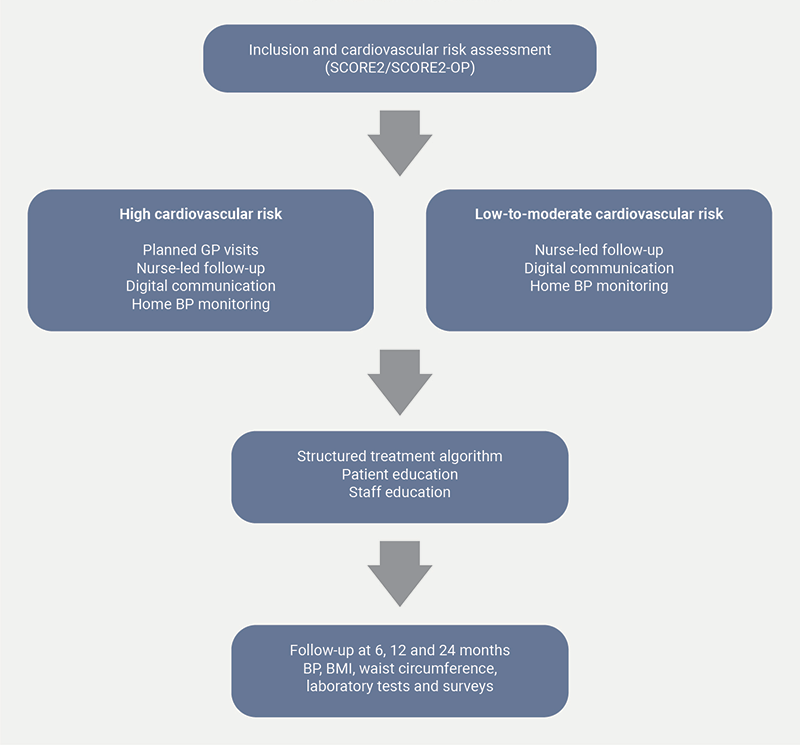
| Key: BMI = body mass index; BP = blood pressure; SHIP-CARE = Sustainable Hypertension Management in Primary Care in Sweden; SCORE2 = Systematic Coronary Risk Evaluation 2; SCORE2-OP = SCORE2 for individuals aged over 70 |
Risk stratification and team-based care
One of the most important innovations within SHIP-CARE is the use of cardiovascular risk stratification to determine follow-up intensity. Patients classified as being at high cardiovascular risk, primarily according to SCORE2 continue to receive planned physician reviews and structured follow-ups.6 This group typically includes patients with a history of established cardiovascular disease, diabetes, chronic kidney disease or other conditions requiring closer medical supervision.
Patients at low or moderate cardiovascular risk are managed differently. Instead of routine physician appointments, they are primarily followed by a designated hypertension nurse who acts as a care navigator. The nurse provides education, reviews blood pressure results and liaises with the responsible physician when treatment adjustments are required.
This approach reflects a simple principle: physician time should be directed towards patients with the greatest need while ensuring that all patients receive appropriate follow-up. The team-based structure also promotes continuity of care. Patients know who to contact, and nurses become familiar with individual patients’ treatment goals and challenges.
Home blood pressure monitoring and digital follow-up
Home blood pressure monitoring forms the foundation of the SHIP-CARE model. Clinic blood pressure measurements provide only a snapshot of a patient’s usual blood pressure, whereas home monitoring provides a more representative assessment of blood pressure and is therefore recommended in international guidelines. All participating patients receive a validated blood pressure monitor together with clear instructions regarding measurement technique and target values. Patients are encouraged to monitor their blood pressure at home and report to the nurse when target blood pressure is not achieved.
Digital communication plays a central role. Rather than scheduling routine appointments for all patients, contact is initiated when clinically necessary. Patients can communicate with the healthcare team through existing digital platforms, while nurses can review reported measurements and coordinate care.
The model aims to shift hypertension management from episodic clinic-based encounters to continuous patient engagement. Equally important, it can reduce unnecessary visits while maintaining access to healthcare professionals when needed.
Practical considerations during implementation
The pilot phase of SHIP-CARE generated several important lessons. Educational sessions for nurses, physicians, and administrative staff helped establish a common understanding of the intervention and its objectives. Patients generally appreciated receiving greater responsibility when adequate support was provided, and many valued access to a home blood pressure monitor and reported increased understanding of their condition. Risk stratification was accepted by both patients and healthcare professionals, although some clinicians initially expressed concerns about reduced physician involvement for lower-risk patients. However, the structured follow-up system helped address these concerns. Digital communication worked well for many patients but was not appropriate for all, making alternative approaches necessary for individuals with limited digital literacy. Finally, implementation highlighted the importance of simplicity. Complex interventions are difficult to sustain in busy primary care settings, and straightforward workflows increased acceptance among healthcare professionals.
Next steps: the SHIP-CARE cluster-randomised trial
The pilot phase of the study was designed primarily to evaluate feasibility and acceptability. The next step is a large cluster-randomised controlled trial involving 22 primary care centres and about 1900 participants across southern Sweden. The study, which started in September 2026, will evaluate whether the SHIP-CARE model improves blood pressure control compared with usual care while also assessing patient satisfaction, staff experiences, and cost-effectiveness. The project addresses a broader question that extends beyond hypertension. Healthcare systems across Europe face similar challenges of a rising burden of chronic disease and limited resources. Risk-stratified, team-based models may offer a more sustainable approach to managing chronic conditions without compromising quality of care. Whether the SHIP-CARE project achieves these aims will be determined by the results of the ongoing trial. Nevertheless, the development process has already demonstrated that rethinking traditional models of care is both necessary and feasible. In an era of increasing demands and constrained resources, sustainable healthcare may depend not only on new treatments but also on new ways of organising care.
Conflicts of interest
None declared.
Funding
The SHIP-CARE study is supported by grants from Forte (the Swedish Research Council for Health, Working Life and Welfare), the Swedish Research Council (Vetenskapsrådet), Region Skåne (ALF funding), the Crafoord Foundation, the Swedish Society of Medicine, and the Gyllenstiernska Krapperup Foundation. The funders had no role in the preparation of this manuscript.
Ethics statement
The SHIP-CARE study has been approved by the Swedish Ethical Review Authority (No. 2024-03625-01, including subsequent approved amendments) and is registered at ClinicalTrials.gov (NCT06580613).
References
1. GBD Risk Factors Collaborators. Global burden and strength of evidence for 88 risk factors in 204 countries and 811 subnational locations, 1990-2021: a systematic analysis for the Global Burden of Disease Study 2021. Lancet 2024;403:2162–203. https://doi.org/10.1016/S0140-6736(24)00933-4
2. NC Risk Factor Collaboration. Worldwide trends in hypertension prevalence and progress in treatment and control from 1990 to 2019: a pooled analysis of 1201 population-representative studies with 104 million participants. Lancet 2021;398:957–80. https://doi.org/10.1016/S0140-6736(21)01330-1
3. Pikkemaat M, de Pinho R, Rodilla E, et al. Clinicians’ time in different aspects of hypertension care: how far are we from optimal management required by guidelines? Results of an international survey of the working group of general practitioners’ and team-based care of the European Society of Hypertension and the European General Practice Research Network. Blood pressure 2026;35:2635826. https://doi.org/10.1080/08037051.2026.2635826
4. Andersson U, Axelsson L, Nymberg P, et al. Sustainable hypertension management in primary care – results from a pilot study [conference abstract]. J Hypertens 2026;44(Suppl 1):e45
5. Nymberg P, Bandel I, Bolmsjo BB, et al. How do patients experience and use home blood pressure monitoring? A qualitative analysis with UTAUT 2. Scand J Prim Health Care 2024;42:593–601. https://doi.org/10.1080/02813432.2024.2368849
6. SCORE2 Working Group and ESC Cardiovascular Risk Collaboration. SCORE2 risk prediction algorithms: new models to estimate 10-year risk of cardiovascular disease in Europe. Eur Heart J 2021;42:2439–54. https://doi.org/10.1093/eurheartj/ehab309


