

A 61-year-old man with Brugada syndrome (BrS) (SCN5A mutation) presented with chest pain to a district general hospital (DGH). There was no history of syncope or ventricular arrhythmias. A subcutaneous implantable cardioverter-defibrillator (S-ICD) was in situ for primary prevention following extraction of a previous transvenous ICD due to infection.
Investigations suggested a non-ST-elevation myocardial infarction. While awaiting coronary angiography, he developed a ventricular tachycardia (VT) storm with recurrent cardiac arrests over 30 minutes due to polymorphic VT, receiving seven S-ICD shocks.
Defibrillation, isoprenaline and quinidine were employed to manage the polymorphic VT storm, permitting transfer to a tertiary centre for further investigations. Coronary angiography demonstrated an occluded marginal artery, which was managed medically. Isoprenaline was weaned following quinidine initiation, the S-ICD reactivated, and he was discharged. A year later, there have been no further ventricular arrhythmias while on quinidine.
This case report demonstrates the effectiveness of isoprenaline, which is easily accessible and readily available in DGHs, in stabilising an acute Brugada storm. Quinidine allowed successful weaning from isoprenaline, but lack of availability limits its use. Finally, this case report highlights both the benefits and risks of primary prevention ICDs in BrS.
Introduction
Brugada syndrome (BrS) is an inherited cardiac channelopathy predisposing patients to ventricular arrhythmias.1 This case demonstrates the difficulties of managing a BrS storm in a district general hospital (DGH) using current guidelines.1–5 It also highlights both benefits and risks of implantable cardioverter-defibrillator (ICD) implantation in previously asymptomatic patients with BrS.1–3
Case presentation
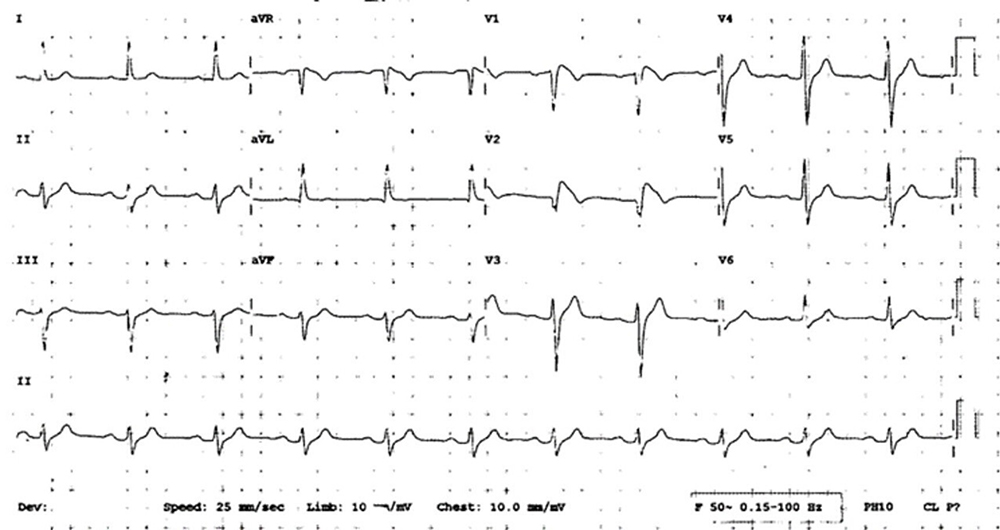
A 61-year-old man presented to a DGH with exertional chest pain associated with diaphoresis without fever. He had a diagnosis of type I BrS (figure 1) with confirmed SCN5A mutation. He had never suffered from syncope, nor symptoms of ventricular arrhythmias, but a subcutaneous ICD (S-ICD) had been in situ since 2020. A transvenous ICD (TV-ICD) was previously implanted in 2014 for primary prevention indications, due to patient preference, after the patient had extensively researched his condition, although there was not a strong indication according to current guidelines. The patient’s TV-ICD required extraction in 2020 due to infection. He had never previously received any device therapies or had any documented ventricular arrhythmias.
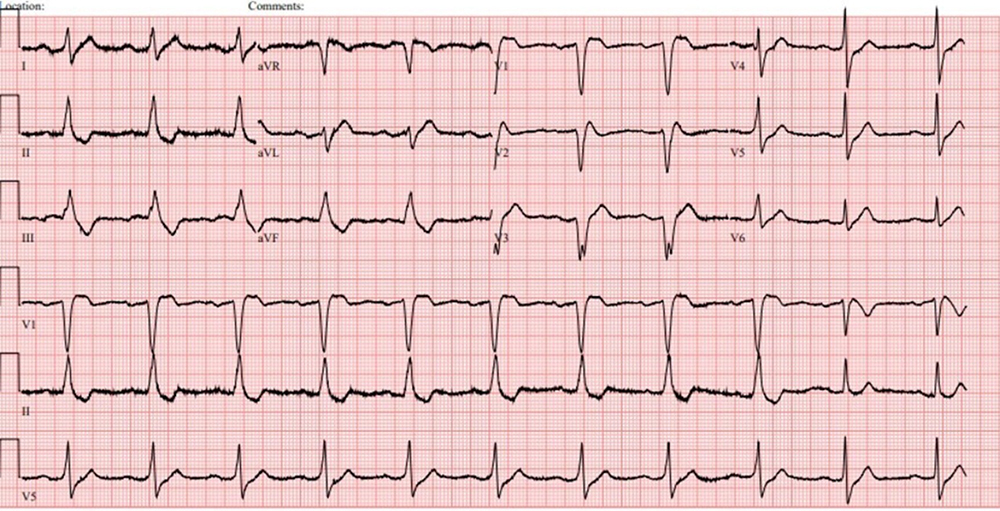
Admission bloods were within normal reference ranges except a raised troponin-T (TnT) of 23 ng/L (normal <14 ng/L), increasing to 426 ng/L 10 hours later. His chest X-ray demonstrated old retained defibrillator leads, a S-ICD and clear lungs. Inpatient transthoracic echocardiogram and device interrogation revealed no sustained arrhythmias or therapies delivered. The admission electrocardiogram (ECG) (figure 2) revealed broadening of the QRS with early precordial ST-elevation, in keeping with his known history of BrS.
He was managed as suspected non-ST-elevation myocardial infarction (NSTEMI) and treated with aspirin, clopidogrel and fondaparinux. He was placed on continuous cardiac monitoring, referred for an inpatient coronary angiogram at the closest tertiary centre, and remained haemodynamically stable with no further chest pain. However, 48 hours into his admission, he suffered loss of consciousness and cardiac arrest due to polymorphic ventricular tachycardia (VT) (figure 3).
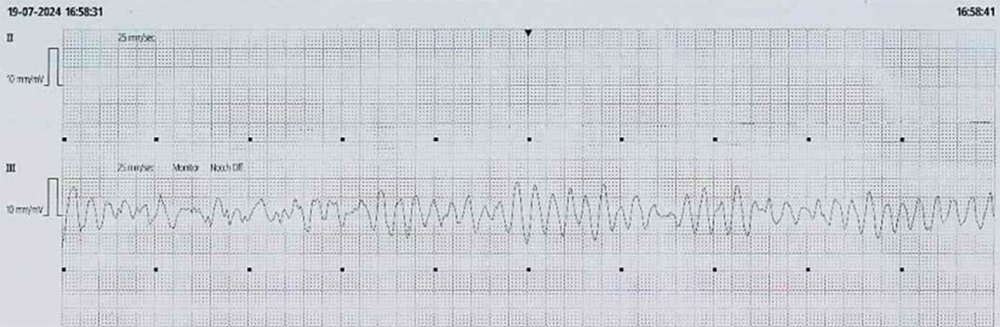
His S-ICD successfully delivered a shock, and he returned to sinus rhythm. He proceeded to suffer from eight episodes of polymorphic VT with recurrent cardiac arrest over 30 minutes. He was commenced on isoprenaline hydrochloride, the S-ICD was deactivated, and external defibrillator pads applied to prevent over-reliance on the S-ICD in the event of generator depletion due to recurrent ICD discharges.2,3 Laboratory bloods demonstrated that extended electrolytes were all within the upper limit of normal reference ranges and a repeat TnT of 1,487 ng/L. Intravenous magnesium was not given during resuscitation. No fevers were recorded and no QT-prolonging medications prescribed. NSTEMI was considered the most likely trigger.
The isoprenaline infusion2 was successful in suppressing sustained ventricular arrhythmias, permitting safe transfer to the tertiary centre. It was initiated at 0.01 µg/kg/min and titrated to his heart rate in intervals to induce a tachycardia, which helped stabilise the arrhythmia. In our case, isoprenaline was titrated to 0.02 µg/kg/min, where the dose was maintained for 24 hours before stepwise reduction. The immediate coronary angiogram demonstrated a small occluded marginal artery (OM1) as the culprit for his recent NSTEMI. This was managed medically and did not require revascularisation. He was established on oral quinidine 200 mg three times daily,2,3,5 his isoprenaline infusion was weaned over 24 hours, with no further arrhythmias. His S-ICD was reactivated, and he was discharged. He continues under cardiac follow-up, remaining arrhythmia-free on long-term quinidine one year later.
Discussion
Current European Society of Cardiology (ESC) guidelines2 confirm that eight treated episodes of polymorphic VT fulfil the criteria for an electrical VT storm. Several studies, including current guidelines,2–4 demonstrate isoprenaline’s beta-adrenergic stimulation increases the inward calcium current in phase 2 of the action potential (AP), preventing the notch and loss of the AP dome. This caused a profound sinus tachycardia as anticipated, but was effective in reducing polymorphic VT, permitting investigations of contributing causes, for example, electrolyte disturbances, cardiac ischaemia, autonomic disturbance, such as pyrexia, or additional QT-prolonging medication.1–3 Stabilisation of the arrhythmia allowed expedited transfer to the tertiary centre for further treatments, such as quinidine, which was unavailable in our DGH, and a coronary angiogram.
Quinidine, a class 1a antiarrhythmic has been shown to be beneficial in reducing arrhythmias in BrS, and permitted successful weaning from isoprenaline.1–3,5 In BrS, many class I antiarrhythmics are contraindicated due to sodium-channel blockade.6,7 In BrS, defective sodium channels reduce the inflow of sodium currents and increase transient potassium outward currents (ITO) resulting in a notch and loss of the AP dome in phase 1. Crucially, quinidine transiently blocks the ITO, reducing the epicardial AP notch and restoring transmural voltage gradient across the cardiac layers.6,7 It also prolongs ventricular refractoriness in phase 2 of re-entry, stabilising the AP, despite sodium channel inhibition.6,7 However, Viskin et al.5 highlight that quinidine was inaccessible in 76% of countries, and only accessible through strict regulatory processes in a further 10% of countries, due to QT-prolongation concerns. In a DGH, lack of quinidine availability increases the complexities in managing BrS storms, including the risks associated with cardiogenic shock from recurrent defibrillation.1,2,5 In contrast, hydroquinidine, which acts in a similar fashion to quinidine, maybe a suitable alternative, particularly where access to quinidine is difficult.8,9 One study,8 showed 91 BrS patients on hydroquinidine demonstrated long-term efficacy over a median follow-up of 61 months, with a significant reduction in ventricular arrhythmia (6% recurrence in high-risk patients). More recently, the QUIET BrS (Non-invasive Assessment of HydroQUInidine EffecT in Brugada Syndrome) study9 used non-invasive electrocardiographic mapping to show increased repolarisation, especially in the right ventricular outflow tract (RVOT); a vulnerable area in BrS responsible for the majority of dangerous arrhythmias.10 In turn, prolonging the AP refractory period and reducing arrhythmias in BrS.10 These studies suggest that hydroquinidine maybe a therapeutic alternative in treating BrS, especially if access to quinidine is limited.8,9
ICD implantation for asymptomatic BrS is not firmly recommended according to current clinic guidelines.2 In this case, patient preference was to have a TV-ICD implant, which subsequently required extraction. Despite experiencing complications with TV-ICD implantation, our patient’s S-ICD proved to be a life-saving intervention, allowing rapid termination of the arrhythmia. Programmed ventricular stimulation may aid in risk stratification by identifying inducible VT, though its routine use remains debated.2 This highlights the issues when discussing the benefits and risks of ICDs with patients, especially for primary prevention indications.2
Repeated defibrillation continues to be first-line management for arrhythmias and cardiac arrest secondary to BrS storm. According to the 2022 ESC guidelines,2 temporary overdrive pacing can be considered, and sedation using propofol can reduce adrenergic stimulation and electrical storm recurrence. In our case, generalised sedation was considered, but not favoured following initial anaesthetic review. The arrhythmia stabilised with isoprenaline, allowing transfer without sedation. Urgent transfer to a tertiary electrophysiology centre is essential to facilitate ongoing treatment and allow for the consideration of catheter ablation, should the arrhythmia not be controlled.2
Cardiac ischaemia is a known cause of triggering ventricular arrhythmias. In BrS, ischaemia can increase ITO, especially in the RVOT, amplifying known BrS intracardiac heterogeneity already present.10 A recent case report,10 explained that this synergistic effect can increase susceptibility to electrical storms, complicating management and creating a unique arrhythmogenic challenge.
Conclusion
Isoprenaline is readily accessible and effective in the acute management of a BrS electrical storm in a DGH setting, especially when quinidine is not available.2,3 Quinidine can be beneficial when managing ventricular arrhythmias in patients with BrS, however, availability limits its use. The role of primary-prevention ICD use in BrS is contentious. This case highlights both the benefits and risks of ICD implantation.
Conflicts of interest
None declared.
Funding
None.
Patient consent
The patient provided their informed consent verbally and in writing.
References
1. Marsman EMJ, Postema PG, Remme CA. Brugada syndrome: update and future perspectives. Heart 2022;108:668–75. https://doi.org/10.1136/heartjnl-2020-318258
2. Zeppenfeld K, Tfelt-Hansen J, De Riva M et al. 2022 ESC guidelines for the management of patients with ventricular arrhythmias and the prevention of sudden cardiac death. Eur Heart J 2022;43:3997–4126. https://doi.org/10.1093/eurheartj/ehac262
3. Furniss G. Isoprenaline and quinidine to calm Brugada VF storm. Case Reports 2012;2012:bcr0420114156. https://doi.org/10.1136/bcr.04.2011.4156
4. Maury P, Couderc P, Delay M, Boveda S, Brugada J. Electrical storm in Brugada syndrome successfully treated using isoprenaline. EP Eur 2004;6:130–3. https://doi.org/10.1016/j.eupc.2003.11.009
5. Viskin S, Wilde AAM, Guevara-Valdivia ME et al. Quinidine, a life-saving medication for Brugada syndrome, is inaccessible in many countries. J Am Coll Cardiol 2013;61:2383–7. https://doi.org/10.1016/j.jacc.2013.02.077
6. Belhassen B, Glick A, Viskin S. Efficacy of quinidine in high-risk patients with Brugada syndrome. Circulation 2004;110:1731–7. https://doi.org/10.1161/01.CIR.0000143159.30585.90
7. Giustetto C, Cerrato N, Dusi V, Angelini F, De Ferrari G, Gaita F. Brugada syndrome: pharmacological therapy. Eur Heart J Suppl 2023;25(suppl C):C32–C37. https://doi.org/10.1093/eurheartjsupp/suad036
8. Angelini F, Pourshayesteh S, Gastino E et al. Long-term efficacy and safety of hydroquinidine in patients with Brugada syndrome. Eur Heart J 2020;41(suppl 2):ehaa946.0397. https://doi.org/10.1093/ehjci/ehaa946.0397
9. Isbister JC, Strocchi M, Riedy M et al. Noninvasive assessment of hydroquinidine effect in Brugada syndrome (QUIET BrS). Heart Rhythm 2025;22:2906–16. https://doi.org/10.1016/j.hrthm.2024.12.014
10. Van Malderen SCH, Schultz CJ, Jordaens L. Synergetic effect of ischaemia and increased vagal tone inducing ventricular fibrillation in a patient with Brugada syndrome: a case report. Eur Heart J Case Rep 2020;4:1–5. https://doi.org/10.1093/ehjcr/ytaa202


