
Community-based cardiovascular risk reduction: age and the Framingham risk score

Br J Cardiol 2011;18:180–84 Leave a comment
Click any image to enlarge
Authors:

This study examined the effect of a community-based intervention on the natural rise with age of the Framingham 10-year risk score. Patients in the 45–64-year-old age group from 10 general practices were sent an invite card including five self-screening questions. Those with any of the prescribed risk factors were invited to arrange an appointment to assess their risk of heart disease, where a Framingham risk score was calculated and advice given, and then invited for re-assessment around 18 months later. 

Of 6,704 individuals contacted, 2,017 individuals (30.1%) arranged a health check, 982 followed up, and risk scores were calculated on 727. A significant reduction in the geometric mean Framingham risk was observed (from 10.65% to 10.34%), largely attributable to improvements in systolic blood pressure, high-density lipoprotein (HDL), reduced smoking and, perhaps, increased fruit and vegetable consumption. Although participants were 1.5 years older at follow-up, their risk profile corresponded to being 0.55 years younger, and, arguably, progression of risk was wound back by just over two years. Some self-selection bias was apparent, as those followed up had higher mean anxiety/depression scores at baseline.

In conclusion, community interventions can reduce cardiovascular risk even in deprived communities, although further analysis is required to establish cost-effectiveness.

Introduction

Cardiovascular disease (CVD) is a major cause of morbidity and mortality, particularly in deprived communities.1 Community or primary care based vascular risk assessment programmes are being introduced in England,2 Scotland and Wales, and are becoming central to USA health reform plans.3 However, the evidence base for these programmes is still emerging.4 The World Health Organization (WHO) estimate that better use of existing preventative measures could reduce the global burden of disease by as much as 70%5 based on some evidence from CVD prevention interventions that target risk factor management.6-8 However, the most effective methods for delivering these interventions are unclear. This study describes one approach, tailored toward the needs of a deprived community in a Welsh valley, with one of the highest standardised mortality rates for CVD in Wales.9,10 There is evidence that screening is particularly challenging in deprived communities as engagement rates are lower.11,12

This study utilised the Framingham Heart Study risk score, which estimates the 10-year risk of CVD. This scoring system combines seven risk factors: gender, age, cholesterol, high-density lipoprotein (HDL), systolic and diastolic blood pressure (BP), smoking status and family history. Although this calculation has been criticised,13 and there are alternatives such as the QRISK score,14 there is still debate on the best tool,15-17 and the Framingham score is still widely recommended and used in clinical practice and in research.18

Although primary prevention, aimed at altering lifestyle factors, has a relatively small impact on mortality,19 there is scope to examine the relative contribution of the components of the Framingham risk score that are impacted on most by primary prevention in high-risk populations. Some risk factors such as age, gender and family history cannot be modified. Taking into account changes to the Framingham risk score between initial assessment and follow-up is challenging, as risk scores will have increased simply because the average age in the study group will have increased. One of the aims of this paper was, therefore, to develop and test the concept that primary prevention of CVD could ‘wind back the clock’ in comparison to the expected rise in the Framingham risk score due to the progression of time alone.

Materials and methods

Participants aged 45–64 years from 10 general practices in the most deprived area in the north of Caerphilly Borough,20 who were not registered on GP disease registers as having CVD, hypertension, hyperlipidaemia, diabetes or terminal illness, were invited to attend an appointment with a nurse in the community for a ‘Healthy Heart’ check. The invitation was in the form of a brief self-screening card with questions on risk factors, a measured piece of string, 80 cm long for women and 94 cm long for men, was included to measure whether their central obesity exceeded accepted thresholds.21 A reminder letter was sent two weeks after the first invitation. A follow-up invitation was sent to attendees around 18 months later, to re-assess the risk of heart disease. All participants completed health locus of control22 and Hospital Anxiety and Depression23 questionnaires. Fasting lipids and blood glucose were measured, BP recorded, and body mass index (BMI) calculated, prior to being seen by a CVD specialist nurse for a discussion on lifestyles, risk factors and assessment of the Framingham risk score. Participants who were identified as being at high risk of CVD (above 20%), or with fasting glucose over 6 mmol/L, or an irregular pulse, were referred back to their GP. The assessment process is described in a previous paper based on a smaller data set.10

Study data were analysed using SPSS. Where data were skewed, log transformation (100 x natural log) was undertaken. Chi-square test, t-test, Wilcoxon test and U/mn index were used to compare groups, as appropriate. The U/mn statistic and its 95% confidence intervals (CI) were useful when comparing ordinal and quantitative variables. The statistic takes the value of 0.5 when the two samples are identical, and 1 or 0 if they do not overlap. It is not affected when a variable is log transformed.24 BMI was calculated using height at baseline. The risk score based on the Framingham longitudinal study was calculated using the algorithm presented in table 6 of Wilson et al.,13 the formula being multiplied by 1.5 in the event of positive family history. This figure was chosen as reasonably representative of the impact of family history in the available literature.13,25-27

The Framingham score has an inbuilt dependence on age; furthermore, most of the other variables included in the formula are prone to change systematically with ageing. To calculate the effect of ageing by 18 months, changes observed at follow-up for quantitative variables were adjusted. The adjustment was based on the regression coefficient b, representing the rate of change of the variable in question per year of age in a cross-sectional analysis of the baseline data. For consistency, only those individuals with follow-up as well as baseline data for the variable in question were used in this regression model. The adjusted mean change was, therefore, given by Δ -b×t where Δ denoted the unadjusted mean change and t represents the mean interval to follow-up in years, restricted to the same subjects. The standard errors for Δ and b were used to construct a standard error and, hence, a hypothesis test and 95% CI for the adjusted mean change.

Three additional analyses using the Framingham formula were undertaken to address this issue using a range of methods.

  • Scores at baseline and follow-up were calculated, except that a constant age of 55 years was used in both baseline and follow-up scores.
  • The score at baseline was calculated using the standard formula and the score at follow-up using the subject’s age at baseline.
  • The score at baseline was calculated using the standard formula and the score at follow-up using the subject’s age at follow-up, but other data as at the baseline visit.

The analyses were designed to give insight into several different facets of the input of age into the score.

Ethical approval for the study was obtained from the Gwent Research Ethics Committee (Ref. No. RD/294/04).

Results

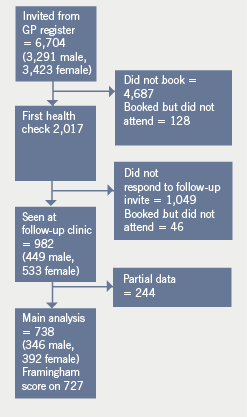
Between September 2004 and May 2007, 6,704 individuals were contacted and invited to self-assess their eligibility to attend an appointment to assess their risk of heart disease, of whom 2,017 individuals (30.1%) presented themselves for a health check. Of these, 982 attended an 18-month follow-up appointment. Framingham scores were calculated on 727 subjects, although data were available for most fields for 738 individuals. This was because of problems in calculating a Framingham score for individuals with very high lipid levels. The exact number of records, for whom data were available for each variable, is indicated in tables 1 and 2. Figure 1 briefly summarises the data used in the study.
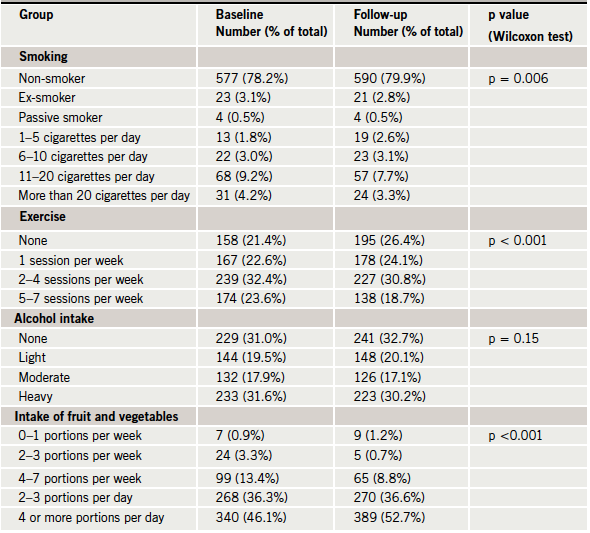
 

Table 1. Changes in categorical variables in 738 participants at follow-up
Figure 1. Flow chart of participantsBaseline and follow-up data comparing characteristics of those who were, and were not, followed up are available from the authors. There were missing data for psychometric scales and also for low-density lipoprotein (LDL) cholesterol, as this could not be calculated when the triglycerides were raised. Analyses of blood glucose were restricted to the 1,926 individuals who had fasting measurements on entry to the study.

Comparing the data of those who were and were not followed up, the proportion of participants who smoked was statistically significantly lower among those who were followed up (70.5%), compared with those who were not (78.2%). There was also a small (0.12 mmol/L) but significantly higher fasting glucose level in those who presented for follow-up. Participants, who were followed up, were on average more than a year older at entry than those who were not, had higher levels of anxiety and depression, and had slightly lower blood pressure levels, than those who did not come for follow-up.

Waist circumference at or above the 94 cm threshold for men was present in 53.7% of men; similarly, 63.3% of women were over the female waist circumference threshold of 80 cm.

Changes at follow-up

These analyses relate to 738 of the 2,017 participants who were followed up on average 1.488 years (range 0.844 to 2.162 years) from the initial visit. A positive family history was reported at baseline in 215 of these 738 participants; however, an additional eight of them reported a positive family history by the time of follow-up.

Table 1 summarises changes in the categorical variables. At follow-up there were modest, nevertheless statistically significant, improvements in fruit and vegetable intake, reduction in smoking, and a slight suggestion of a decrease in alcohol consumption. Conversely, there was a statistically significant decrease in exercise, which was not explicable in terms of seasonal differences.

Table 2. Changes in quantitative variables in 738 participants at follow-up, without and with adjustment for the effect of ageing, Results transformed back to original and ratio scales

Table 2 summarises changes in the quantitative variables. The depression and anxiety scores, HDL cholesterol levels, and systolic and diastolic BP show very clear evidence of improvement at follow-up. There was a small, although statistically significant, increase in the ‘internal locus of control’. Mean height decreased by 0.5 cm over the 18 months of the study.

The Framingham score decreased, from a geometric mean of 10.65 to 10.34, representing a reduction in 10-year risk of CVD from 10.65% to 10.34%. The change in the geometric mean (0.971) represents a relative decrease in the Framingham risk score of 2.9%. A 95% CI for this change is from a 6.0% decrease to a 0.4% increase.

Compensating for the effect of ageing on CVD risk

Table 2 also incorporates an adjustment for the fact that, on average, 18 months had elapsed from entry to follow-up. The effect of adjustment for ageing is to enhance substantially the benefit for systolic BP reduction. Taking elapsed time into account enhances the mean systolic BP decrease from 2.27 mmHg to 3.45 mmHg. In effect, winding back of the clock enhances the effect of the intervention on systolic BP by around 50%.

Diastolic BP, HDL cholesterol, anxiety and depression scales alter little on adjustment for ageing. Adjustment for ageing partly explains the deterioration in cholesterol, triglycerides, waist circumference and blood glucose. Only blood glucose was no longer statistically significant after adjustment.

The first Framingham analysis presented in table 2 indicates a reduction of 2.9 (in log-scale units) in the log-transformed Framingham risk score, at follow-up. This reduction in the Framingham risk score may be regarded as the consequence of two separate effects: an increase of 5.8 units, due purely to the age component of the score being increased by 1.5 years, and a decrease of 8.7 or 8.8 units, due to the other risk factors included in the Framingham score having improved at follow-up. Some of the health gain in ‘winding back’ CVD risk, as a result of the intervention, is masked by the effect of ageing on the Framingham risk calculation.

Additional analyses are presented in table 2, which address the issue of adjusting for ageing in different ways. The separate estimates (a, b, and regression adjustment) of age-adjusted benefit of 8.8, 8.7 and 10.8, are reasonably similar, considering that they are derived in quite different ways, and demonstrate that when age is taken into account, the improvements this intervention has demonstrated are significantly enhanced. Even in those individuals where the Framingham risk score has not decreased, there has been some ‘winding back of the clock’ in relation to CVD risk, as the risk would have been expected to rise with age.

Based on the cross-sectional analysis of the baseline scores, the adjusted analysis showed that the risk score at follow-up was 8–10% lower than would have been expected as a result of the cohort ageing by 1.49 years. Indeed, it could be said that the effect of intervention on the Framingham score was to ‘wind back the clock’ by approximately 0.55 years (2.924/5.295). These participants were actually 1.49 years older than at entry, but their risk profile corresponded to being 0.55 years younger, so it could be argued that at follow-up their risk was equivalent to retarding the progression of risk by just over two years.

Discussion

A significant reduction in the mean Framingham risk was demonstrated in this study for those who attended the follow-up appointment around 18 months later. This effect was largely dependent on improvements in systolic BP, HDL and a reduction in the proportion who smoked. Fruit and vegetable consumption was also increased and this may have played a part. The small change in internal locus of control may indicate that the intervention has had some effect in the direction of empowering participants. This study supports the proposal that nurse-led CVD screening in a deprived population has a reasonable uptake, is feasible, and is of benefit in reducing mean CVD risk. This study did not elicit data on changes to drug prescribing. Part of the benefit observed in this study may have resulted from screened individuals then being prescribed blood pressure and cholesterol lowering medications by their GPs.

The study also explored the concept of adjustment for the passage of time. Using a variety of approaches, it has been demonstrated that when the Framingham risk score does not rise to the extent that would be expected solely on the basis of the passage of time, the intervention has ‘wound back the clock’ in that some health gain is achieved in those individuals. A concept similar to winding back the clock has previously been described.28 The authors of this paper used the concept of ‘heart age’ and compared this against ‘chronological age’. Both concepts may be useful in communicating risk to individuals and communicating something of the benefit that has been gained by changes in the individual’s Framingham risk score.

It is possible that the small increase in internal locus of control may represent increased empowerment of participants, which may have mediated some of the health gain achieved. The project emphasised the importance of motivational interviewing and sought to empower participants to take responsibility for their own wellbeing.

Attendance for health checks in socioeconomically deprived populations is widely recognised as being lower than that of the wider population.11,12 Given the deprived nature of this community, and the fact that community interventions usually have great difficulty in recruiting men, an encouraging proportion of those who attended were men (44.8%). It may be possible to improve this figure further by the introduction of ‘out of hours’ appointments.

A significant proportion of participants did not attend for follow-up. Differences in the characteristics of those who are followed up can introduce bias as they are a self-selected population. Examining the baseline data, there were differences between those who were followed up and those who were not. The differences may indicate that those who believed they had made significant changes to their risk profile were more ready to return to a follow-up appointment.

In this study, those who attended for follow-up had significantly higher mean anxiety and depression scores (p<0.001), which would support the concept that those who participate in ongoing health check ups have some characteristics associated with poorer mental health. However, the intervention does not appear to have increased anxiety in those who did return when anxiety levels at baseline and follow-up are compared.

This study was not a randomised-controlled trial and the results should, therefore, be considered as ‘hypothesis raising’. A randomised trial might be the next step forward. However, the resources required to undertake one would be very much greater than those incurred in the present study, for two reasons. A trial randomised at individual level requires at least four times as many subjects as a before-and-after study in order to be powered to detect a difference of any specified size. Moreover, the increase in sample size required would be very much larger still, in that only a cluster randomised trial, randomised at practice level, is likely to provide a robust form of randomisation. However, cluster randomised trials have successfully been undertaken for a range of other behavioural interventions, for example smoking cessation, and funding should be sought to test cardiovascular risk reduction in a cluster randomised trial.

It was evident that there were no improvements in waist circumference, exercise levels and total cholesterol. There is, therefore, a need to further examine ways in which the effectiveness of the intervention can be increased.

The slight reduction in average height, an average of 0.5 cm over 18 months, was an interesting incidental finding. This rate is consistent with the average loss of height of several centimetres that occurs in middle age.29

There are a number of ways in which this work can be taken forward in the future. Vascular risk assessment could be provided in a wider variety of community contexts, particularly in community pharmacies. There is also scope to compare the use of the Framingham risk score against the QRISK score in community settings. Finally, there is also a need for further work to examine the cost-effectiveness of vascular screening in different community settings and to compare this with the National Institute for Health and Clinical Excellence (NICE) cost-effectiveness threshold of £30,000 per quality-adjusted life year (QALY).

Acknowledgements

We want to express our thanks to the GP practices
that helped identify patients from their registers, and to staff that have worked on this project including Tracey Deacon, Sue Scrozynska, Monica Harries, Lyn Stallard and David Simpson. This project was funded by Caerphilly Teaching Local Health Board which now forms part of Aneurin Bevan Health Board. REH was employed by this organisation.

Conflict of interest

None declared.

Key messages

  • Community-based interventions can reduce Framingham cardiovascular risk scores, even in deprived communities
  • The effect of this intervention was to ‘wind back the clock’ on the Framingham score by approximately 0.55 years, and arguably, progression of risk was wound back by just over two years
  • This study supports the increased development of vascular risk reduction measures, although further health economic assessment of the potential benefits is required

References

  1. World Health Organization. Prevention of Cardiovascular Disease. Guidelines for assessment and management of total cardiovascular risk. Geneva: WHO, 2007.
  2. Department of Health. Putting prevention first – NHS health check: vascular risk assessment and management. Best practice guidance. London: DoH, 2008.
  3. Obama B. Modern health care for all Americans. N Engl J Med 2008;359:1537.
  4. Robson J, Boomla K, Hart B, Feder G. Estimating cardiovascular risk for primary prevention: outstanding questions for primary care. BMJ 2000;320:702–04.
  5. Chan M. The world health report 2008: Primary health care now more than ever. Geneva: WHO, 2008.
  6. Cupples ME, Smith SM, Murphy AW. How effective is prevention in coronary heart disease? Heart 2008;94:1370–1.
  7. Hobbs FD. Primary prevention of cardiovascular disease: managing hypertension and hyperlipidaemia. Heart 2004;90(suppl 4):iv22–iv25.
  8. Redberg RF, Benjamin EJ, Bittner V et al. ACCF/AHA 2009 performance measures for primary prevention of cardiovascular disease in adults. Circulation 2009;120:1296–336.
  9. Davies G, Price T. Health Needs Assessment 2006 – Health Status and Key Determinants. Cardiff: National Public Health Service for Wales, 2007.
  10. Richardson G, van Woerden HC, Morgan L et al. Healthy Hearts – a community-based primary prevention programme to reduce coronary heart disease. BMC Cardiovasc Disord 2008;8.
  11. Thorogood M, Coulter A, Jones L, Yudkin P, Muir J, Mant D. Factors affecting response to an invitation to attend for a health check. BMJ 1993;47:224–8.
  12. Waller D, Agass M, Mant D et al. Health checks in general practice: another example of inverse care? BMJ 1990;300:1115–18.
  13. Wilson PWF, D’Agostino RB, Levy D, Belanger AM, Silbershatz H, Kannel WB. Prediction of coronary heart disease using risk factor categories. Circulation 1998;97:1837–47.
  14. Hippisley-Cox J, Coupland C, Vinogradova Y, Robson J, May M, Brindle P. Derivation and validation of QRISK, a new cardiovascular disease risk score for the United Kingdom: prospective open cohort study. BMJ 2007;335:136–41.
  15. Collins GS, Altman DG. An independent external validation and evaluation of QRISK cardiovascular risk prediction: a prospective open cohort study. BMJ 2009;339:b2584.
  16. Liew SM, Glasziou P. QRISK validation and evaluation QRISK may be less useful. BMJ 2009;339:b3485.
  17. Tunstall-Pedoe H, Woodward M, Watt G. QRISK validation and evaluation ASSIGN, QRISK, and validation. BMJ 2009;339:b3514.
  18. Wood D, Wray R, Poulter N et al. JBS 2: Joint British Societies’ guidelines on prevention of cardiovascular disease in clinical practice. Heart 2005;91(suppl 5):v1–v52.
  19. Ebrahim S, Beswick A, Burke M, Smith GD. Multiple risk factor interventions for primary prevention of coronary heart disease. Cochrane Database Syst Rev 2006;(4):CD001561.
  20. Caerphilly County Borough. A partnership strategy for health, social care and well-being in Caerphilly County Borough 2005–2008. Ystrad Mynach: Caerphilly County Borough, 2005.
  21. Dobbelsteyn CJ, Joffres MR, MacLean DR, Flowerdew G. A comparative evaluation of waist circumference, waist-to-hip ratio and body mass index as indicators of cardiovascular risk factors. The Canadian Heart Health Surveys. Int J Obes Relat Metab Disord 2001;25:652–61.
  22. Wallston KA, Wallston S. Development of the multidimensional health locus of control (MHLC) scales. Health Educ Monogr 1978;6:160–70.
  23. Zigmond AS, Snaith RP. The hospital anxiety and depression scale. Acta Psychiatr Scand 1983;67:361–70.
  24. Newcombe RG. Confidence intervals for an effect size measure based on the Mann-Whitney statistic. Part 2: Asymptotic methods and evaluation. Stat Med 2006;25: 559–73.
  25. Roncaglioni MC, Santoro L, D’Avanzo B et al. Role of family history in patients with myocardial infarction. An Italian case-control study. GISSI-EFRIM Investigators. Circulation 1992;85:2065–72.
  26. Cooper JA, Miller GJ,
    Humphries SE. A comparison of the PROCAM and Framingham point-scoring systems for estimation of individual risk of coronary heart disease in the Second Northwick Park Heart Study. Atherosclerosis 2005;181:93–100.
  27. Philips B, de Lemos JA, Patel MJ, McGuire DK, Khera A. Relation of family history of myocardial infarction and the presence of coronary arterial calcium in various age and risk factor groups. Am J Cardiol 2007;99:825–9.
  28. D’Agostino RB, Vasan RS, Pencina MJ et al. General cardiovascular risk profile for
    use in primary care: The Framingham heart study. Circulation 2008;118:E86.
  29. Sorkin JD, Muller DC, Andres R. Longitudinal change in height of men and women: implications for interpretation of the body mass index: the Baltimore Longitudinal Study of Aging. Am J Epidemiol 1999;150:969–77.
Implementation of the new NICE guidelines for stable chest pain: likely impact on chest pain services in the UK

Br J Cardiol 2011;18:185–88 Leave a comment
Click any image to enlarge
Authors:

National Institute for Health and Clinical Excellence (NICE) guidelines for the management of chest pain suggest a care pathway based on symptoms and clinical risk, which differs from that currently used in most hospitals. To compare the impact on workload, and costs of these guidelines with the current ‘exercise electrocardiogram (ECG)’-based service, a retrospective review of 150 patients referred to our rapid access chest pain clinic was performed. We compared investigations under the current system with that expected under the NICE guidelines. Cost analysis was performed to compare the two methods. GP questionnaires investigated likely changes in primary care referrals.

Continue reading Implementation of the new NICE guidelines for stable chest pain: likely impact on chest pain services in the UK

Academic clinical trials – exaggerated reports of their death

Br J Cardiol 2011;18:149–51 Leave a comment
Click any image to enlarge
Authors:

Modern medical practice calls for an evidence-based approach. The best medicine is, therefore, built on a foundation of the best evidence. The best evidence, in turn, comes from the best research. When it comes to the use of drug therapy this is provided by the most scientifically robust and ethically sound clinical trials. 

The history of clinical trials has clearly shown us that while they are essential for the progress of medical practice; their conduct may also be harmful to participants.1 A lack of ethical conduct and failure to uphold basic human rights have prompted the introduction of several codes of practice to guide and constrain the activities of investigators. Our patients require protection and never more so than in the context of clinical research.

Quality standards and legislation

To ensure the overall quality of clinical trials of medicinal products the pharmaceutical industry spearheaded, in January 1997, the use of a set of quality standards known as Good Clinical Practice (GCP).2 In 2001, the European Union (EU) used this approach as the basis for a new draft Directive on Clinical Trials, which would extend the coverage of GCP to include all clinical trials of investigational medicinal products in humans, irrespective of their funding and support.3 For the first time there would be a legal framework for the conduct of clinical trials across Europe and in the UK in accordance with the principles of GCP.

On 1 May 2004, the European Clinical Trials Directive (ECTD) (2001/20/EC) was transposed into UK legislation in the form of the Medicines for Human Use (Clinical Trials) Regulations.4 Its aims were clear: to simplify and harmonise the regulatory approach to clinical trials conducted across the EU, and to ensure the health and safety of participants, ethical soundness and the reliability of data generated from a trial.5 Ultimately, it was hoped that this legislation would improve the quality of clinical research and create an even playing field for investigators throughout Europe.

European response to the Directive 

However, despite its good intentions, many feel that the ECTD has had a negative impact on academic research.6 The Directive, which was subsequently interpreted and implemented by each of the EU member states, carries extensive regulatory procedures, and many investigators feel that it imposes an excessive bureaucratic burden upon them.6

The approach used by the drafters of this legislation has been criticised as a one-size-fits-all strategy.7 The Directive identifies minimum standards for all clinical research without taking into account the risk or financial backing of a trial. Consequently, academic researchers involved in the study of well-established drugs, used commonly in daily clinical practice, must adhere to the same stringent regulations as large pharmaceutical companies investigating the potential of a novel therapy. Many researchers feel that, in some cases, the risk to the trial participants does not always justify the financial and regulatory burdens imposed upon them by the Directive.

Furthermore, many have suggested that the prime objective of the Directive, which was to create a harmonised approach to the regulation of clinical trials across the EU, has been unsuccessful because of the variation in its interpretation in different member states.8,9

UK response to the Directive 

Although the legislation has a pan-European dimension, 75% of clinical trials are conducted in a single member state.10 What then has been the impact on clinical trials based in the UK?

The Medicines for Human Use legislation in the UK is relatively vague. For example, the definitions of an interventional versus a non-interventional clinical trial are open to different interpretations and the definition of an investigational medicinal product is unclear.5

The management of the implementation of the legislation since 2004 in the UK has also been imperfect. When the Directive was translated into UK law in the spring of that year, there were limited resources available to support investigators. Many were unaware of the important changes that had taken place and the opportunities for GCP training were limited.11 It was not until a year later, with the publication of the EU Directive on GCP,12 that investigators received confirmation of the form of GCP they were to follow. Further amendments to the legislation in 200813 and 200914 have been necessary to provide further clarification, but many investigators still report that they are ill-equipped to put the legislation into practice.15

The academic community in the UK has been fierce in its criticism of the ECTD and the Medicines for Human Use legislation.6 This is based on a strong conviction that the legislation has been singularly responsible for the perceived reduction in clinical trial activity, but is this true?

Trends in research activity across Europe and in the UK

When data are compared pre- and post-implementation of the ECTD, a number of interesting points emerge. The European Forum for Good Clinical Practice (EFGCP) recently conducted a Europe-wide survey of the impact on clinical research of European legislation.9 The EFGCP compared data which predated the implementation of the ECTD with that in the three years following it. Between 2003 and 2007 the number of commercially sponsored clinical trial authorisations (CTAs) submitted and the number of such trials conducted actually increased by 11% and 30%, respectively. In contrast, the number of applications from academic trialists remained unchanged, but the number of trials actually conducted decreased by approximately 25%. However, the EFGCP noted that while some countries experienced dramatic decreases in non-commercial CTA applications, others showed an increase. Also, not all countries report a decline attributable to the implementation of the ECTD. In Denmark, although both academic and commercial clinical trials were on the decline between 1993 and 2006, there was no noticeable change after 2004.16

The European Organization for Research and Treatment of Cancer recently analysed the effect of the Directive on European cancer clinical trials.8 The number of new trials fell by 63% between 2004 and 2005. Similarly, there have been claims that academic clinical trials have fallen by 75% in Finland, 70% in Ireland, 25% in Sweden17 and 66% in Austria.18

Perhaps the most robust UK data come from our competent authority, the Medicines and Healthcare Products Regulatory Agency (MHRA) and the National Research Ethics Service (NRES). The MHRA data on the number of CTA applications show a fairly flat response between 2000/01 (1,144 applications) and 2008/09 (1,173) with a dip in 2004/05 (818), which recovers the following year.19,20 Similarly, the NRES data for England show no marked trend in ethics applications for clinical trials of an investigational medicinal product (CTIMPs) between 2005/06 (1,059 applications) and 2007/08 (1,033).21 When the overall numbers of ethics applications are compared before and after 2004 there is an apparent 30% fall. However, this must be interpreted in the light of changes to the ethics service, which resulted in fewer duplicate applications to multiple ethics committees.21

Overall, the quality of all these data are difficult to assess for a number of reasons:

  1. The current definition of a CTIMP was not used prior to 2004 and even in the early years post 2004 it was variably interpreted. This means that making comparisons of figures across different years is fraught with difficulty.
  2. In many published reports, e.g. those of the MHRA and NRES, clinical trial data are not broken down into commercial and academic studies. It is, therefore, impossible to discern if there has been a difference in the trends for each type of study.
  3. In 2003, in preparation for the introduction of the new legislation, many investigators pushed forward with their applications in an attempt to avoid the increased complexity they perceived would result from the implementation of the Directive. This means that 2003 figures may be unusually high and, if used as a baseline to calculate changes, may result in inflated differences.
  4. Most studies that have reviewed this issue have not taken into account other confounders that may have had a significant impact on the set-up and conduct of new clinical trials.
  5. Equally, most studies have also failed to take into account pre-existing trends in the numbers of clinical trials prior to 2003.

Confounding factors

While the implementation of the ECTD may account for a portion of the alleged change observed in the pattern of clinical trial conduct in the UK, it is certainly not the only potential culprit. At, or about the same time, five major changes took place in the clinical research landscape. These may have had a potentially detrimental effect on research activity, but were quite distinct from the ECTD.

First, the introduction of the National Health Service (NHS) Research Governance Framework in 2001 presented a set of guidelines for the conduct of clinical research, including clinical trials, in the NHS.22 Adherence to the principles of GCP were promoted, but not legally enforced, by this document.

Second, the Research Ethics Service in the UK underwent extensive re-organisation in 1997 and in 2004.23 This restructuring, while ultimately of benefit to investigators, did, undoubtedly, create periods of relative confusion.

Third, in 2003, the new Consultant Contract was introduced in the UK, which affected the available time for clinical research.24

Fourth, a variety of changes in the patterns of medical training in the UK have, for many junior medical staff, resulted in changed priorities given to clinical research and fewer opportunities to conduct research as part of their career paths.

Finally, although the majority of concern rests with changes in the pattern of academic research, the numbers of commercially sponsored clinical trials are also changing as a result of shifts away from the UK and Western Europe to Eastern Europe and the Far East.25 Pharmaceutical companies are responding to increased costs, and perhaps increased levels of regulation in the UK, by turning to alternative host nations. A fall in commercially sponsored clinical trials may have a knock-on effect on academic research as it reduces the number of training opportunities for junior researchers.

The future

The ECTD, and the UK legislation that flows from it, are dynamic documents under review and subject to change. Already the Medicines for Human Use legislation in the UK has been amended three times and a major review of the Directive is currently underway. In preparation for this a consultation process has just been completed to collect and collate the opinions of stakeholders.5 A number of options are on the table. Repeal of the legislation is one (unlikely) option, while a major overhaul or redrafting of the law as a European Regulation rather than a Directive may be possibilities. The latter would force all member EU states to adopt a common piece of legislation unaltered by national influences. While this may satisfy the original aim of the Directive, of harmonising the approach across Europe, the imposition of such a European law may not be welcome in every member state, including the UK.

Conclusions

Without the regulation of clinical trials, patient safety is not assured. History has shown us that, at times, vulnerable subjects can be put at risk in the name of science. With clinical trials being conducted throughout Europe in accordance with national regulations, the ECTD was conceived in a bid to ensure that patient safety is the primary concern of investigators across the board. Despite this, many feel that the administrative and financial burdens imposed upon researchers by the Directive discourages investigators from participating in research and could have a subsequent effect on the development of novel therapies vital in the fight against disease. Fundamentally, the Directive has failed to meet its primary aim of harmonising regulation throughout the EU. Vague directions and definitions mean that the Directive has been adopted with slight, but significant, legislative differences by individual member states across the EU. Further guidelines should be more explicit and member states should be supported in their implementation to help achieve this goal in the future.

Finally, in spite of the concern raised by academic researchers, there is little hard evidence to support the notion that academic clinical trials are in marked decline. Indeed, in some studies no change has been reported, but this has been attributed to the provision of an adequate infrastructure to support academics through the regulatory process. In the UK, we already have a network of clinical research facilities, which, through their concentration of expertise, experience of GCP and the regulatory environment, and through the provision of dedicated space and equipment, can greatly ease the difficulties experienced by investigators and appease fears that tight regulatory control could bring an end to academic clinical research in the UK.

Conflict of interest

None declared.

References

  1. Gaw A. Trial by fire – lessons from the history of clinical trials. SA Press, 2009.
  2. European Medicines Agency. Guideline for Good Clinical Practice. CPMP/ICH/135/95. Available from: http://www.ema.europa.eu/htms/human/ich/ichefficacy.htm [accessed 1 June 2010].
  3. Directive 2001/20/EC of the European Parliament and of the Council of 4 April 2001 on the approximation of the laws, regulations and administrative provisions of the Member States relating to the implementation of good clinical practice in the conduct of clinical trials on medicinal products for human use. Official J Eur Commun 2001;L121:34–44.
  4. The Medicines for Human Use (Clinical Trials) Regulations 2004. Available from: http://www.aapec.org.uk/documents/MHRA.pdf [accessed 5 June 2010].
  5. European Commission. Assessment of the functioning of the CTD 2001/20/EC. Public Consultation Paper. Brussels, 2009.
  6. Griffin GE, Brown M, Gilmore I et al. UK research trials are on verge of extinction. The Times 2009;Jan 14:27.
  7. Mayor S. Squeezing academic research into a commercial straitjacket. BMJ 2004;328:1036.
  8. Hemminki A, Kellokumpu-Lehtinen PL. Harmful impact of EU clinical trials directive. BMJ 2006;332:
    501–02.
  9. Impact on Clinical Research of European Legislation (ICREL) Final Report. Available from: http://www.efgcp.be/ICREL [accessed 5
    June 2010]
    .
  10. MHRA. UK Response to the Commission’s Consultation on Review of the Clinical Trials Directive. Available from: http://www.mhra.gov.uk/howweregulate/medicines/medicinesregulatorynews/CON068367 [accessed 5 June 2010].
  11. Gaw A, Mungall MMB. New European clinical trials directive – Implementation requires funding for effective training programmes. BMJ 2004;328:522.
  12. Commission Directive 2005/28/EC of 8 April 2005 laying down the principles and detailed guidelines for Good Clinical Practice as regards investigational medicinal products for human use, as well as the requirements for authorisation of the manufacturing or importation of such products. Available from: http://eur-lex.europa.eu/LexUriServ/LexUriServ.do?uri=CELEX:32005L0028:EN:NOT [accessed 1 June 2010].
  13. The Medicines for Human Use (Clinical Trials) and Blood Safety and Quality (Amendment) Regulations 2008. Available from: http://www.opsi.gov.uk/si/si2008/uksi_20080941_en_1 [accessed 1 June 2010].
  14. The Medicines for Human Use (Miscellaneous Amendments) Regulations 2009. Available from: http://www.opsi.gov.uk/si/si2009/uksi_20091164_en_1 [accessed 1 June 2010].
  15. European Commission. Assessment of the functioning of the CTD 2001/20/EC. Summary of Responses to the Public Consultation Paper. Brussels: European Commission, 2009.
  16. Berendt L, Hakansson C, Bach KF et al. Effect of European Clinical Trials Directive on academic drug trials in Denmark: retrospective study of applications to the Danish Medicines Agency 1993–2006. BMJ 2008;336:33–5.
  17. Keim B. Tied up in red tape, European trials shut down. Nat Med 2007;13:110.
  18. Singer E. Future of investigator initiated trials in EU academia. [Abstract] Basic Clin Pharmacol Toxicol 2007;101(suppl 1):11.
  19. MHRA. Annual Statistics 2008/2009. Available from: http://www.mhra.gov.uk/Publications/Corporate/AnnualReports/CON051877 [accessed 1 June 2010].
  20. MHRA. Annual Report and Accounts 2003/04: ‘Continuity and change’. Available from: http://www.mhra.gov.uk/Publications/Corporate/AnnualReports/CON008339 [accessed 1 June 2010].
  21. National Research Ethics Service. Year in Review 2009/2010. Available from: http://www.nres.npsa.nhs.uk/news-and-publications/publications/general-publications/ [accessed 1 June 2010].
  22. Department of Health. Research governance framework for health and social care. London: DoH, 2001.
  23. Ashcroft RE, Newson AJ,
    Benn PMW. Reforming research
    ethics committees. BMJ 2005;
    331:587–8.
  24. British Medical Association. Consultant Contracts. Available
    from: http://www.bma.org.uk/employmentandcontracts/employmentcontracts/consultantscontracts/index.jsp [accessed 1 June 2010].
  25. Thiers FA, Sinskey AJ, Berndt ER. Trends in the globalization of clinical trials. Nat Rev Drug Discov 2008;7:13–14.

Latest news from the world of cardiology

Br J Cardiol 2011;18:153-154 Leave a comment
Click any image to enlarge
Authors:

NHS Improvement: what is the future for heart and stroke services?

On the eve of his retirement, the outgoing National Director for Heart Disease and Stroke, Professor Sir Roger Boyle, has cautioned against reckless change in the new NHS, describing this as a threat to the continuous improvement that has been made over the past past decade. 

Speaking to the BJC he said: “My criticism of this government is that they have been so busy condemning what’s happened before, when (actually) the NHS has improved more than it’s ever done”. 

Sir Roger commented on current changes in the NHS at an event held by NHS improvement (NHSI) ‘Celebrating Clinical Leadership in Heart and Stroke – the Improvement Story so far’. 

“To say that we are an over-managed health service is complete baloney,” he added, highlighting the NHS’ low transaction costs among developed nations. “We’ve done smaller commissioning in the past and we’ve tried bigger commissioning – we’ve settled for something in between and that seems to have been the best compromise”.

He warned that in any major reorganisation, authority has to be re-earned in order for anything to change. “I’m very wary about where we’re going to over the next couple of years because corporate memory is lost,” he said. 

Later in a panel discussion at the meeting with NHS Medical Director Professor Sir Bruce Keogh and National Clinical Director for Cancer Care Professor Mike Richards, Sir Roger said that his opposition to major NHS reorganisation was amongst the reasons for his retirement in July. “I’m partly leaving because I’m opposed to substantial reorganisation of this service I love deeply, and which is regarded across the world as one of the best”.

Asked about the future role of clinical networks, Sir Roger criticised the abolition of strategic health authorities and primary care trusts (PCTs). “What we need at the moment is stability, not more change. Where we know we have tried things and they have worked, great. But we have also tried things that haven’t worked and we need to learn from that as well, otherwise…we just re-learn the same lessons time and time again”. 

He also emphasised the importance of national clinical audits in monitoring the performance of new strategies, to ensure continued improvement, warning against the complacency of a “task and finish” approach: “If you go back and look at the National Service Framework…we started writing it in 1998, and there’s not a lot we’d want to change. But I think we are in a different decade, and we really ought to be revitalising our approach. We need to get further upstream, get better at prevention, as well as maintaining the excellence of improved care…we have to keep monitoring to ensure we are improving”.

Sir Roger paid tribute to the improvements that have been made. “Over the last decade we have seen a transformation in heart services across England. The National Service Framework outlined what needed to be done and the NHS has delivered almost every aspect laid out in March 2000. Service improvement does not happen spontaneously. It requires organisation, leadership, and a great deal of hard work. This is what NHS Improvement has provided in spades over the years. Their industry and commitment have been consistent levers for change over the years working with the local delivery mechanisms and the 28 cardiac networks”.

Future improvements

Ongoing improvements were also showcased at the NHSI event. These included the reduction of strokes attributable to atrial fibrillation (AF) through use of the Guidance on Risk Assessment for Stroke Prevention in Atrial Fibrillation (GRASP-AF) risk management tool. Used by GP practices to identify patients registered for AF, it highlights patients with a CHADS2 score of 2 or more not currently receiving anticoagulant treatment. Identified patients can be reviewed for suitability for anticoagulation, to reduce overall stroke mortality. NHSI is committed to increasing GRASP-AF use from 830 to 2,000 GP practices by April 2012.

The national implementation of primary percutaneous coronary intervention (PCI) for patients with ST segment elevation myocardial infarction (STEMI) has increased access to primary PCI from 27% of the population in 2008 to 88% by February 2011. The work, spearheaded by the Cardiac Networks, has been a success due to its adaptation to different regions. NHSI aims to make primary PCI available to 100% of eligible STEMI patients by December 2011.

A further ambition announced is to increase widespread uptake of the serum natriuretic peptide (NP) blood test to quickly rule out heart failure, reducing the need for further investigations by 30-40%. The NHSI projects that adoption of the serum NP test by PCTs not yet using it would yield national savings of £13.7 million, as well as enabling more rapid referral of genuine heart failure patients.

NHSI has collaborated with the National Institute for Health and Clinical Excellence (NICE) on a recently published quality standard for chronic heart failure, presenting an improved pathway for total heart failure care.

Palliative care is also the target of NHSI reforms of end of life care for patients with heart failure. The recently implemented National End of Life Care Strategy examines the problems of inappropriate intervention and avoidable admission as heart disease reaches terminal stages

Janet Williamson, National Director of NHSI, said that the challenge now was to continue to make improvements and spread good practice within heart and stroke as well as other clinical areas. She said the government had pledged to retain and strengthen clinical networks in any reform. They would cover more areas of specialist care, as well as having a stronger role in commissioning.

E-learning tool for warfarin self-monitoring

A new online training tool (CoaguChek® Academy, Roche) has been made available for patients receiving long-term anticoagulation therapy that will provide them with information about self-monitoring in advance of a face-to-face appointment with a healthcare professional.

The e-learning tool covers topics including an introduction to anticoagulation and International Normalised Ratio (INR) testing and the use of specific self-monitoring devices.  On successful completion of the online tool test, patients receive a certificate to show that they have understood the information.

It is estimated that up to 50% of patients taking long-term warfarin therapy would be eligible to self-minotor. Recent research from the Atrial Fibrillation Association (AFA), AntiCoagulation Europe (ACE) and Roche as part of their Personal Touch campaign, revealed that 94% of patients on warfarin want to be more involved or consulted in their care decisions. Findings also showed that currently less than 2% of patients in the UK benefit from self-monitoring.

“The Department of Health recently highlighted self-monitoring for warfarin users as a prime example of the modern NHS coping with the millions of people with chronic conditions, yet too often we hear that our members are not able to get access to self-monitoring,” said Eve Knight, Chief Executive of ACE.

Steve Davidson, Chairman of the Clinical Leaders of Thrombosis (CLOT) said: “Self-testing is a win-win situation for the patient, the healthcare professional, and the NHS.  Self-testing has been shown to improve compliance and outcomes, giving patients control over their therapy and lives, and reducing clinic waiting and travelling times. The results of this new survey show that there is a missed opportunity for patients and the NHS, who could benefit more from self-testing.”

Helen Williams joins BJC editorial board

We are pleased to welcome to our editorial board Helen Williams, a Consultant Pharmacist for Cardiovascular Disease for the South London sector. Helen works across a number of PCTs, acute trusts and the South London Cardiac and Stroke Network. She is involved in a wide range of activities including developing pharmacist-led clinics in primary care to manage hypertension and vascular risk, supporting community heart failure services and contributing to the NHS Health Checks roll-out. She has also worked worked on various NICE clinical guidelines as well as supporting the development of a Commissioning Guide for Cardiac Rehabilitation.

NICE guidance on stable angina

The National Institute for Health and Clinical Excellence (NICE) has published a new clinical guideline for the management of stable angina (NICE clinical guideline 126). The guideline partially updates the NICE technology appraisal guidance 73.

Key priorities for implementation include:

  • exploring and addressing issues according to each person’s needs including self management skills, concerns about stress, anxiety or depression on angina; and advice about physical exertion including sexual activity
  • optimal drug treatment for the initial management of stable angina with revascularisation for people whose symptoms are not satisfactorily controlled with optimal medical treatment
  • when revascularisation is appropriate, the potential survival advantage of coronary artery bypass grafting over percutaneous coronary intervention, and also the risks and benefits of the procedure
  • regular multidisciplinary team meetings
    to discuss the risks and benefits of continuing drug treatment or a revascularisation strategy.
  • The full guidance is available at http://guidance.nice.org.uk/CG126.
  • A future supplement to the BJC will also review implications of this guidance for primary and secondary care.

In brief

Br J Cardiol 2011;18:156–7 Leave a comment
Click any image to enlarge
Authors:

News in brief from the world of cardiology

SAPIEN valve positive results

Clinicians have achieved successful one-year outcomes in high-risk or inoperable patients undergoing transcatheter aortic valve replacement during the first two years since release of the valve (Sapien®, Edwards) commercially, according to results presented at the Euro PCR 2001 meeting in Paris, France.

Despite high predicted mortality and multiple co-morbidities in many of these patients, survival at one year was 76% in the 1,038 patients treated as part of Cohort I (first year of commercialisation), and 77% in the 1,269 patients treated as part of Cohort II (second year of commercialisation).  Since November 2007, over 2,300 patients were enrolled in the post-market European SOURCE Registry.

Clinical outcomes improved by biodegradable stent

Drug-eluting stents (DES) using a biodegradable polymer significantly improve clinical outcomes and reduce stent thrombosis by 50% compared with those using a durable polymer, according to findings from an independent patient-level meta-analysis involving over 4,000 patients announced at the Euro PCR 2011 meeting in Paris, France, recently.

The incidence of the composite primary end point (cardiac death, myocardial infarction or clinically-indicated target vessel revascularisation) at three years was significantly lower in the biodegradable polymer DES-treated group than in the durable polymer DES-treated group. Rates of definite stent thrombosis at three years were also significantly lower in the biodegradable polymer DES-treated group than in the durable polymer DES-treated group.

NICE updates on bivalirudin and ticagrelor

Bivalirudin therapy (Angiox®, The Medicines Company), in combination with aspirin and clopidogrel, has been recommended by the National Institute for Health and Clinical Excellence (NICE) for the treatment of adults with ST-segment-elevation myocardial infarction (STEMI) undergoing primary percutaneous coronary intervention (PCI).

In its review the Appraisal Committee noted “the robustness of the clinical data, in which treatment with bivalirudin dominated treatment with a glycoprotein IIb/IIIa inhibitor plus heparin (that is, was less costly and more effective) and that the results of the model are robust to the various sensitivity analyses”. Full guidance is available at http://guidance.nice.org.uk/TA230

In an appraisal consultation document, NICE has concluded that ticagrelor (Brilique®, AstraZeneca) is a cost-effective treatment option in adult patients with acute coronary syndromes (ACS) in England and Wales. It has recommended its use in combination with aspirin as a treatment for adult patients with ACS. Final guidance is expected later this year.

Dronedarone safety review 

The European Medicines Agency (EMA) and the US Food and Drug Administration (FDA) have announced that results from the PALLAS trial will be considered in their safety reviews of dronedarone (Multaq,® Sanofi-Aventis).

The PALLAS study investigating high-risk patients with permanent atrial fibrillation was prematurely stopped after first results indicated that there was a 2.3 fold increase in the combined end point of stroke, systemic arterial embolism, myocardial infarction or cardiovascular death in the dronedarone arm compared to the placebo arm.

The EMA’s Committee for Medicinal Products for Human Use (CHMP) is expected to shortly finalise its review of the overall benefit-risk balance of the drug.

The FDA currently considers that the PALLAS study results are preliminary because the data have not undergone quality assurance procedures and have not been completely adjudicated. They advise, however, that Multaq® should not be prescribed to patients with permanent atrial fibrillation.

Sanofi-Aventis have reminded doctors that the current indication for dronedarone in the UK is in adult clinically stable patients with a history of, or current non-permanent AF to prevent recurrence of AF or to lower ventricular rate.

Dabigatran licensed in the UK

Dabigatran (Pradaxa®, Boehringer Ingelheim) has now been licensed by the EU for the prevention of stroke and systemic embolism in adult patients with non-valvular atrial fibrillation (AF) and one or more risk factors. It is the first new oral anticoagulant for over 50 years.

Its licence follows results from the RE-LY study which showed that dabigatran, at the recommended dose (150 mg twice daily), reduced the relative risk of stroke or systemic embolism by 35% in eligible AF patients compared to warfarin (1.71 % versus 1.11 %, respectively, p = < 0.001). The RE-LY study involved 18,113 patients in 44 countries.

AF is the most common heart rhythm condition in the UK affecting 1.2 million people, and is a leading cause of stroke.

EMA recommends new pioglitazone labelling

The European Medicines Agency (EMA) has recommended labelling changes for medicines containing pioglitzone (Actos®, Takeda), as a result of the small increased risk of bladder cancer seen in patients taking these medicines.

The EMA’s Committee for Medicinal Products for Human Use (CHMP) recommends new contraindications and warnings regarding appropriate patient selection, and periodic review of the efficacy and safety of treatment, to reduce risk.

The CHMP’s European review of pioglitazone-containing medicines, initiated in March 2011, reviewed all available data on the occurrence of bladder cancer, finding that the benefit/risk balance remained positive in limited populations of patients with type-2 diabetes. The EMA’s recommendation will be forwarded to the European Commission for a final decision.

SMC recommendation for intravenous iron in anaemia

Intravenous iron (Ferinject®, Vifor) has been recommended by the Scottish Medicines Consortium (SMC) for the treatment of iron deficiency anaemia when oral iron preparations are ineffective or non-applicable.

Intravenous iron has also received approval for a simplified dosing regimen to treat iron deficiency from the Medicine and Healthcare products Regulatory Agency (MHRA). The new regimen means the treatment can be delivered in standardised doses depending on a given patient’s body weight and haemoglobin level.

New lipid management guidelines

Clinicians should aim for low-density lipoprotein (LDL) cholesterol levels below <3.0 mmol/L in moderate-risk patients with dyslipidaemia, <2.5 mmol/L in high- risk patients, and <1.8 mmol/L and/or at least a 50% reduction in levels if this target cannot be reached in very high risk patients, according to new guidelines from the European Atherosclerosis Society (EAS) and the European Society of Cardiology (Eur Heart J 2011 doi: 10.1093/eurheartj/her158)

In addition to LDL cholesterol as the key target, two other options have been introduced: non-high-density lipoprotein (HDL) cholesterol and apolipoprotein B.

Digital stethoscope to aid early diagnosis

Earlier diagnosis of heart disease could be aided by a digital stethoscope currently in development by a Queen Mary, University of London team. The technology synchronises the sounds of a human heartbeat, representing the beat and any anomalies in graph-form.

The ‘DigiScope’ system is designed to be used in the same way as a normal stethoscope to collect the four separate sounds of a heartbeat. These are then transmitted wirelessly to a laptop or desktop and synchronised into one combined signal, which can be processed by independent component analysis.

Readings will produce visual graphs that can be compared with ‘normal’ readings while the patient is present, studied at a later time, or transmitted to peers via the internet for a second opinion.

Smoking cessation drug linked to CV events

A smoking cessation treatment varenicline may increase the risk of serious cardiovascular (CV) events, resulting in hospitalisation, disability or death, according to a study by the University of East Anglia and two US universities. The systematic review and meta-analysis (CMAJ 2011 doi:10.1503/cmaj.110218) used data from 14 double-blind randomised controlled trials lasting between one and 52 weeks, finding serious heart problems of around 1%.

While the US Food and Drug Administration has revised the medication’s labelling after finding it to be associated with an increase in adverse cardiovascular events, the European Medicines Agency (EMA) has confirmed that the treatment’s proven efficacy for smoking cessation means its benefit-risk balance remains positive, despite the side effects.

Statins reduce atherosclerosis in patients with CKD

A lipid-lowering medicine has been shown to reduce major atherosclerotic events in patients with chronic kidney disease (CKD) for the first time, according to a study published recently in The Lancet (doi:10.1016/S0140-6736(11)60739-3).

Ezetimibe/simvastatin (10/20 mg) reduced the risk of major atherosclerotic events (non-fatal myocardial infarction (MI) or coronary death, non-haemorrhagic stroke or revascularisation procedures) by a statistically significant 17% compared with placebo (p = 0.0021) in the SHARP (The Study of Heart and Renal Protection) study, which randomised 9,270 patients with CKD (3,023 on dialysis and 6,247 not) with no known history of MI or coronary revascularisation to simvastatin 20 mg plus ezetimibe 10 mg daily versus matching placebo.

The combination also reduced low-density lipoprotein cholesterol by an average of 0.85 mmol/L more than placebo at study midpoint of 2.5 years. Patients were followed up for a median of 4.9 years.

Professor Michael Kirby, University of Hertfordshire, said of the results: “Chronic kidney disease is a prevalent condition estimated to affect up to one in ten and it was added to the Quality and Outcomes Framework in 2006. Traditionally blood pressure has been a focus in these patients but this study highlights the importance of cholesterol as well. It is important that we continue to monitor for and understand CKD, a condition which brings risk of serious cardiovascular repercussions”.

EHRA prize for London doctor 

Dr Tarvinder Dhanjal, a trainee in electrophysiology at Guy’s and St Thomas’ Hospital, London, has won the European Heart Rhythm Association’s electrophysiology case college prize after describing how he diagnosed and cured his patient’s two different arrhythmias, one of which masked the other. The case was in a patient who had undergone transcatheter aortic valve implantation (TAVI) surgery but retained a very rapid heartbeat that was unresponsive to drug treatment. After a surface electrocardiogram (ECG) showed atrial flutter, the patient underwent an electrical catheter study to diagnose and destroy the aberrant region but his elevated heart rate did not decrease.  Dr Dhanjal then diagnosed and treated a second arrhythmia, an atrioventricular nodal re-entry tachycardia, which had been masked because, at 180 beats per minute, it was exactly half the speed of the flutter

Old problems, new solutions: the HEART UK annual conference

Br J Cardiol 2011;18:158–9 Leave a comment
Click any image to enlarge
Authors:

HEART UK – The Cholesterol Charity held its 25th annual conference at Warwick University from 6th-8th July 2011, entitled ‘Partners in Prevention – Lipids in Cardiovascular Disease and Beyond’. The conference looked at past, present and future strategies for assessing and reducing risk of cardiovascular disease. Highlights included news of the upcoming Joint British Societies guidelines update, and the launch of a new campaign to map variations in coronary heart disease mortality across England. Tim Kelleher reports.

Heart hotspots campaign

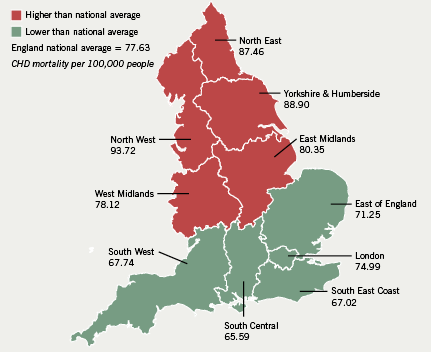
The North/South divide in coronary heart disease (CHD) mortality remains significant despite improvements in cardiovascular disease (CVD) care, according to the ‘Heart Hotspots’ campaign launched at this year’s conference.

The North West region has the highest mortality (93.72 per 100,000) versus South Central, which showed the lowest mortality (65.59 people per 100,000), according to NHS Information Centre data highlighted by the campaign (figure 1).1 CHD mortality in Tameside and Glossop, near Manchester, is almost four times as high as for those living in Kensington and Chelsea, London (140.84 vs. 36.91 people per 100,000), it found.

Figure 1. Coronary heart disease mortality in England showing the North South divide

Wide variations were also seen within Southern cities. In London, for example, a person in Islington is three times more likely to die of CHD (114.12 people per 100,000) than someone in Kensington and Chelsea (36.91 people per 100,000), and more than twice as likely to die compared to those in Westminster (46.76 people per 100,000). These data reflect recent findings from the Care Quality Commission.2

As part of the campaign, a survey sponsored by Merck Sharp & Dohme Ltd. (MSD) shows that prevention of CVD is not a current priority for some people despite them already having risk factors. Some 1,034 people were questioned by ICM Research during June across England, Scotland and Wales. More than two thirds (69%) were not worried about their cardiovascular health, even though 19% had high blood pressure, 14% had high cholesterol and 5% already had a heart condition. While 66% of people were likely to start exercising, improve their diet or lose weight to make themselves more physically attractive, only 36% started exercising to reduce the risk of damaging their heart.

Professor Sir Roger Boyle, National Director for Heart Disease and Stroke, commented: “The latest data reinforce the fact that despite recent progress in the management of CVD, there is still more that we can do to ensure people are aware of the risk factors for having a heart attack or stroke and what can be done to address these risk factors. The ‘Heart Hotspots’ campaign is a valuable step in raising awareness and it is vital that we continue to focus on tackling the UK’s leading cause of death, CVD, and ensuring that inequalities are being addressed”.

The campaign will help primary care trusts (PCTs) to monitor local healthcare performance, enabling better targeting of resources, HEART UK claims. Plans to contact MPs, particularly those from problem areas, will also help to spread local awareness of the campaign and its initiatives, it is hoped.

JBS3 guidelines

The updated Joint British Societies guidelines on the prevention of CVD (JBS3) are due to be published in October/November this year, and will greatly benefit from upgrading to lifetime risk measures, said Dr Alan Rees (University Hospital of Wales, Cardiff).

The new guidelines are to include an even broader coalition of specialist societies, and recognise the inherent cardiovascular risk in patients with chronic kidney disease, peripheral vascular disease, and a reappraisal of the differing risks in people with type 1 and type 2 diabetes.

Although their final details are yet to be agreed, the guidelines will focus on active management of high-risk patients, and the adoption of an innovative means of calculating CVD risk, Dr Rees said. Guidelines based on the established 10-year risk metric are inadequate, he claimed, highlighting the fact that a person can have both a low 10-year risk and a high lifetime risk of CVD. Dependence on short-term measures discourages early intervention and delays treatment, which could impair CVD prevention, he said.

The JBS3 guidelines will use an updated lifetime risk measure, using factors including heart age and time until first cardiovascular event to calculate how many heart attack or stroke free years a patient has remaining. ‘Heart age’, Dr Rees clarified, will be a graphic new means of communicating CVD risk to patients, impressing on them that in terms of cardiac health “after a certain time chronological age becomes irrelevant”.

There is some dispute amongst JBS3 authors as to whether the Framingham or QRISK algorithms should be used to calculate risk, debate hinging on social deprivation as a risk factor for CVD, Dr Rees revealed. While the inclusion of deprivation by QRISK was described by some as “crude”, it was considered by others as preferable to no inclusion at all, he said.

Myant lecture

This year’s guest Myant lecturer, Professor Ernst J Schaefer (Tufts University School of Medicine, Boston, USA), also spoke on cardiovascular risk factors for the 21st century, assessing the various risk factors incorporated by competing scores used to calculate CHD risk. He cast the Framingham risk score as an inferior tool to newer algorithms, such as the Reynolds risk score, which incorporates family history and increased C reactive protein (CRP), and the PROCAM score which factors in both family history and triglycerides (but does not incorporate CRP).

Professor Schaefer also briefly summarised key developments in lipid research, from the work of 19th century pathologist Rudolf Virchow to that of his own mentor Dr Robert I Levy. He spoke at length on the atherogenic activities of the lipoprotein (Lp(a)) particle, as well as the protective properties of apolipoprotein A1 (ApoA-1).

Physical activity and CVD prevention

Traditional guidelines on physical activity are outdated and overly simplistic, according to research presented by Dr Jason Gill (Institute of Cardiovascular and Medical Sciences, University of Glasgow). He surveyed the body of evidence on reducing CVD risk with physical activity, as well as the increased risk associated with a sedentary lifestyle.

He asserted that the benefits of physical activity go beyond simple reduction of fat, resulting from its effects on lipid metabolism, insulin sensitivity, blood pressure and inflammation. It is important to communicate to the public that exercise without weight loss can considerably reduce visceral and ectopic fat deposits, he said, asserting that weight and waist circumference are not necessarily the best measures of exercise’s health impact.

He acknowledged that lifestyle changes are a “difficult public health issue”, with exercise guidelines caught in a “tug of war between what people are prepared to do and the optimal amount”. However, we should move on from the traditional recommendation of 30 minutes of exercise at least five days a week, he claimed.

Recent research he cited recommends more targeted goals of 150 minutes moderate or 75 minutes of vigorous exercise per week for beginners, and 300 minutes moderate or 150 minutes vigorous per week for conditioned individuals.3

He also drew attention to the newly published guidelines on physical activity from the DOH, which are the first UK guidelines to cover sedentary lifestyle as an independent risk factor for ill health.4

CVD and possible use
of the polypill

Use of a polypill is a potentially powerful tool in the prevention of CVD in those most at risk, said Dr Tom Marshall (University of Birmingham). He argued that, despite their differences, major algorithms for cardiovascular risk such as Framingham, QRISK, ASSIGN and SCORE, all show age and gender to be stronger predictors than individual risk factors.

Overemphasis on normalising individual risk factors could distract from the goal of preventing CVD in those at highest risk, he claimed, citing the proven benefits of antihypertensives, statins and aspirin as a more reliable means of prevention. Multiple therapy combining such medication is the logical course of treatment for high risk patients, he said.

Future plans

HEART UK Chief Executive Jules Payne laid out the charity’s plans for the coming years, including this year’s National Cholesterol Week ‘Know It, Lower It!’ from the 19th–25th September 2011. It will focus this year on improving public awareness of cholesterol levels as a CVD risk factor, and how to maintain them – HEART UK’s objective is that by 2016 a majority of British adults will know their cholesterol levels, and the best methods of improving them, she announced.

Other inititatives include ‘Health Unlocked’, a free online community for those suffering from or concerned about high cholesterol to share questions and experiences,5 and ‘Medicine & Me: Living with Cholesterol’,6 a CPD accredited meeting between patients, families, and medical experts to be held at the Royal Society of Medicine, 26th October 2011.

Further information

  1. NHS Information Centre For Health and social care. Mortality from coronary heart disease 1993–2009. 2011. Available from: http://www.nchod.nhs.uk
  2. www.cqc.org.uk/_db/_documents/Closing_the_gap.pdf
  3. O’Donovan G, Blazevich AJ, Boreham C, et al. The ABC of Physical Activity for Health: A consensus statement from the British Association of Sport and Exercise Sciences. J Sport Sci 2010;28:573–91.
  4. http://www.dh.gov.uk/en/Publicationsandstatistics/Publications/PublicationsPolicyAndGuidance/DH_127931
  5. http://heartuk.healthunlocked.com
  6. www.rsm.ac.uk/medandme

British Cardiovascular Society: Annual Conference 2011 and education plans for 2011-2012

Br J Cardiol 2011;18:161–162 Leave a comment
Click any image to enlarge
Authors:

In this sixth article from the British Cardiovascular Society (BCS), Dr Sarah Clarke, BCS Vice-President Education & Research, writes about this year’s Annual Conference and plans for the year ahead.

The British Cardiovascular Society (BCS) and its Affiliated Groups (AGs) are uniquely placed to coordinate and deliver high quality education for cardiology trainees, trained cardiologists and allied professionals. It provides education through a variety of sources.

2011 BCS Annual Conference

Despite many national and international congresses seeing a downturn in the number of delegates attending, the 2011 BCS Annual Conference, held in Manchester on June 13th–15th, saw a record number of registrations for what was one of the best conferences to date. This year saw a complete overhaul of the programme with the introduction of five ‘tracks’.

Education for Revalidation Track: This track will cover areas defined by the cardiology curriculum over a three to five year cycle. Each session will have an online formative assessment, which on completion provides members with certification for revalidation portfolios.

Clinical/Translational Science Track or Innovations Track: We are grateful for the support by the British Heart Foundation for this track. They also supported the linked British Atherosclerosis Society/British Society for Cardiovascular Research meeting, which formed the Basic Science Track. This year abstracts were incorporated into the programme with discussants after each session. Together with the Young Research Workers Prize and Michael Davies Award, this track showcases the best and latest in cardiovascular research. Congratulations to all prize winners.

Imaging Track: This covered areas of imaging as they integrate into cardiovascular medicine.

Affiliated Groups Track: We were delighted that the affiliated groups embraced the new format of this year’s programme contributing not only to their track but also to the programme in general.

The National Training Day, incorporated into the meeting, highlighted the less well covered areas in the cardiology curriculum for trainees. Together with the Education for Revalidation Track and ever-popular simulator sessions in the Exhibition, trainees were well catered for.

Two excellent international guest lectures were given at the conference this year. Dr David Sahn gave the Paul Wood Lecture entitled ‘Improved understanding of cardiac form and function – how the development of the heart continues to influence heart function’. The Strickland Goodall Lecture entitled ‘Re-engineering regenerative cardiovascular medicine. Towards heart stem cell therapeutics’ was given by Professor Kenneth Chien.

Despite the recession, exhibition space at the conference was completely sold out. Thank you to all our exhibitors for supporting our meeting and the education of our members.

For those not able to attend the meeting, and for those who missed some sessions, there are session reports and webcasts of the majority of sessions available to members at www.bcs.com.

As we look to the 2012 Annual Conference, my first Conference as Chair of the Programme Committee, please let me know if you have any ideas on how we might improve the conference further at [email protected].

Thanks

Organisation of the 2011 meeting was the responsibility of the Programme Committee, chaired by Dr Iain Simpson, to whom we are all indebted for producing an excellent meeting this year. We also thank the team at the Society offices in Fitzroy Square. Their support in helping deliver the meeting is invaluable. The Communication and Education Committee together with numerous trainees coordinated the online conference reports and webcasts. The Committee also coordinates the BCS website and educational courses throughout the year. Thanks to all for their hard work.

BCS Educational Courses

The BCS provides numerous other educational courses in addition to the Annual Conference. The following are scheduled for the coming year at the Royal College of Physicians (RCP), London.

2011

BCS & Mayo Clinic ‘Cases, Controversies and Updates’ 26th–28th September
An in-depth look at difficult cases, current controversies and latest updates in cardiovascular medicine

BCS & RCP Cardiology Update 11th October
For all Cardiologists, GPs or Practitioners with an interest in cardiology. Visit the RCP website to register for this course www.rcplondon.ac.uk

National Training Day 28th November
For trainees only

A Year in Cardiology 2011 14th December
Hot topics of the year for all cardiologists and trainees.

2012

A Career in Cardiology 17th February
Covering the ST3 selection process from application form to interview. A must for any doctor wishing to pursue cardiology as a career.

BCS & Mayo Clinic Cardiology Review Course 19th–23rd March
Overview of cardiology based on the curriculum. Suitable for both trainees and trained cardiologists.

Research in Cardiology – What, why, when, how?  27th April
Essential for all trainees and those wishing to conduct Postgraduate Research in cardiovascular medicine

BCS Annual Conference 2012 20th–30th May, Manchester
We look forward to seeing you next year

The Oblique View – Watch your language!

Br J Cardiol 2011;18:164–66 Leave a comment
Click any image to enlarge
Authors:

We continue our series in which Consultant Interventionist Dr Michael Norell takes a sideways look at life in the cath lab…and beyond. In this column, he considers Latin.

Latin is a language
As dead as dead can be,
It killed the ancient Romans
And now it’s killing me.

Such was the oft muttered rhyme that could be heard in the hushed corridors of a North London Grammar school, circa the late 1960s. Indeed, I suspect this echoed in most classrooms up and down the country as teenagers struggled to recite “amo, amas amat, amamus, amatis, amant”, even though the social and emotional significance of the verb had little relevance to ‘Norell minor’ at that age.

As O levels (or GCSEs as they are now known) appeared over the horizon, we had to select a subject in addition to the usual Maths, Add. Maths (whatever that was), Physics, Chemistry, History, Eng. Lang., Eng. Lit. and French. This choice was from Biology, German and …Latin.

Choices

At that time I had a vague idea that Medicine might feature among my career possibilities, in addition to footballer (yeah, right!), spy or comedian. So while learning about plants and animals might have been considered the logical answer, there was something about studying an ancient tongue that had a classical quaintness about it. Learning Latin also came with a certain degree of elitism as the class contained relatively few pupils, was taught by one of the school’s most exacting and strictest ‘masters’, and resulted in one being regarded by one’s peers as a tad quirky.

Furthermore, I had rationalised my juvenile decision with the contention that much of the language of Medicine had its origins in Latin and that I could make up for any ignorance of anatomy and physiology by taking Zoology at A level. Also, our classwork or homework (we didn’t call it ‘prep’ because this was a state school), had to be written – without errors – with a fountain pen, and in an impressive hardback exercise book, rather than in the more traditional and slightly cheap looking soft-cover version used by my pals for all other subjects.

Translation

And so began my brief flirtation with what might be regarded as ‘classics-light’ and culminated eventually in a reasonable grade C. Lessons were festooned with translations from Latin to English, and vice versa, and characterised by developing familiarity with phrases that could have no possible practical use in the modern era whatsoever.

So, sentences like “the daughters of the farmers are in the field with the sailors” would require writing in Latin, and the reverse would apply to other memorable lines like “some say one thing, others another, but they all blame the folly of the general”.

Our main textbook (Approach to Latin, if I recall) did contain some pleasing attempts at humour, allowing the odd smile or chuckle to permeate the otherwise stony silence of our classroom. So the phrase “o me miserum” appeared in the vocabulary list as “woe is me” and, as an alternative, “hang it all!”

History

There is no doubt that such study also provided a glimpse into Roman history and the various characters dotted about the Empire that have since become legend. One such personality was Cicero who, it turns out, was a bit of a wit. In one section of our textbook he appeared in a passage for translation headed “Some of Cicero’s Jests”. Apparently he was sitting in judgement over a youth accused of bumping off his father by poisoning him with appropriately doctored pastries. The angry young man continually berated the judge with an endless series of expletives, which Cicero listened to patiently. Eventually, after the rancour had subsided, our hero remarked, “Shout all you like. I would rather have your insults than your cakes”. (I’ll pause here to allow you to recover from a fit of uncontrollable hysterics.)

Modern TV and cinema provide somewhat more lurid accounts of that portion of world history. No doubt if our own lessons had been dotted with more of the sand, sweat, sex, scandals, seedy politics and grotesque violence that characterise films like Gladiator, our classes would have been well over-subscribed, and recruitment to increase the number of available Latin teachers would have been demanded.

Writing the date in Latin was an exercise in itself, as each day related to its position relative to fixed points in the Roman month, namely the Nones (the fifth day) and the Ides (the thirteenth). N.B. (nota bene), this does not apply to all months of the year. As we used to recite ad nauseam, “March, July, October, May, make Nones the seventh and Ides the fifteenth day”.

Relevance

Is it relevant? Judging by the blank expressions I got earlier this year when I embarked upon a particularly complex percutaneous coronary intervention (PCI) list and warned the lab staff that it was the Ides of March, I doubt it. But you will have noticed in the paragraphs above that many Latin phrases have assumed a day-to-day role in our own language, and Medicine is no exception.

We write the letter ‘c’ as a short version of cum meaning ‘with’, and talk about mane for procedures scheduled for the next morning. We prescribe drugs to be taken as o.d., b.d. or t.d.s., perhaps oblivious to their classical origins. Similarly, abbreviations such as e.g., et al., i.e. and etc., all started the same way and the annotated ‘R’ that we use as an abbreviation to indicate treatment, originates from recipe, the imperative form of the verb recipere, meaning ‘take’.

As for Cardiology, some still refer to the ramus intermedius as it leaves the left main stem, let alone to it being full of atheroma (from Greek, via Latin and meaning ‘porridge’ or ‘gruel’)

Understanding

Did studying Latin help with my medical career? Probably not, but it was enormous fun. It also provided an opportunity to glimpse at a small aspect of the past and the origins of so much of our language. And anyone who likes to write, or talk, or to communicate generally (which I guess applies to me) may do so with a richer understanding of from when and where their words have come.

And be in no doubt that the study of Latin pertains to the modern interventional era as well. As Julius Caesar famously announced in 47 BC after succeeding in a short war in Turkey, and encountering a patient with severe and inoperable aortic stenosis, “Veni vidi, TAVI.

Correspondence

Br J Cardiol 2011;18:179 Leave a comment
Click any image to enlarge
Authors:

Correspondence from the world of Cardiology

Amiodarone for the treatment of stable ventricular tachycardia – has the Resuscitation Council got it wrong?

Dear Sirs,

Amiodarone has been the UK Resuscitation Council’s recommendation for the treatment of haemodynamically stable ventricular tachycardia (VT) since 2000. It is my opinion that the evidence in support of amiodarone in this setting is poor and that superior agents may exist.

In the last six years, three retrospective studies have been published showing a dismal success rate when amiodarone is used to treat patients with stable VT. Marill et al reported that eight out of 28 (29%) patients cardioverted using a dose of 150 mg.2 Tomlinson et al looked retrospectively at stable VT patients given a dose of 300 mg and reported that six out of 41 (15%) patients cardioverted after 20 minutes.3 A further multicentre retrospective chart review also by Marill looked at 53 patients given amiodarone – of these just 25% cardioverted.4

These studies are low level evidence – retrospective chart reviews with small numbers and less than perfect methodology. Nonetheless they appear to be the best evidence we have in support of amiodarone in the treatment of stable VT.

So what are the alternatives? A single trial in favour of sotalol was published in 1994. Lignocaine and sotalol went head-to-head in a randomised crossover trial looking at the treatment of spontaneous, sustained stable VT.5 The study was methodologically sound with sensible and pragmatic inclusion criteria, comparable groups at baseline, effective double-blinding and intention-to-treat analysis. Over two-thirds (11/16 [69%]) of patients given sotalol as an initial treatment cardioverted compared with only 3/17 (18%) who received lignocaine. Numbers are small and the trial may be inadequately powered but the success rate for sotalol appears convincing.

Procainamide was studied in a randomised crossover trial in comparison with lignocaine.6 In response to initial drug infusions, 12/15 (80%) of patients reverted to sinus rhythm compared to 21% of patients given lignocaine. A similar success rate of 76% was reported in a recent Japanese case-series.7 At odds with these results is the 2010 chart-review by Marill et al who reported a 30% success rate – but only a minority of these patients received procainamide first-line.

VT is thought in most cases to be due to a re-entrant arrhythmia arising in an area of scarred myocardium. Drugs prolonging the refractory period in this area of scarring would be predicted to terminate the arrhythmia. Whilst procainamide and sotalol lengthen the myocardial refractory period acutely, amidarone does not appear to do so and may be predicted to work poorly on theoretical grounds alone.

Many argue that amiodarone remains the drug of choice for safety reasons. In patients given amiodarone, direct-current cardioversion (DCCV) was required in 6-19% due to cardiovascular collapse, which is similar to rates reported for procainamide and sotaolol (7–13% and 10%, respectively).  Numbers are small and there is no standardised event reporting across the studies, but this is the best evidence we have from real patients, and amiodarone does not appear to live up to its reputation as a safer agent.

The Resuscitation Council has the difficult job of producing a guideline, which is simple, pragmatic and of benefit to the majority. However, it could be anticipated that resuscitation guidelines will be most useful to the non-specialist seeing a patient who has presented acutely with VT. For such patients, amiodarone does not appear to work well.

It is without doubt that UK physicians have great experience and familiarity with amiodarone, but this should not be an excuse to use it as a ‘comfort-blanket’ if better drugs exist.  It is also true that sotalol and procainamide are not always readily available as intravenous preparations but, again, this is no justification for using an inferior drug.

When next confronted with a patient in VT, my inclination will be to reach for the defibrillator. However if this were unavailable, I would like the option of sotalol or procainamide in my armamentarium!

Beth Newstead
Royal Devon & Exeter Hospital, Exeter

References

  1. Resuscitation Guidelines 2010. Resuscitation Council UK. http://www.resus.org.uk/pages/periarst.pdf.
  2. Marill KA, deSouza IS, Nishijima DK, Stair TO, Setnik GS, Ruskin JN. Amiodarone is poorly effective for the acute termination of ventricular tachycardia. Ann Emerg Med 2006;47:217–24.
  3. Tomlinson DR, Cherian P, Betts TR, Bashir Y. Intravenous amiodarone for the pharmacological termination of haemodynamically-tolerated sustained ventricular tachycardia: is bolus dose amiodarone an appropriate first-line treatment? Emerg Med J 2008;25:15–8.
  4. Marill KA, deSouza IS, Nishijima DK, et al. Amiodarone or procainamide for the termination of sustained stable ventricular tachycardia: an historical multicenter comparison. Acad Emerg Med 2010;17:297–306.
  5. Ho DS, Zecchin RP, Richards DA, Uther JB, Ross DL. Double-blind trial of lignocaine versus sotalol for acute termination of spontaneous sustained ventricular tachycardia. Lancet 1994;344:18–23.
  6. Gorgels AP, van den Dool A, Hofs A, et al. Comparison of procainamide and lidocaine in terminating sustained monomorphic ventricular tachycardia. Am J Cardiol 1996;78:43–6.
  7. Komura S, Chinushi M, Furushima H, et al. Efficacy of procainamide and lidocaine in terminating sustained monomorphic ventricular tachycardia. Circ J 2010;74:864–9.

Chest pain – troponin and athletes

Dear Sirs,

We read with great interest the article by Magdy and Dubrey1 on the subject of chest pain and troponin elevation in athletes and, in particular, the case of an Afro-Caribbean athlete who presented in this manner. This was accompanied by the finding of T-wave inversion in leads V4-V6 on the resting electrocardiogram (ECG), which normalised on exercise, and left ventricular hypertrophy on echocardiography.

In our experience of over 900 Black athletes, the incidence of T-wave inversion in the lateral ECG leads is only 4.1%.2 During a mean follow-up period of 70 months, one Black athlete experienced aborted sudden death, whilst two were diagnosed with hypertrophic cardiomyopathy (HCM). All three of these athletes had T-wave inversions in the lateral leads. In contrast, our experience of Black HCM patients is that lateral T-wave inversion is an extremely common finding (77%).2 We would also point out that normalisation of T-wave inversion on exercise is a non-specific finding which may also be observed in HCM.3

We note that the athlete in question demonstrated a ‘mean left ventricular wall thickness of 15 mm’, suggesting that the maximal wall thickness may have been in excess of this figure. Our experience of Black athletes has demonstrated a maximal left ventricular wall thickness greater than 15 mm in only 1.5% of cases, with none greater than 16 mm.4

We agree with the authors that troponin elevation in athletes must be interpreted with caution. However, an athlete of any ethnicity demonstrating repolarisation anomalies in the inferior or lateral ECG leads requires detailed investigation including cardiac magnetic resonance imaging and familial evaluation, particularly in the presence of cardiovascular symptoms. Even in the absence of marked left ventricular hypertrophy, such anomalies may reflect early HCM, which may not manifest fully until many years later, and hence long-term follow-up is also essential.

These assertions are supported by recent European Society of Cardiology guidelines which state that ‘T-wave inversion in inferior and/or lateral leads are uncommon even in black athletes and warrant further investigation for an underlying heart disease’.5

Conflict of interest

None declared.

Abbas Zaidi
Sanjay Sharma

Cardiac Risk in the Young Centre for Sports Cardiology,
St George’s Hospital, London

References

1. Magdy F, Dubrey S. Chest pain – troponin and athletes. Br J Cardiol 2011;18:129.

2. Papadakis M, Carre F, Kervio G et al. The prevalence, distribution, and clinical outcomes of electrocardiographic repolarization patterns in male athletes of African/Afro-Caribbean origin. Eur Heart J 2011 doi:10.1093/eurheartj/ehr140.

3. Olearczyk B, Gollol-Raju N, Menzies DJ. Apical hypertrophic cardiomyopathy mimicking acute coronary syndrome: a case report and review. Angiology 2008;59:629-63.

4. Basavarajaiah S, Boraita A, Whyte G et al. Ethnic differences in left ventricular remodeling in highly-trained athletes: relevance to differentiating physiologic left ventricular hypertrophy from hypertrophic cardiomyopathy. J Am Coll Cardiol 2008;51(23): 2256–62.

5. Corrado D, Pelliccia A, Heidbuchel H et al. Recommendations for interpretation of 12-lead electrocardiogram in the athlete. Eur Heart J 2010;1(2):243–59.

Audit of the NT-ProBNP guided transthoracic echocardiogram service in Southend

Br J Cardiol 2011;18:189–92 Leave a comment
Click any image to enlarge
Authors:

Heart failure is one of the most common conditions in industrialised society. Plasma N-terminal prohormone of brain natriuretic peptide (NT-ProBNP) levels are raised in heart failure and increase with severity and New York Heart Association functional class. A NT-ProBNP level guided community echocardiogram service has been in place at Southend University Hospital since 2005. A previous audit of the service in 2006 showed that a cut-off point of 300 pg/ml provided a negative predictive value of 97% for detecting significant left ventricular systolic dysfunction, defined as an estimated ejection fraction of less than 40%. We have now repeated the audit for the calendar year 2008 and have shown that an additional cut-off point of 450 pg/ml can be applied to the over 75 age group with a reassuring negative predictive value of 96%. 

Introduction

Heart failure is one of the most common conditions in industrialised society. Today, in the UK, around 900,000 people have heart failure with a further similar number who have yet to develop symptoms.1 Heart failure is predominantly a disease of the elderly, and the increasing age of the population, combined with improvements in the treatment of ischaemic heart disease (IHD), account for the increasing prevalence.

Heart failure has a poor prognosis: just under 40% of patients diagnosed with heart failure die within a year, depending on initial severity, although, thereafter, mortality is less than 10% per year. This suggests that a prompt diagnosis and treatment would be beneficial in reducing morbidity and mortality in those patients who do have heart failure.

Echocardiogram is recognised as the gold standard test for diagnosing heart failure. However, there are a number of issues around the diagnostic test that need to be taken into account:

  • The demand for echocardiogram results will rise with the increasing elderly population
  • Waiting for an echocardiogram can also delay a patient getting onto the right treatment pathway particularly if an echocardiogram proves negative for heart failure
  • Trusts must reduce non-invasive diagnostic waiting times to a recommended maximum of two weeks.

Plasma NT-ProBNP testing in heart failure

Plasma N-terminal prohormone of brain natriuretic peptide (NT-ProBNP) levels are raised in heart failure and increase with severity and New York Heart Association (NYHA) functional class. It is already known that natriuretic peptide levels provide sensitive (and reasonably specific) tests for the diagnosis of heart failure and left ventricular systolic dysfunction. While echocardiogram is considered to be the gold standard, a brain natriuretic peptide (BNP) test can be performed as a precursor to echocardiogram, and BNP testing has been shown to be cost-effective in primary care for the diagnosis of heart failure.2,3 Heart failure is unlikely in the presence of a normal electrocardiogram (ECG) and negative BNP test. Using BNP testing as a ‘rule out’ test will mean fewer inappropriate referrals to secondary care. There are currently no national guidelines as to the cut-off level to be set for triggering referral for echocardiography, although Cowie et al.4 have recently published recommended cut-off points for use of natriuretic peptides as a ‘rule out’ test in the heart failure diagnostic pathway.

NT-ProBNP guided community echocardiography service at Southend University Hospital

Figure 1. Summary of total number of N-terminal prohormone of brain natriuretic peptide (NT-ProBNP) tests processed at Southend University Hospital in 2008

A NT-ProBNP level guided community echocardiogram service has been in place at Southend University Hospital since 2005. The test is requested by the local primary care practitioners if they suspect heart failure. A positive test (currently a NT-ProBNP level >300 pg/ml) is automatically forwarded to the cardiology department by the biochemistry laboratory and an out-patient transthoracic echocardiogram appointment is sent to the patient. Following the echocardiogram, the patients are seen in the out-patient clinic for assessment and treatment. General practitioners also have direct access to out-patient echocardiogram requests, as well as directly referring patients to the cardiology out-patient department, although, due to waiting times, the NT-ProBNP pathway allows for more rapid exclusion of significant left ventricular systolic dysfunction. A previous audit of the service in 2006 showed that a cut-off point of 300 pg/ml provided a negative predictive value of 97% for detecting left ventricular systolic dysfunction, defined as an estimated ejection fraction of less than 40%. The aim of this repeat audit was to assess whether an age-related cut-off could be introduced, as NT-ProBNP levels are known to rise with age.

Audit methodology

We performed retrospective analysis of all patients with NT-ProBNP tests done between January 2008 and December 2008, inclusive. We studied echocardiography results of all patients with BNP levels between 300 and 449 pg/ml and compared them with those of patients with BNP levels above 450 pg/ml. We specifically looked at left ventricular ejection fraction, valvular disease and diastolic dysfunction.

Audit results

A total of 2,241 plasma NT-ProBNP tests were processed by the biochemistry laboratory at Southend University Hospital from January 2008 to December 2008.
There were 806 (36%) tests with levels greater than 300 pg/ml following which 751 of these patients underwent transthoracic echocardiography via the automated appointment service (figure 1).

Figure 2. Number of patients aged over 75 years with NT-ProBNP level between 300 and 449 pg/ml. Left ventricular (LV) systolic dysfunction defined as normal if ejection fraction (EF) > 55%; mild if EF 41–55%; moderate if 30–40% and severe if EF < 30%

There were 136 patients older than 75 years with a NT-ProBNP level between 300 and 449 pg/ml and only 3% of the subsequent echocardiograms showed significant left ventricular systolic dysfunction, as defined by an estimated ejection of less than 40% (figure 2). In contrast, there were 45 patients aged under 75 years with a NT-ProBNP level between 300 and 449 pg/ml, but, in this age group, 13% had significant left ventricular impairment (figure 3). There were a total of 625 patients with a NT-ProBNP level above 450 pg/ml, with 19% of these patients subsequently confirmed to have significant left ventricular systolic dysfunction. The negative predictive value of a NT-ProBNP level >450 pg/ml in the above 75 years age group is 96%, but only 86% in those aged below 75 years (figure 4).

Figure 3. Number of patients aged under 75 years with NT-ProBNP between 300 and 449 pg/ml
Figure 4. Summary data showing sensitivity and negative predictive values of detecting significant LV systolic dysfunction by having a NT-ProBNP cut-off level of 450 pg/ml in patients aged above and below 75 years

In addition to detecting left ventricular systolic dysfunction, the echocardiograms were assessed for evidence of significant diastolic dysfunction (figure 5), defined as at least Grade 2 dysfunction, which is represented by a pseudonormal transmitral filling pattern on Doppler echocardiography. There were a total of 74 patients with significant diastolic dysfunction (10% of all the echocardiograms performed), and the majority (88%) of these patients had a NT-ProBNP level >450 pg/ml. The remaining 12% of patients with diastolic dysfunction had NT-ProBNP levels between 300 and 450 pg/ml and they were all aged 75 years and above.

We also assessed for the presence of valvular heart disease which was of at least moderate severity, and the majority of these patients had a NT-Pro-BNP level greater than
450 pg/ml (figure 6).

Finally, we found that approximately 25% of all patients with a NT-ProBNP level greater than 450 pg/ml who did not have significant left ventricular systolic dysfunction on echocardiogram had atrial fibrillation, which was thought to be the sole causative factor for the elevation in the peptide level.

Summary and conclusions

NT-ProBNP measurement can provide a simple and rapid exclusion of the diagnosis
of heart failure. Although it is a sensitive test for left ventricular dysfunction, it can be
raised in a variety of other clinical situations (e.g. arrhythmias and ischaemic heart disease) and also increases with age. A NT-ProBNP guided transthoracic echocardiography
service can provide a pathway to this service for primary care, but to be able to meet
the demands of an ageing population it is important to avoid unnecessary scans.
The aim of this audit was to assess whether the current NT-ProBNP cut-off level for automatic transthoracic echocardiography could be increased without affecting the diagnostic yield.

Figure 5. Total number of patients with significant diastolic dysfunction (defined as greater than Grade 2, pseudonormal transmitral filling pattern on Doppler echocardiography). This shows that 88% of patients with diastolic dysfunction had a NT-ProBNP level greater than 450 pg/ml

The current audit has shown that applying a NT-ProBNP cut-off level of 450 pg/ml in patients aged above 75 years is associated with a negative predictive value of 96% for excluding significant left ventricular systolic dysfunction. We have, therefore, suggested that a NT-ProBNP cut-off level of 450 pg/ml be adopted in patients aged above 75 years. However, in patients aged below 75 years we have maintained the previous cut-off of 300 pg/ml. If these cut-off points were applied to the current study population, 136 (18%) of the echocardiograms would not have been required and this may have meant quicker access to the service for those who need it most.

This audit also shows that the majority of patients with significant diastolic dysfunction and valvular heart disease have NT-ProBNP levels greater than 450 pg/ml, so these diagnoses are unlikely to be missed with the new cut-off. Furthermore, general practitioners can refer patients directly to the cardiology clinic for specialist assessment if they feel the patient may still have failure from whatever cause despite not having a significantly raised NT-ProBNP level.

Figure 6. Number of patients with significant valvular heart disease. This shows that the majority of patients with significant valvular heart disease had a NT-ProBNP greater than 450 pg/ml

Finally, we have also shown that 25% of patients with significantly raised NT-ProBNP levels actually had atrial fibrillation as the cause, and we would advocate routine examination of the peripheral pulse to exclude atrial fibrillation in patients suspected to have heart failure. This will prompt the patient being managed via a different pathway and may avoid delay in appropriate therapy being administered.

Conflict of interest

None declared.

Key messages

  • N-terminal prohormone of brain natriuretic peptide (NT-ProBNP) measurement can provide a simple and rapid exclusion of the diagnosis of heart failure
  • A two-tier age-stratified NT-ProBNP cut-off level can be applied to exclude significant left ventricular systolic dysfunction: 450 pg/ml in patients aged above 75 years and 300 pg/ml in patients aged under 75 years, with negative predictive values of 96% and 97%, respectively

References

  1. National Collaborating Centre for Chronic Conditions. Management of chronic heart failure in adults in primary and secondary care. London: National Institute for Clinical Excellence, 2003.
  2. Collinson PO. The cost effectiveness of B-type natriuretic peptide measurement in the primary care setting – a UK perspective. Congest Heart Fail 2006;12:103–07.
  3. Galasko GIW, Barnes SC, Collinson PO et al. What is the most cost-effective strategy to screen for left ventricular systolic dysfunction: natriuretic peptides, the electrocardiogram, hand-held echocardiography, traditional echocardiography, or their combination? Eur Heart J 2006;27:193–200.
  4. Cowie MR, Collinson PO, Dargie H et al. Recommendations on the clinical use of B-type natriuretic peptide testing (BNP or NTproBNP) in the UK and Ireland. Br J Cardiol 2010;17:76–80.