
News from the American College of Cardiology Scientific Session 2011

Br J Cardiol 2011;18:105–8 Leave a comment
Click any image to enlarge
Authors:

Highlights of the recent American College of Cardiology (ACC) meeting, held in New Orleans, USA, on 2nd – 5th April 2011, included the promise of new, less invasive methods that might be an alternative to both aortic and mitral valve surgery. Long-term results from the STICH trial also suggest that CABG may have a role for patients with heart failure and ischaemic heart disease.

PARTNER: transcatheter valves just as good as surgery for high risk aortic stenosis

Transcatheter aortic valve implantation (TAVI) is just as effective at reducing mortality as surgery for severe aortic stenosis in elderly patients whose age and overall health posed high risks for conventional surgery, according to the results of the PARTNER (Placement of AoRTic TraNscathetER Valve trial). However, stroke rates were higher in the trancatheter group.

The transcatheter approach involves delivering a bioprosthetic valve to its target location with a catheter using either transfemoral access or trans-apical access (through the ribs) if peripheral arteries are not large enough.

One-year results from the cohort A of the trial (table 1), in which 699 elderly patients with severe aortic stenosis who were randomised to either TAVI or conventional surgery, showed that the transcatheter approach was non-inferior to traditional surgical aortic-valve replacement in terms of all-cause mortality. Major strokes, however, were higher in the catheter-treated group. Major bleeding was far more common in the surgery group, as was new-onset atrial fibrillation whereas vascular complications were higher in the transcatheter group. Symptom improvement was similar in the two groups at one year.

Table 1. Major results in the PARTNER trial: cohort A

Principal investigator Dr Craig Smith (Columbia University, New York, USA) said: “Surgical aortic valve replacement is one of the most effective operations surgeons offer, and transcatheter aortic valve replacement is the most exciting new treatment for aortic stenosis in the past two to three decades.”

“These results clearly show that the transcatheter approach is an excellent alternative to surgery in high-risk patients,” he continued. “Recommendations to individual patients will need to weigh the appeal of avoiding open-heart surgery, with its known risks, against less invasive transcatheter approach, with different and less well understood risks. Future trials will help delineate the role of transcatheter aortic valve replacement in intermediate risk patients.”

Transcatheter approach also shows cost-effectiveness in surgery-ineligible cohort

In a second part of the PARTNER trial involving patients with severe aortic stenosis who were not candidates for surgery (cohort B), transcatheter aortic valve replacement was linked to a 20% absolute benefit in survival at one year compared to medical therapy. These results were reported at last year’s TCT meeting in the US.

New data from this cohort, presented at the ACC meeting, suggested that the transcatheter valve replacement was cost effective in this group of patients.

Lead investigator, Dr Matthew Reynolds (Harvard Clinical Research Institute, Boston, USA) reported that the initial cost for transcatheter valve replacement, along with care before and after the procedure, was approximately US$78,000, with the commercial cost for the new valve system estimated at about US$30,000.

A higher rate of hospitalisation in the standard care group, however, led to costs during the first 12 months of around US$23,000, which partially offset the initial high cost of the trancatheter procedure.

The investigators projected a gain in life expectancy of approximately 1.9 years for the transcatheter valve replacement group, at an incremental cost-effectiveness ratio of about US$50,200 for each additional year of life gained, or approximately US$62,000 per each quality-adjusted life year gained. Dr Reynolds said this was “within accepted values for commonly used cardiovascular technologies.” He added: “Our perspective is that the costs of this intervention, even in this elderly and extremely high-risk population, are justified by the very significant benefits, and that the ratio of costs to benefits stacks up well compared with other therapies the US health care system pays for today.”

EVEREST II: MitraClip™ an option for mitral regurgitation patients unsuitable for surgery

Percutaneous repair of the mitral valve with the new MitraClip™ device was significantly less effective at reducing mitral regurgitation than surgery, but the percutaneous procedure was safer and resulted in similar improvements in clinical outcomes, latest results from EVEREST II (Endovascular valve edge-to-edge repair study) show.

Discussants of the study at an ACC press conference said the clip would be useful for mitral regurgitation patients who were too high risk to undergo surgery. The trial randomised 279 patients with moderately severe or severe (grade 3+ or grade 4+) mitral regurgitation to undergo either percutaneous or surgical repair of the mitral valve. The primary composite end point of freedom from death, from surgery for mitral-valve dysfunction, and from grade 3+ or 4+ mitral regurgitation at 12 months was significantly better in the surgery group
(table 1). The primary safety end point of adverse events at 30 days was significantly reduced in the MitraClip™ group, but this was primarily accounted for by a reduction in blood transfusions.
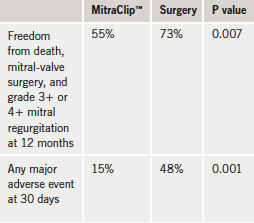
Table 1. EVEREST II: major results

Commenting on the study, cardiac surgeon Dr Steven Bolling (University of Michigan Cardiovascular Center, Ann Arbor, USA), noted that the clip left many more patients with grade 2+ or more regurgitation. Saying he “wouldn’t be happy to leave the operating room with this situation”, Dr Bolling added that residual mitral regurgitation normally predicts adverse long-term clinical outcomes.

STICH: CABG does appear beneficial in heart failure patients

Long-term results of the STICH (Surgical Treatment for Ischaemic Heart Failure) trial suggest that there may be a benefit after all in performing coronary artery bypass grafting (CABG) in patients with heart failure and ischaemic heart disease.

The trial assigned 1,200 patients with coronary artery disease and heart failure to either CABG plus the best possible medical therapy to aggressive medical therapy alone.

As expected, CABG was associated with an early risk of death as a result of the surgical intervention itself in the study but this disadvantage for surgery disappeared after two years post-procedure.

Five-year results (see table 1), presented at the ACC meeting, showed a trend towards a reduced risk of death from any cause in the CABG group. Cardiovascular death and the combined risk of death from any cause plus hospitalisation for heart disease were both significantly lower in the CAGB group.
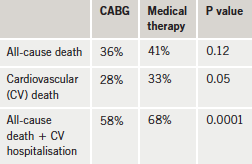
Table 1. STICH: five-year results

Rheos® – an implantable device to control blood pressure

A new implantable device helps patients with severe and uncontrolled hypertension achieve and maintain target blood pressure levels, according to a new study.

The Rheos® device is implanted just below the collarbone, like a pacemaker, and delivers four to six volts of electricity to the carotid arteries. The pulses mimic a spike in blood pressure that activates the carotid baroreflex, causing the blood pressure to drop.

In the phase III study, the device was implanted in 265 patients with resistant hypertension of >160/80 mmHg who were taking at least three antihypertensives. The patients were then randomised to two groups. The first group had the device activated for the study’s full 12-month duration, and the second group had the device programmed to start activation at six months. Patients were seen monthly and those who had not reached the target systolic blood pressure of 140 mmHg had their device adjusted on an individual basis to assert more voltage and so further reduce blood pressure.

The trial did not meet all its end points, but blood pressures were generally lower in the active treatment group. Short-term acute response (at least a 10 mmHg reduction in systolic pressure at six months) was achieved in 65% of patients in the active treatment group, but the control group had a higher response than expected, with 45% of patients achieving the goal.

In the first group, systolic pressure decreased to target levels for 41% of patients after six months and 54% after 12 months. In the second group, 21% achieved target pressures during the control phase, and 46% were in the target range after six months of treatment.

Presenting the study, Dr John Bisognano (University of Rochester, USA) commented: “The system is safe, and its effect is as good as two or three drugs for people who are already taking five or six drugs and still can’t control their hypertension. It’s a good additional option for these patients.” He said the data were “encouraging”, but further studies were needed to define which group of patients benefits the most.

EXCELLENT: can clopidogrel be stopped six months after
drug-eluting stent?

Some patients may be able to stop clopidogrel six months following drug-eluting-stent implantation, according to the results of the EXCELLENT study. Although the 1,443-patient study was not powered for hard clinical end points, it did show a similar rate of target vessel failure among patients treated with six- and 12-months of clopidogrel.

Lead investigator Dr Hyeon-Cheol Gwon (Sungkyunkwan University School of Medicine, Seoul, Korea) said: “The take-home message from our study is that, at least in low-risk, nondiabetic patients treated with second-generation drug-eluting stents, we can safely discontinue clopidogrel at about six months, especially if the patient is at high risk for bleeding or is anticipating some surgery”.

But he added that the data should only be considered hypothesis-generating at this point, and larger trials with harder end points were needed to confirm the results.

Commenting on the trial, Dr Sanjay Kaul (Cedars Sinai Medical Center, Los Angeles, USA) noted that there was no significant reduction in the risk of major bleeding, which provided little support for stopping treatment at six months.

Major results of the trial showed the composite end point of cardiac death, myocardial infarction, or target vessel revascularisation at 12 months occurred in 4.7% of those treated with dual antplatelet therapy for six months, and 4.4% of those treated for 12 months, a result that satisfied non-inferiority criteria. However, diabetes patients had more than a three-fold risk of the end point in the six-month treatment group.

OSCAR: which antihypertensive best in elderly?

Treating elderly hypertensive patients with a combination of an angiotensin II receptor blocker (ARB) and a calcium blocker leads to similar rates of cardiovascular events and death compared to therapy with a high-dose ARB alone. This was the main result from the OSCAR study, conducted in a Japanese population.

For the study, 1,164 high-risk elderly hypertension patients unable to manage their high blood pressure through standard-dose monotherapy with the ARB olmesartan, were randomised to receive either high-dose olmesartan (40 mg per day) or a calcium blocker (either amlodipine or azelnidipine) combined with olmesartan 20 mg per day.

At 36 months of follow-up, blood pressure was reduced significantly more in the combination group (by 2.4 mmHg systolic and 1.7 mmHg diastolic). However, no significant difference was seen between the two groups in terms of clinical events – defined as cerebrovascular disease, coronary artery disease, heart failure, other atherosclerotic disease, diabetes complications, the deterioration of renal function, and all-cause death (table 1).
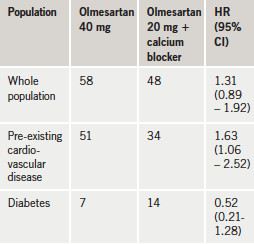
Table 1. Clinical events in the OSCAR study

On subgroup analysis, however, patients who had pre-existing cardiovascular disease did have fewer events if on combination treatment. But another subgroup analysis including only patients with diabetes showed a higher incidence of the primary end point in the combination therapy group.

ISAR CABG: drug-eluting stents reduce repeat revascularisation in saphenous vein grafts

Use of drug-eluting stents was associated with fewer clinical events than bare metal stents when treating saphenous vein graft lesions, results of the ISAR CABG (Is Drug-Eluting Stenting Associated with Improved Results in Coronary Artery Bypass Grafts?) trial showed.

Saphenous vein grafts are used extensively in CABG surgery, but these grafts often develop atherosclerotic disease, requiring another revascularisation procedure.

Presenting the ISAR-CABG trial, Dr Julinda Mehilli (German Heart Center, Munich, Germany) explained that drug-eluting stents had proven superior to bare metal stents in all coronary artery lesion subsets examined, but there was a lack of data in saphenous vein graft lesions.

The ISAR-CABG trial enrolled 610 patients who had previously undergone CABG surgery, and had subsequently developed at least one lesion in their saphenous vein graft. They were randomised to receive either a drug-eluting stent or a bare metal stent.

Results (table 1) showed a reduced rate of major adverse cardiac events (death, myocardial infarction, target-lesion revascularisation) at one-year in the drug-eluting stent group. The benefit was primarily due to a significantly lower rate of target-lesion revascularisation. There was no significant difference in the rates of death or myocardial infarction.
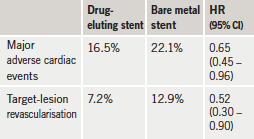
Table 1. ISAR-CABG results

RIVAL: radial versus femoral access for stenting in ACS patients

Stenting with radial access was not associated with a reduction in major clinical events compared with femoral access in acute coronary syndrome (ACS) patients, although the newer approach did appear to reduce large vascular-access complications in the 7,000-patient RIVAL (Radial versus Femoral Access for Coronary Intervention) study.

In addition, subgroup analysis suggested a benefit of the radial approach in patients with ST-elevation myocardial infarction (STEMI), and those treated at centers that perform a high volume of radial access procedures.

Presenting the results (table 1), Dr Sanjit Jolly (McMaster University, Hamilton, Canada) said that the study showed both radial and femoral procedures to be safe and effective, but that radial access might be preferable because of the lower rates of vascular complications.
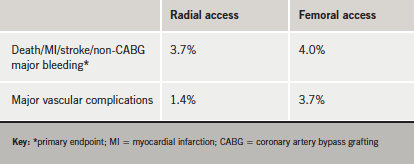
Table 1. RIVAL: 30 day results

In an editorial accompanying publication of the study in the April 4th issue of The Lancet (Lancet 2011; DOI:10.1016/S0140-6736(11)60469-8) Drs Carlo Di Mario and Nicola Viceconte (Royal Brompton Hospital, London) suggest that operators with a high workload of acute procedures should consider retraining in transradial PCI, and all new interventionalists should be taught the transradial approach. But they add that the femoral approach may still be more suitable when large guiding catheters are required and prolonged procedural time is expected for complex lesions.

In the RIVAL study, major bleeding was not different in the primarily analysis, but a post hoc exploratory analysis using the ACUITY definition of bleeding did show reduced bleeding with the radial approach. This was said to be because the ACUITY definition includes large access-site haematomas, which is a vascular-site complication.


In brief

Br J Cardiol 2011;18:111–12 Leave a comment
Click any image to enlarge

News from the world of cardiology

Controversial salt paper published


A new European study has caused controversy by suggesting that lowering salt intake may not be beneficial. The study, published recently in JAMA (May 4th 2011 issue), was conducted by a team from the University of Leuven, Belgium.

They followed 3,681 participants who
were free of cardiovascular disease at baseline for a median of 7.9 years, and found an inverse relationship between cardiovascular deaths and 24-hour sodium excretion (which correlates to salt intake), although systolic blood pressure was higher with higher salt intake.

But an editorial in the Lancet (May 12th 2011 issue) criticises the study, describing it as “disappointingly weak”. The editorial continues: “It is dangerous to jump to conclusions on the basis of single studies and ignore the totality of evidence…At a time when cardiovascular disease is the world’s leading cause of death and excess dietary sodium has been convincingly shown to be a serious public-health hazard, the results of this work should neither change thinking nor change practice.”

Dramatic drop in heart transplants in UK

The number of heart transplants conducted in the UK has fallen by almost half in the past 10 years, according to figures published in the BMJ (BMJ 2011; 342:d2483).

This contrasts with the US and Europe where heart-transplant rates are steady or increasing marginally, the report says. One explanation for the UK decline could be the relatively small number of intensive care unit beds available.

The authors note that there will probably be a reduction in the number of heart transplant centres in the UK and the editorial urges the Department of Health to recognise that the use of long term ventricular assist devices for destination therapy is an essential service that needs to be developed in transplant centres as a consequence of the falling heart transplant numbers.

Ticagrelor accepted by SMC

The antiplatelet agent ticagrelor (Brilique®, AstraZeneca) has been accepted by the Scottish Medicines Consortium (SMC) for the prevention of atherothrombotic events in patients who have had a myocardial infarction or an episode of unstable angina. This includes patients managed medically, or those who are managed with percutaneous coronary intervention (PCI) or coronary artery bypass grafting (CABG).

Within Scotland there are an estimated 260,000 people who are suffering or have suffered from angina, 140,000 who have had a myocardial infarction (MI) and 15,500 admissions to Scottish hospitals for MI in 2008. Guidance for England and Wales from the National Institute for Health and Clinical Excellence (NICE) on ticagrelor is expected later this year.

Positive opinion for dabigatran in AF

The European Medicines Agency (EMA) has issued a “positive opinion” for dabigatran (Pradaxa®, Boehringer Ingelheim) for the prevention of stroke/systemic embolism in patients with atrial fibrillation (AF). This is based on the RE-LY trial in which dabigatran was superior to warfarin for this indication. Final approval is expected in June.

According to the proposed new indication listed on the EMA website, dabigatran would be marketed in the 110 mg and 150 mg strengths. It would be indicated for the primary prevention of stroke and systemic embolism in adult patients with nonvalvular AF with one or more risk factors — namely, previous stroke, transient ischaemic attack, or systemic embolism; left ventricular ejection fraction <40%; symptomatic heart failure (New York Heart Association class 2); age >75 years; and/or age >65 years associated with one of the following: diabetes mellitus, coronary artery disease, or hypertension.

RE-LY subgroup analysis reports

Meanwhile subgroup analysis of the RE-LY study presented at the recent American College of Cardiology meeting in New Orleans, USA, has shown that debigatran is more effective than warfarin in stroke prevention for patients with AF, regardless of the risk of stroke (measured using the CHA2DS2VASc score) or the type of AF (paroxysmal, persistent, permanent).

ARBs do not increase MI

A new review of 37 trials including a total of 147,000 patients has found no evidence of an increased risk of myocardial infarction (MI) associated with the use of angiotensin-receptor blockers (ARBs).

The review, published online in the BMJ (BMJ 2011;342:doi:10.1136/bmj.d2234) refutes previous suggestions (from the VALUE trial in 2004) suggesting that ARBs might increase the risk of MI.

For the current review, the researchers, led by Dr Sripal Bangalore (New York University School of Medicine, USA) included all randomised clinical trials comparing ARBs with controls (placebo or active treatment) with follow-up of at least one year, and reporting clinical outcomes. They performed both an intention-to-treat meta-analysis, and a trial sequential analysis, which takes into account the sample size.

Results showed that compared with controls, ARBs were not associated with an increase in the risk of MI (relative risk 0.99). And they were associated with a reduction in heart failure (RR 0.87), new-onset diabetes (RR 0.85), and stroke (RR 0.90).

The researchers point out, however, that despite lower blood pressure compared with placebo, there was no detectable beneficial effect for the outcome of MI or cardiovascular mortality. Thus ARBs, unlike ACE inhibitors, seem not to have any special ‘cardioprotective’ effects, even when compared with placebo.

One preventable CVD death every four minutes

One preventable death from cardiovascular disease (CVD) occurs in Europe every four minutes, according to results presented at the recent EuroPRevent conference in Geneva, Switzerland.

EURIKA (The European Study on Cardiovascular Risk Prevention and Management in Daily Practice) found that poor management of risk factors including hypertension, hyperlipidaemia, smoking and diabetes accounts for nearly 30% of the risk of CVD death, equating to approximately 135,000 deaths each year.

Health impact of coffee debated


Research citing coffee consumption as a potential risk factor for hypertension and stroke has been disputed by a statement from the British Coffee Association (BCA).  They point out that the study by Dr Monique Vlak et al, published recently in Stroke, (doi: 10.1161/STROKEAHA.110.606558) lists ‘anger’, ‘sexual intercourse’, and ‘straining for defecation’ as factors all having a greater influence on risk of subarachnoid haemorrhage. The BCA claims coffee had one of the lowest relative risks compared with all risk factors studied in the paper.

The Association highlights how another paper (Am J Clin Nutr doi: 10.3945/ajcn.110.010249) shows moderate coffee consumption (four to five cups a day) is not associated with cardiovascular disease associated mortality or all-cause mortality.  Results from a large population-based study (Breast Cancer Research 2011, 13:R49doi:10.1186/bcr2879) shows that female coffee drinkers had a lower incidence of antioestrogen-resistant oestrogen-receptor-negative breast cancer than women who rarely drank coffee.

NHS leads world in blood clot prevention

The NHS is leading the world in monitoring and preventing venous thromboembolism (VTE) in hospital patients,  according to Health Minister Lord Howe.

Speaking at a meeting hosted by the All-Party Parliamentary Thrombosis Group (APPTG), the minister said that reducing VTE was a chance “to reduce the suffering of thousands of people and to save a great many lives,” praising cooperation within the NHS of junior doctors, nurses, pharmacists and GPs.

Praising the NHS’ transparency on clot prevention, he continued: “The aim of the system is to see that every patient admitted to hospital has had a risk assessment and appropriate prevention. While the NHS still has some work to do to achieve this, the initial results are impressive – the numbers of hospitals achieving the target of 90 per cent of patients assessed virtually trebled between July and December, from 18 to 53. The NHS in England is the only health system in the world to implement such a comprehensive system at a national level.”

…..and new drug approved in Japan for VTE

A new factor Xa inhibitor, edoxaban (Lixiana®), has recently been approved for the treatment of VTE in patients with total knee arthroplasty, total hip arthroplasty and hip fracture surgery in Japan.  This is the first marketing approval for this new once-daily oral anticoagulant, which has been developed by Daiichi Sankyo.  It is currently being evaluated in an ongoing global clinical development programme in several indications including stroke prevention in patients with atrial fibrillation, and the treatment and prevention of recurrent VTE.

NICE advises improved commissioning for CKD

Commissioners must design services to both improve outcomes for patients with chronic kidney disease (CKD), and to help the NHS make better use of its resources, according to the latest in a series of good practice commissioning guides from the National Institute for Health and Clinical Excellence (NICE).

Building on the NICE clinical guideline and the quality standard on CKD, the commissioning guide – Illustrated with examples from the NHS – identifies the potential benefits of an effective, integrated service for the early identification and management of CKD in adults, which would also help reduce the risks of other vascular events, such as stroke and cardiac failure.

The full guidance can be found at: http://egap.evidence.nhs.uk/CMG37/contents

Sildenafil approved for paediatric PAH

Sildenafil citrate (Revatio®, Pfizer) has been approved for the treatment of pulmonary arterial hypertension (PAH) in children aged one to 17 years by the European Commission.  The Commission’s approval was based on the results of a dose-ranging phase III multi-centre, global study that evaluated its efficacy and safety versus placebo in 234 patients.

The phosphodiesterase inhibitor was first approved for the treatment of adult sufferers of PAH in 2005. For paediatric patients, sildenafil will be available as an oral suspension.

Philip Steer joins BJC editorial board

We are delighted to welcome Professor Philip Steer to our editorial board. Professor Steer is a consultant obstetrician at the Chelsea and Westminster Hospital, London, with a long and distinguished career. He has published widely in international journals and textbooks, being editor of one of the world’s leading textbooks on high-risk pregnancy, as well as being editor-in-chief of the British Journal of Obstetrics and Gynaecology. He is a past president of the British Association of Perinatal Medicine, and of the obstetrics and gynaecology section of the Royal Society of Medicine. Through his work in antenatal clinics, he has developed a special interest in cardiac disease.

Heart failure: what’s new? The 2011 BSH medical training meeting

Br J Cardiol 2011;18:113–14 Leave a comment
Click any image to enlarge

The latest evidence in heart failure was presented at the 3rd Annual British Society of Heart Failure (BSH) medical training meeting, which took place in London, recently. Combining informative lectures from prominent figures in the field, together with interactive case presentations, the meeting was a resounding success, writes Dr Vikram Khanna.

Neurohormonal blockade

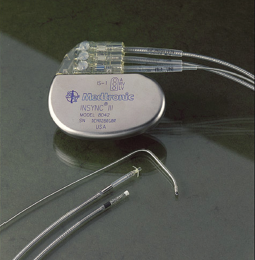
A cardiac resynchronisation therapy pacemaker (CRT-P), provides cardiac resynchronisation therapy and diagnostics to assist in patient management

The meeting set off to a stimulating start with Professor Theresa McDonagh (Kings College Hospital, Chair of the British Society of Heart Failure) reviewing primarily the growing evidence for aldosterone antagonists in the management of systolic heart failure (HF). Large clinical trials have established the role of aldosterone antagonists, such as spironolactone, in severe systolic HF (Randomised Aldactone Evaluation Study – RALES) and eplerenone in acute myocardial infarction (MI) complicated by left ventricular dysfunction (Eplerenone Post-Acute Myocardial Infarction Heart failure Efficacy and Survival Study – EPHESUS).

More recently the results of the EMPHASIS-HF (Eplerenone in Mild Patients Hospitalisations and Survival Study in Heart Failure) study showed a reduction in cardiovascular death or admissions with HF when eplerenone was added to standard medical therapy in patients with mild symptoms (New York Heart Association class II functional status). As expected, there was a higher incidence of hyperkalaemia in patients treated with eplerenone, highlighting the importance of close monitoring of renal function in these patients.

Device therapy

Implantable cardiac defibrillator (ICD)

A session looking at the evidence for primary prevention device therapy started with a review of the original landmark studies by Dr Derek Connelly (Consultant Cardiologist, Glasgow Royal Infirmary). The MADIT-II (Multicentre Automatic Defibrillator Implantation Trial II) trial was the first major study to show a survival benefit for prophylactic ICD implantation in patients with previous MI and a left ventricular ejection fraction (LVEF) of less than 30%.

Most of the primary prevention ICD trials have focused on patients with ischaemic aetiology of HF. Dr Jay Wright (Consultant Cardiologist, Liverpool Heart and Chest Hospital) discussed the SCD-HeFT (Sudden Cardiac Death in Heart Failure Trial) study, which also enrolled patients with non-ischaemic cardiomyopathy (NICM). This showed a similar relative risk reduction of death of 27% in the NICM group as compared to 21% in the ischaemic group. Nevertheless, the absolute risk reduction over five years was only a modest 7.2%, and this was cited as a possible reason as to why the National Institute for Health and Clinical Excellence (NICE) have not issued specific guidance on implantation of an ICD in the non-ischaemic population.

Cardiac resynchronisation therapy (CRT)

The CARE-HF (Cardiac Resynchronisation – Heart Failure) study was pivotal being the first to show that a CRT device without a defibrillator could reduce the risk of death from any cause by 36%, when compared to standard medical therapy. In his review of this study, Dr Connolly said that, crucially, a number of important patient groups were excluded from this seminal trial, such as those with permanent atrial fibrillation (AF), mild HF symptoms (New York Heart Association [NYHA] functional class I and II), or a narrow QRS duration (< 120 msec). Dr Paul Foley (Consultant Cardiologist, Wiltshire Cardiac Centre) was charged with the challenging task of reviewing the latest evidence for implanting CRT in these selective populations.

When considering AF, a large Italian cohort study has reported improvements in LVEF, NYHA class and exercise capacity, similar to those seen in sinus rhythm, when CRT is combined with AV node ablation. Nevertheless, there is consensus that there is insufficient evidence to support a mortality benefit with this strategy, and more prospective randomised studies are necessary.

The most compelling evidence for use of CRT in patients with mild HF symptoms comes from the MADIT-CRT (Multicentre Automatic Defibrillator Implantation Trial with Cardiac Resynchronisation Therapy) study, which enrolled patients in NYHA class I and II and randomised to ICD or CRT-D. This showed a 41% reduction in the risk of HF-events in the CRT-D group, which was primarily evident in a prespecified group of patients with significant electrical dysynchrony (QRS > 150 msec).

Echocardiography in dysynchrony

In her lecture, Dr Alison Duncan (Consultant Cardiologist, Royal Brompton Hospital, London) discussed the clinical effectiveness of various echocardiographic markers of ventricular dysynchrony, on response rates to CRT implantation. The PROSPECT (Predictors of response to CRT) trial was a large multicentre and prospective study evaluating the utility of various echocardiographic parameters of dysynchrony, based on M-mode, pulsed-wave Doppler and Tissue Doppler imaging (TDI). It concluded that the predictive value of such parameters was insufficient to influence clinical decision making.

Dr Duncan has studied global markers of dysynchrony, such as total isovolumic time (t-IVT), as part of a small retrospective single-centre study. She concluded that, global rather than segmental markers of ventricular dysynchrony may be more valuable predictors of response to CRT, though this has yet to be tested by a large prospective study.

Novel therapeutic strategies in heart failure

Anaemia in CHF

The need for checking haemoglobin and haematinics in patients with CHF, and correcting iron deficiency, where appropriate, was emphasised by Dr Klaus Witte (Honorary Consultant Cardiologist, Leeds General Infirmary, Leeds) in an epidemiological overview of anaemia in CHF. This is based on the findings of FAIR-HF (Ferinject Assessment in Patients with Iron Deficiency and Chronic Heart Failure), a large multicentre study, which showed benefit in various clinical end-points such as symptom limitation and quality of life, when comparing intravenous iron to placebo. The use of erythropoietin stimulating agents (ESAs) in CHF is more controversial. Whilst initial studies suggested improvements in LVEF, exercise capacity and quality of life, the randomised clinical trials that followed disappointingly did not show a significant benefit. Results of RED-HF (Reduction of Events with Darbopoetin-α in Heart Failure), a large mortality driven study are eagerly awaited.

Heart rate: the SHIFT study

Epidemiological and observational studies have shown that an elevated resting heart rate is a risk factor for mortality and poor cardiovascular outcomes. Professor Martin Cowie (Consultant Cardiologist, Royal Brompton Hospital, London) discussed this phenomenon and went on to look at the SHIFT (the Systolic Heart failure treatment with If inhibitor Ivabradine Trial) results, which showed a significant reduction in hospitalisation and death from HF when comparing ivabradine to placebo in patients with advanced HF on optimal therapy. Unsurprisingly, subgroup analysis suggested that those with higher resting heart rates derived greater benefit.

Sleep-disordered breathing

Sleep-disordered breathing conditions are prevalent in a staggering 50-60% of HF patients and Dr Anita Simonds (Consultant in Respiratory Medicine, Royal Brompton Hospital, London) gave a very insightful lecture on this area. These conditions can have adverse haemodynamic consequences for the failing heart. Studies have shown that CHF patients suffering from obstructive sleep apnoea (OSA) treated with continuous positive airway pressure (CPAP) have improved LVEF as well as a significantly reduced risk of death and hospitalisation.

CPAP has not shown any convincing evidence in the management of central sleep apnoea (CSA) associated with CHF. Dr Simonds did, however, talk about adaptive servoventilation (ASV), a novel ventilatory therapy which provides ventilatory support on detection of Cheynes Stokes respiration. A small randomised study has shown ASV to be of greater benefit than CPAP in treating CSA associated with CHF. We eagerly await the results of the SERVE-HF (Treatment of Sleep Disordered Breathing by Adaptive Servoventilation in HF patients) study, a large trial driven by mortality outcomes.

Exercise training in heart failure

Professor Andrew Clark (Honorary Consultant Cardiologist, Castle Hill Hospital, Hull) spoke about the importance of exercise training in the management of patients with CHF. He felt that skeletal muscle mass and function are more critical in determining exercise capacity than LVEF alone.

The safety and efficacy of exercise training in heart failure as compared to usual-care was evaluated in HF-ACTION (Heart Failure: A Controlled Trial Investigating Outcomes of Exercise Training), a large, multicentre randomised controlled trial. Whilst there was no significant improvement in outcomes, a substudy of the trial did show a significant improvement in patient-reported health status as assessed using the Kansas City Cardiomyopathy Questionnaire.

Professor Clark went on to discuss his small pilot study involving training using electrical muscle stimulation in patients with HF who lead sedentary lifestyles. There may be a future role for therapies directed at skeletal muscle to improve HF symptoms, he concluded.

Heart failure in congenital heart disease

There is a growing problem of HF in adults with congenital heart disease. In an informative lecture, Dr Aisling Carroll (Consultant Cardiologist in GUCH, Southampton General Hospital, Southampton) said HF is now common in this population and is becoming increasingly prevalent even amongst patients with corrected defects as they are now surviving well into adulthood, owing to advances in cardiac surgery.

Dr Carroll presented cases using echocardiographic images to illustrate how failure develops in the chronically pressure overloaded systemic right ventricle, or in the volume overloaded subpulmonic right ventricle or in single ventricle physiology. Medical management of these patients is challenging as the anatomy and loading conditions of the heart are very different. Furthermore there are no large studies proving safety and efficacy of conventional therapies used in acquired HF. Dr Carroll therefore advocated adopting an individualised approach in the management of these patients.

Conclusion

The BSH medical training meeting is an ideal opportunity for cardiology trainees to gain a broad understanding of key issues in the management of heart failure from experts in the field. Interactive case presentations also delivered a number of key learning points useful for trainees in their everyday clinical practice. The informal and interactive structure of the day allowed for healthy audience participation, and it was particularly useful to learn how other clinicians approach common challenges encountered in the management of heart failure.

The meeting was co-organised by Dr Paul Kalra (Consultant Cardiologist, Queen Alexandra Hospital, Portsmouth) and Professor Iain Squire (Consultant Cardiologist, Leicester Royal Infirmary).

If you would like more information about the British Society of Heart Failure, please visit www.bsh.org.uk or email [email protected]

Vikram Khanna

Cardiology Specialist Registrar

Queen Alexandra Hospital, Portsmouth

([email protected])

Physician heal thyself? Not on your nelly

Br J Cardiol 2011;18:115–116 Leave a comment
Click any image to enlarge
Authors:

We continue our series in which Consultant Interventionist Dr Michael Norell takes a sideways look at life in the cath lab…and beyond. In this column, he considers diets.

It all began on Boxing Day last year. Full of yuletide spirit we had descended upon my brother’s home and, in addition to indulging in a general familial ‘catch up’, we were also appraised about the progress of his wife’s diet. Now the paragraphs ahead are not intended to provide a forum in which to debate the need – or otherwise – of such restraint on her part. I was more struck by the results. 

Apparently, her simple avoidance of potatoes, rice, pasta and bread was sufficient to produce an impressive loss of poundage. It sounded to me like a slightly modified Atkins diet (reference available upon request), which switches the metabolism of carbohydrate to fat. The effectiveness of such tweaking of one’s cellular biochemistry can be monitored by testing the urine for ketones, but at this juncture the recollection of my first year at medical school – and, particularly, the Kreb’s cycle – begins to fade, so don’t quote me.

In any event, given the time of year, and the excessive degree of engorgement that invariably occurs, I was quite taken with the idea. Also, I had seen a recent TV programme about the dangers of visceral or so called hidden fat, as opposed to the more obvious external and wobbly variety. Hence, I was already contemplating a modification of my gustatory input, and this conceivably painless approach did seem to present an ‘easy win’. So, then; very much my sort of strategy. 

Adverse reaction

Now, I know what might well be your immediate reaction to this plan of mine. Indeed most (but oddly, not all) of my acquaintances have reacted with a similar degree of incredulity (well, almost) when I inform them that I am reducing my carbohydrate intake. 

You don’t need to diet!” they exclaim, aghast. (Author’s note: I just added that ‘aghast’ bit to leave readers in no doubt as to the incongruity – if not utter bewilderment – experienced). I do my best to be reassuring and suggest that a kilo or two fewer would not be such a bad thing. Anyway, I would not plan to restrict myself from all carbohydrates; ‘fluids’, as it were, would certainly be retained. In addition, such stringency would stand me in good stead were I to consider preparing for the London Marathon in 2019.

And so it began; poached eggs instead of toast for breakfast, even more salad and green vegetables instead of spuds, rice or spaghetti for dinner, and any daytime pangs of hunger assuaged by dates, fruit and a variety of nuts. I confess that I did not go the whole hog in terms of checking the finer details of my own metabolism with specific testing strips. I was fairly happy that if less was going in, and my usual physical activities (walking the dog and the occasional jog) were unchanged, then at least one of the Laws of Thermodynamics would suggest that I could expect a result.

Unpleasant taste

A month or so into my new programme I noticed an odd symptom that I had never experienced before, namely a peculiar but unmistakable bitter taste. Anything I ate or drank (sadly), was followed by the feeling that I had just chewed on a paracetamol/codeine tablet and that microscopic bits of it were still hanging around my gums, the inside of my cheeks and all over my tongue. Nothing would shift it; mouthwash and toothpaste had no effect, and I certainly had no intention of gargling with Dettol to see if that might improve matters.

Now, in younger age groups, such a new sensation might be received with interest and bemusement; yet another addition to life’s rich tapestry which one is expected to acquire over the years ahead. But as age advances, and more time lies behind than in front, such phenomena are rightly regarded more with caution and suspicion. (To put this into context, and while on the subject of age, I like to describe myself as approaching 50, but from the wrong direction.)

After 24 hours or so, I consulted my wife. Her response comprised an expected lack of sympathy or concern, a disinterested observation regarding alcohol and a throwaway comment about oesophageal reflux. 

Day two. It is a truism that you ‘know your own body’, and this allowed me to dismiss promptly both her, no doubt well meant, suggestions. Over the years I have become familiar with the odd aches and pains, and so feel justified in recognising rapidly any new developments that might be alien. And, while I would not regard my body as a temple, I think it can, nevertheless, be described as a reliable – if slightly run down and draughty – church hall, with a leaky roof and no central heating.

Day three. Being medical is not helpful; attempts at self-diagnosis are unwise as all objectivity is lost, but at least I was fairly sure that my dysgeusia was unlikely to have a cardiac aetiology. An ancient copy of Harrison’s Principles of Internal Medicine was of little help, and so I sought an answer in what nowadays provides an almost instantaneous and inexhaustible font of knowledge: the internet.

Information overload

Far from a reassuring solution, my e-searches around this symptom complex only filled me further with apprehension and foreboding. Indeed, I would have preferred my spouse’s original diagnostic efforts rather than Google’s list of often unpleasant – if not terminal – conditions that popped up as “The ten most likely causes of a bitter taste”.

Day five and back at work after the weekend. Frustrated and miserable I had shared my new found sensation with anyone who would listen. Eating and drinking (anything) had become frankly unpleasant and, while my original intention had been to reduce my food intake, this had not been the method I had envisaged. A more than casually interested colleague quizzed me further about my symptom and then turned purposefully to his laptop. 

I was peering out from a second floor window into a cold, grey and dank morning, the weather perfectly matching my sombre mood, when his computer enquiries, which had presumably found an answer, prompted him to look up from his screen. “Pine nuts?” 

Bong.

Problem solved

Day eight (supplementary). I had consumed a variety of nuts since my diet had begun and, while these were mostly almonds, walnuts and Brazil nuts, I had also chanced upon (and admittedly ravaged) a small bag of pine nuts that my wife had picked up in a supermarket. It turns out that certain species of said nut have been associated with a bitter aftertaste and there are many supportive accounts and other publications to be found electronically that testify to this discovery. Full recovery, albeit after some days, was well documented.

Day eleven and the epilogue. The solution to my mystery had been greeted less than enthusiastically by some. So with my taste now back to normal and acknowledging a smattering of scientific training, I, therefore, contemplated re-challenging myself with the offending item in order to confirm their causal role. Happily, such a sacrifice was unnecessary. My wife, who had been less than keen to swallow my theory, had nevertheless been more happy to consume some of the pine nuts themselves and was now complaining of … guess what?

And my diet? Well, physics is not my strong point. As I write this we are talking two months and three pounds, and I haven’t even had breakfast yet.

British Cardiovascular Society: plans for 2011

Leave a comment
Click any image to enlarge

In this fifth article from the British Cardiovascular Society (BCS), Professor Keith Fox, BCS President, looks to the future of a changing healthcare environment.

The past year and what lies ahead


For each of our key BCS Divisions, the
Vice-Presidents have not only set out strategic objectives but have also implemented the first stages of these plans – while also responding to all the external issues that impact upon cardiology. A huge tribute goes to the work
of the BCS Executive and the respective BCS Committees. Without this personal effort and major time commitment none of our achievements would have been possible.

Education and research

Dr Iain Simpson, Vice-President for Education and Research, has set out our educational strategy – clear tracks have been set in education and continuing professional development for trained specialists, dedicated sessions for trainees and an ‘innovation track’ consisting of clinical, translational and basic science. Dr Simpson completes his term this year, having made a huge impact on our education programme. We are delighted that Dr Sarah Clarke will start her Vice-Presidency of the Education and Research Division having already made excellent contributions to communications and education.

Despite the financial climate, we held a dynamic and successful conference in 2010 with increased participation. We have done this by structuring the conference to directly meet the needs of our membership and Affiliated Groups. Importantly for our BCS Annual Conference, we have worked with Affiliated Groups to develop highly relevant and integrated programmes. This is important to provide key information on who needs
sub-specialty referral and what new developments impact upon symptoms and outcome. Hence, the BCS Annual Conference aims to complement, not compete with, the Affiliated Groups’ own conferences.

We have been successful in establishing a partnership with the British Heart Foundation to support first the basic science track of the BCS Annual Conference (linked to the British Atherosclerosis Society and the British Society for Cardiovascular Research) and following the increased attendance and success of this track we now have funding support from the British Heart Foundation for the clinical/translational science track in the conference this year. This not only underpins and strengthens our programme but also allows us to invite key international speakers. In 2010, the National Training Day in December was a great success as was the BCS & Mayo Clinic Cardiology Review Course, which attracted a record number of participants (over 260).

With the California Chapter of the American College of Cardiology (ACC), we have developed a ‘twinning programme’ of educational activities, a bidirectional fellowship and new preceptorships (opportunities for short-term experience and training in specialist centres in California, and reciprocal places in the UK).

Training

Dr Jim Hall, Vice-President for the Training Division and also the Chair of the Specialist Advisory Committee in Cardiology, is helping to ensure the Training Programmes are well developed. We will again run the Knowledge Based Assessment for StRs in Cardiology at the BCS Annual Conference. Workforce planning is challenging, especially in light of the proposed healthcare reform, and a great deal of work has gone into ensuring that we meet the cardiology workforce needs, for the medium and long term not just those of the immediate financial constraints.

Clinical standards

The Clinical Standards Division, led by Vice-President Dr Simon Ray, has been very active. The Imaging Council is innovative and links a range of imaging modalities with the aim of defining common standards and devising the most appropriate pathways for investigating cardiology patients. Through the hard work of the Clinical Standards Committees, the Map of Medicine Pathways have been substantially revised and improved, and this work is conducted in conjunction with the Royal College of Physicians. We see the Maps of Medicine as increasingly important, alongside National Institute for Health and Clinical Excellence (NICE) guidance, in providing a ‘tool box’ for new healthcare commissioners.

Corporate and financial affairs

Our Corporate and Financial Affairs Division has been expertly led by Vice-President Professor Derek Yellon. We have managed to reduce our costs and diversify our income streams. This is a healthy position where income to the Society comes not only from subscriptions and the Annual Conference but also from our co-ownership of Heart, with BMJ Publishing. Heart continues to flourish and this is a real tribute to the editorial team and to Professor Adam Timmis. During the turbulent financial crisis Professor Yellon and the Finance Committee have sought expert external advice and guided us through this difficult time. Because of this, we can continue to develop and embark on new initiatives.

Thanks

BCS is based at 9 Fitzroy Square, London W1T 5HW. The Society can be contacted on [email protected]. Its web address is: www.bcs.com

At the 2011 Annual Conference Dr Charles Knight will step down as Honorary Secretary and we owe him a huge debt of gratitude for all his work behind the scenes. Our membership numbers have grown to 2,250 and we now have a more active voice in the public domain through the BCS Press Office.

Above all, we must thank our Chief Executive, Steven Yeats, and the staff of the BCS – we have a vibrant, busy and productive organisation.

Valve disease: the forgotten epidemic

Br J Cardiol 2011;18:118 Leave a comment
Click any image to enlarge
Authors:

A report from the first training day of the British Heart Valve Society, held recently at the Royal Society of Medicine, London. 

The recently-formed British Heart Valve Society aims to enlarge knowledge and understanding in order to improve the management of valve disease. A feature will be the involvement of all disciplines with an interest in valve disease to enlarge research ideas but also to help address clinical or organisational problems. This approach was evident in the Society’s first training day Valve disease: the forgotten epidemic but will also be carried out through educational events, collaborative research and articles focusing on points of concern.

Genetics of valve disease

The value of cross-fertilisation from specialisations outside clinical cardiology was illustrated by a summary of the genetics of valve disease by Dr Leema Robert (Guy’s and St Thomas’ Hospitals, London) showing the complexity of valve development and biology and hinting at the largely unaddressed importance of genetics in clinical studies. Professor Kim Parker (Imperial College, London) summarised basic hydrodynamic theory and demonstrated methods of imaging flow disturbances, which will be particularly important in improving ways in which we describe valve-aortic interactions. Professor David Newby (Edinburgh University) reviewed the biological mechanisms of aortic atheromatous disease and the likely reasons for the cholesterol-lowering trials being negative. Current work on inflammation may lead to new treatment methods.

Regional variation in services

The Society aims to detect and, if possible, correct deficiencies in the service. Mr James Roxburgh (Guy’s and St Thomas’ Hospitals, London) discussed the huge variation in access to aortic valve replacement surgery with East Anglia being best-served and Yorkshire the most deprived region in the UK. The reasons for these variations need closer examination but may partly be due to differences in the organisation of care for valve disease including the existence of specialist centres with ‘hub and spoke’ referral from feeder hospitals. Mr Frank Wells (Papworth Hospital, Cambridge) discussed advanced techniques for mitral valve repair feasible only in a highly specialist centre. We know that mitral valve repair rates also vary unacceptably between centres in the UK, as in Europe and the USA, and this is probably best addressed by concentrating valve surgery at specialist centres with specialist surgeons, interventional cardiologists, non-invasive cardiologists specialising in valve disease and expert sonographers. 

Methods of organising surveillance clinics at feeder-hospitals were discussed by Dr Guy Lloyd (Eastbourne Hospital) and improvements in timing of surgery obtained by biomarkers, mainly BNP as discussed by Dr Simon Ray (Wythenshawe Hospital, Manchester) and routine exercise testing as discussed by Professor John Chambers (KCL and Guy’s and St Thomas’ Hospitals, London). The need for better methods of risk assessment were delineated by Professor John Pepper (Imperial College and the Royal Brompton Hospital, London) and Mr Prakash Punjabi (Hammersmith Hospital, London), who discussed the effect of right ventricular anatomy and physiology on risk in valve disease. In addition, we need to improve the initial step of detecting valve disease early in the community. Dr Bernard Prendergast (John Radcliffe Hospital, Oxford) reported early results from the OxValve study showing a high incidence of undiagnosed valve pathology. We need to evolve methods of improving this and, although routine auscultation above the age of 65 might be attractive, the OxValve results suggest that a programme of screening echocardiography might be needed.

John Chambers

Professor of Clinical Cardiology

St Thomas’ Hospital, Westminister Bridge Road, London SE1 7EH

Involvement in the British Heart Valve Society is open to anyone with an interest in valve disease. Contact John Chambers ([email protected]) or Roger Hall ([email protected]). 

Correspondence

Leave a comment
Click any image to enlarge

News from the world of cardiology

Chest pain – troponin and athletes

Dear Sirs.

We recently admitted two young men with chest discomfort suggestive of an acute coronary syndrome, who were troponin I positive.

One was a 26-year-old Caucasian with left-sided chest heaviness engaging in regular triathlons. While serial resting electrocardiograms were unremarkable, troponin I on admission and one month later were elevated at 0.1 and 0.09 mg/L, respectively (normal range 0-0.04). An echocardiogram was entirely normal. An exercise treadmill stress test (ETT) was performed to 13 minutes (99% target heart rate achieved) of a Bruce protocol without symptoms or changes in the ECG recordings.

The second was a 39-year-old Black male with chest pain and a troponin value of 0.09 mg/L. He was extremely muscular as a result of regular weight training, kick boxing, karate and ‘cage-fighting’. The ECG showed resting T-wave inversion in leads V4–V6. The echocardiogram confirmed mild left ventricular hypertrophy (mean left ventricular wall thickness of 15 mm), no regional abnormalities and was otherwise a normal study. A Bruce protocol ETT was performed to 13 minutes (98% target heart rate achieved) without symptoms. The T-waves normalised within 30 seconds of starting the test, with no changes to suggest ischaemia throughout, or in recovery.

Both men were reassured and discharged. These cases represent examples of described elevations in troponins, and other cardiac biomarkers, seen in athletes.1 Such examples are reported in marathon runners, tri-athletes and other competitors in extreme endurance events, with levels correlating to increased endurance time.2

The mechanism remains unclear. Proposals include transitory leakage of cardiac troponins from injured myocytes, reduced renal clearance, elevated levels of catecholamines and isoenzyme release from skeletal muscle biochemically altered by training. The latter is supported by marathon experience and age appearing to be significant predictors of post-marathon troponin elevation.3

Clinicians should be cautious of interpreting positive troponin values in such individuals.

Fady Magdy and Simon W Dubrey

Hillingdon Hospital, Uxbridge

References

  1. Regwan S, Hulten EA, Martinho S et al. Marathon running as a cause of troponin elevation: a systematic review and meta-analysis. J
    Intervent Cardiol 2010;23:443–50.
  2. Jassal DS, Moffat D, Krahn J et al. Cardiac injury markers in non-elite marathon runners. Int J Sports Med 2009;30:75–9.
  3. Mingels A, Jacobs L, Michielsen E et al. Reference population and marathon runner sera assessed by highly sensitive cardiac troponin T and commercial cardiac troponin T and I assays. Clin Chem 2009; 55:101–8.

Cracking down on the problem

Br J Cardiol 2011;18:102–3 Leave a comment
Click any image to enlarge
Authors:

The prevalence of cocaine use in the UK has been steadily increasing over recent years, with 6.6% of 16–24 year olds admitting to regular use.1 United Nation figures from 2009 suggest that there are more than one million current cocaine users in the UK.2 In the USA, there are an estimated 5.8 million users.3,4 This high level of use is associated with considerable healthcare implications and costs. The most common cocaine-related presentation is chest pain, which is responsible for approximately 64,000 assessments per year in the USA, costing $83 million.3,4 If we extrapolate those figures to the UK, there would be approximately 11,000 assessments per year for cocaine-related chest pain. While this is perhaps a statistically dubious analysis of the figures, it does give us some idea of the scale of the problem.

Problems with cocaine use

Cocaine can cause multiple acute and chronic cardiac pathologies, including acute coronary syndromes, arrhythmias, accelerated hypertension, endocarditis, aortic dissection or rupture and cardiomyopathies. In this issue, Sultan et al. (see pages 142–4) present a case report of one of the rarer cardiovascular manifestations of cocaine use; that of coronary artery dissection.5

More commonly, cocaine has been reported to cause myocardial infarction (MI) due to acute thrombus formation or to severe coronary vasospasm, or accelerated atherosclerosis. In 2001, it was estimated that one of every four non-fatal MIs in persons aged 18 to 45 years was attributable to frequent cocaine use,6 and that proportion is likely to have increased with the increasing prevalence of cocaine use in this age group.

The haemodynamic effects of cocaine use have been studied in humans. Boehrer et al. in 19927 measured haemodynamic variables in 30 patients given either intranasal cocaine or intranasal saline. Cocaine caused significant increase in heart rate, blood pressure, cardiac index and positive and negative dP/dt. Nicotine and alcohol use can enhance these changes, creating extra myocardial work and increasing oxygen demand.

Much of the damage caused by cocaine results from a combination of this increased myocardial demand with the vasoconstrictive and pro-coagulant effects of cocaine. Vasoconstriction of the coronary arteries is thought to be caused by increased alpha-adrenergic stimulation, as well as an alteration of the balance of cytokines, which regulate vascular tone. There is an increase in production of endothelin-1, a potent vasoconstrictor, with a concomitant decrease in production of the vasodilator nitric oxide. To add further insult, there is an increase in platelet count and platelet activation, as well as a shift toward a pro-coagulant state mediated by increases in plasminogen-activator inhibitor, von Willebrand factor and fibrinogen.

Regular cocaine use can also lead to early atherosclerosis, probably by chronic exposure to the conditions described above creating endothelial dysfunction and plaque formation. These early atherosclerotic changes also lead to a potentiation of the vasoconstrictive and thrombogenic effects of cocaine; thus, atherosclerotic lesions can act as a trigger point for vasospasm or thrombus formation.

It is likely that increased shear stress due to cocaine’s haemodynamic effects, coupled with endothelial dysfunction, led to the coronary artery dissection seen in the case described in this issue. There have been several case reports of cocaine causing aortic dissection; however, coronary dissection remains a rarely reported phenomenon. Probably <1% of cases of aortic dissection are attributable to cocaine use, but it remains a worrying complication in young cocaine users; particularly those with other risk factors for atherosclerosis, such as smoking and hypertension. The explanation given for these cases is similar to that given for cocaine-related MI, with chronic cocaine use leading to endothelial dysfunction and early atherosclerosis, and then the acute haemodynamic effects of cocaine (particularly
crack cocaine) leading to intimal tears. With cocaine use, such tears most commonly occur at the ligamentum arteriosum, as this part of the aorta is relatively anatomically fixed, and is, therefore, less able to adapt to the sudden increase in the pressure waves accelerating down the aorta. Similar mechanisms are likely to underlie coronary dissection.

Management

According to Florida treatment centers, due to the multi-factorial nature of cocaine-related heart disease, it is important that its management focuses on conventional atherosclerotic risk factors as well as cocaine cessation. In chest pain associated with cocaine use, benzodiazepines can both relieve the pain and have helpful haemodynamic effects. In patients presenting with findings consistent with an acute MI, standard anticoagulant and antiplatelet treatment is of vital importance, as the vasospasm typically seen in acute cocaine use may also be associated with ruptured atherosclerotic plaque and thrombus formation. Early angiography is, therefore, vital and certainly in this case, allowed prompt detection of a potentially fatal pathology. Beta blockers should not be administered due to the risk of increasing vasospasm; even labetalol (which has both alpha and beta effects) seems to be unhelpful as the beta effects are more powerful.8 Esmolol can be associated with significant increases in blood pressure.9 Nitrates are helpful for symptoms, and there is some evidence that verapamil can reduce cocaine-induced vasospasm, although there are no large studies that have looked at outcome. In the longer term, treatment of hypertension and treatment with statins and antiplatelet agents may also help to prevent further atherosclerotic change and to stabilise areas of unstable plaque. However, key to successful long-term management is to support cocaine cessation.

Sadly, drug dependence treatment programmes remain poorly successful, with advertising campaigns such as “Talk to Frank” seemingly impotent against the increasing trends of cocaine use among young people. By comparison with smoking, there seems to be little discussion in the public domain about the dangers of cocaine use. High-profile users, such as Kate Moss or Amy Winehouse, have perhaps contributed to the allure of the drug to Britain’s celeb-conscious youth, and, while the drug’s contribution to their personal and social chaos is never far from the front page, the danger to their physical and cardiac health remains largely unspoken.

This case highlights the need for vigilance in detecting cardiac pathology in cocaine users, and the importance of the acute management and timely investigation of these patients.
It also perhaps reminds us of a renewed need to combat cocaine use in young people, with improved education about, and frank discussion of, the risks they take with
each use.

Conflict of interest

None declared.

Editors’ note

See also the case report by Sultan et al. on pages 142–4 of this issue.

References

  1. Home Office. Research, Development and Statistics Directorate and BMRB. Social Research, British Crime Survey; 2008 — 2009 . Colchester, Essex: UK Data Archive [distributor].
  2. United Nations Office on Drugs and Crime (UNODC). World Drug Report 2009. United Nations Publication Sales No. E.09.XI.12. Available online at http://www.unodc.org/documents/wdr/WDR_2009/WDR2009_eng_web.pdf
  3. Substance Abuse and Mental Health Services Administration, Office of Applied Studies. National Household Survey on Drug Abuse: Population Estimates, 1998. OAS Series #H-9, DHHS Publication No. (SMA) 99-3327. Rockville, MD: US Department of Health and Human Services, 1999.
  4. Substance Abuse and Mental Health Services Administration, Office of Applied Studies. Drug Abuse Warning Network, 2005: National Estimates of Drug-Related Emergency Department Visits. DAWN Series D-29, DHHS Publication No. (SMA) 07-4256. Rockville, MD: Substance Abuse and Mental Health Services Administration, Office of Applied Studies, 2007.
  5. Sultan A, Jahangir A, Louis A A, Muthusamy R. Coronary artery dissection secondary to cocaine abuse. Br J Cardiol 2011;18:142–4.
  6. Qureshi AI, Suri MF, Guterman LR, Hopkins LN. Cocaine use and the likelihood of nonfatal myocardial infarction and stroke: data from the Third National Health and Nutrition Examination Survey. Circulation 2001;103:502–06.
  7. Boehrer JD, Moliterno DJ, Willard JE et al. Hemodynamic effects of intranasal cocaine in humans.
    J Am Coll Cardiol 1992;20:90–3.
  8. Boehrer JD, Moliterno DJ, Willard JE, Hillis LD, Lange RA. Influence of labetalol on cocaine-induced coronary vasoconstriction in humans. Am J Med 1993;94:608–10.
  9. Sand IC, Brody SL, Wrenn KD, Slovis CM. Experience with esmolol
    for the treatment of cocaine-associated cardiovascular complications. Am J Emerg Med 1991;9:161–3.

Could coronary artery calcium scores replace exercise stress testing? A DGH analysis

Br J Cardiol 2011;18:120–3 Leave a comment
Click any image to enlarge
Authors:

The National Institute for Health and Clinical Excellence (NICE) has issued guidance on the investigation of patients with recent onset of chest pain, recommending CT calcium scoring (CAC) as the preferred test in some low-risk groups. This reflects concern about the low sensitivity (high false positive rate) of exercise stress tests (EST). This represents a major shift away from traditional rapid-access EST clinics and has generated concern. We looked at 125 consecutive ungraded patients with equivocal ESTs referred for CAC, and CT coronary angiography (CTA), if required. We found that 53% of patients had a CAC = 0 and would need no further testing under the NICE protocol. We estimate this would rise up to 70–80% if only low likelihood patients were studied. Two per cent of patients with a CAC = 0 required coronary intervention.

As per NICE protocol, all patients with a CAC between 1 and 400 underwent CTA, and, of these, 25% required invasive coronary angiography (ICA) and 17% underwent coronary intervention. 

The overall strategy of CAC followed by CTA (if CAC between 1 and 400) and ICA (if CAC >400) produced a final sensitivity of 88% (higher than EST) and a negative predictive value of 98% (similar to EST). We believe the strategy is a useful way to assess recent onset chest pain but concerns about radiation dose, availability and patients with obstructive non-calcific plaque remain.

Continue reading Could coronary artery calcium scores replace exercise stress testing? A DGH analysis

Varicose veins, haemorrhoids and the risk of circulatory diseases: record-linkage study

Br J Cardiol 2011;18:124–9 Leave a comment
Click any image to enlarge
Authors:

Varicose veins and haemorrhoids both involve the venous circulatory system, but it is unclear whether they are predictors of elevated rates of other circulatory diseases. Our aim was to determine whether they are. 

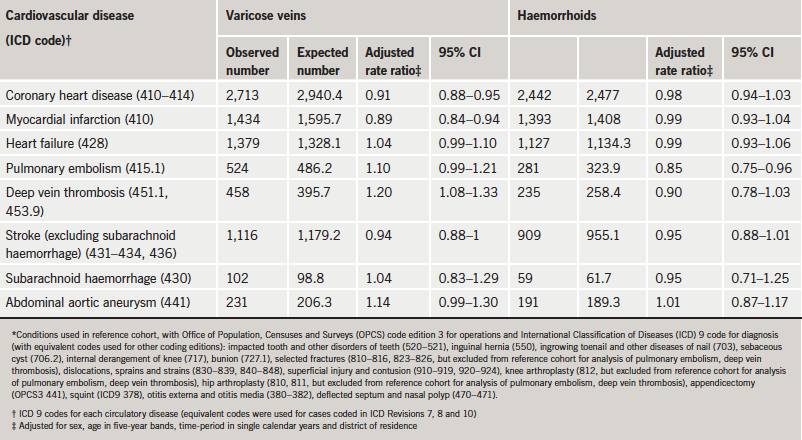
We analysed an epidemiological database of hospital admission and day-case statistics, constructing cohorts of people admitted for care for varicose veins or haemorrhoids, and comparing their experience of subsequent circulatory diseases with a control cohort. Compared with the control cohort, there was an elevated risk of deep vein thrombosis (DVT) in the varicose veins cohort (rate ratio 1.20; 95% confidence interval 1.08–1.33) but not in the haemorrhoids cohort (0.90; 0.78–1.03). No other circulatory diseases showed significantly elevated risks associated with varicose veins or haemorrhoids. The rate ratio for coronary heart disease in the varicose veins cohort was 0.91 (95% confidence interval 0.88–0.95) and that in the haemorrhoids cohort was 0.98 (0.94–1.03). 

We conclude that neither varicose veins nor haemorrhoids showed strong association, either positive or negative, with other circulatory diseases. There was a significant, but numerically modest, elevated risk of DVT associated with varicose veins. The risk of coronary heart disease in people with varicose veins was, if anything, a bit low.

Introduction

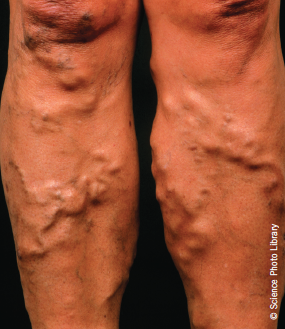
Varicose veins (VV) are dilated, tortuous, superficial veins found typically in the lower limbs. Haemorrhoids are abnormal distensions of the arteriovenous plexus in enlarged vascular anal cushions, although they are often referred to as varicosities.1 It is unknown whether these two conditions, both classified as disorders of the venous circulatory system,2 are associated with altered risks of other circulatory disorders. If they are, this may suggest clues about shared aetiological mechanisms between VV, haemorrhoids and other circulatory diseases. It would also provide information of prognostic clinical relevance about patients with VV or haemorrhoids. We aimed to investigate whether VV and haemorrhoids are predictors of other circulatory diseases.

Methods

Population and data

We used data from the Oxford Record Linkage Study (ORLS). The ORLS includes brief statistical abstracts of records of all hospital admissions, including day-case care, in National Health Service (NHS) hospitals, and all deaths regardless of where they occurred, in defined populations within the former Oxford NHS Region, from 1963 to 1999.3

Selection of cohorts

The method will be described for the investigation of VV as a pre-existing condition and coronary heart disease (CHD) as an outcome. The same basic methods were used for studying each other circulatory disease after VV; and for studying each circulatory disease in people with haemorrhoids. A cohort of people with VV was assembled by identifying the first episode of care for VV as either a day case or inpatient at an NHS hospital. A reference cohort was constructed by identifying the first admission of individual patients in the ORLS for a range of common and generally fairly minor disorders (for details, see table footnotes). We followed the standard epidemiological practice, when hospital controls are used, of selecting a diverse range of conditions, rather than relying on a narrow range (in case the latter are themselves atypical in their risk of subsequent disease). This ‘reference’ group of conditions has been used in a number of other studies of inter-relationships between diseases.4-6 We searched the database for any subsequent NHS hospital admission or day-case care for CHD in the VV and reference cohorts. We excluded individuals for whom CHD was recorded either prior to, or at the first admission for, VV or reference condition. The diagnoses of VV, the reference conditions, and CHD were accepted as those coded on the hospital record abstract. Privacy regulations preclude access to the full records to study the criteria on which the diagnoses were based.

Statistical analysis

The methods will be described for VV followed by CHD. The methods for all other combinations of disorders were essentially the same. We calculated the rate of occurrence of CHD in the VV cohort and compared it with the rate in the reference cohort. We expressed the results as the ratio of the rate in the VV cohort compared with that in the reference cohort. The confidence interval (CI) for the rate ratio and χ2 statistics for its significance were calculated as described elsewhere.6,7 In comparing the VV cohort with the reference cohort, the rates of occurrence of CHD were standardised for age group (in five-year bands), sex, year of first admission for VV or reference condition, and district of residence, to ensure that the results of group comparisons were equivalent in these respects. We used the indirect method of standardisation, using the combined VV and reference cohort as the standard. We applied the stratum-specific rates in the combined VV and reference cohorts to the number of people in each stratum in the VV cohort, separately, and then to those in the reference cohort. This gave the standardised rate in each cohort, and thus, by comparing the rates, the means to calculate the rate ratio. In the reference cohort, we included all the people in the dataset in each stratum with the comparison conditions. We did this to maximise the numbers in each stratum in the reference cohort in order to maximise statistical power. Further detail on population and methods is described elsewhere.6

Results

There were 43,724 people in the VV cohort, 30,353 in the haemorrhoids cohort, and 464,533 in the reference cohort. In the VV cohort, 43.4% of patients were aged under 45, 43.5% aged 45–64, and 13.1% aged 65 and over. In the haemorrhoids cohort, the corresponding percentages were 42.5%, 39.7% and 17.8%, respectively (table 1). In each five-year age group, there were at least four cases in the reference cohort for each case in the VV or haemorrhoids cohort; and in many age groups there were many more.

Table 1. Number and percentage of people in each age group with varicose veins or haemorrhoids; and percentage in each age group who were male

In the VV cohort, the rate ratio for CHD was a little low (0.91, compared with the reference cohort, 95% CI 0.88–0.95) (table 2). In the haemorrhoids cohort, the rate ratio for CHD was very close to one at 0.98 (95% CI 0.94–1.03). The rate ratio for deep vein thrombosis (DVT) was significantly high in the VV cohort (rate ratio 1.20; 95% CI 1.08–1.33); that for pulmonary embolism was not quite significant (rate ratio 1.10; 95% CI 0.99–1.21). The rate ratio for DVT associated with haemorrhoids was 0.90 (95% CI 0.78–1.03) and that for pulmonary embolus was borderline significantly low at 0.85 (95% CI 0.75–0.96). The rate ratio for stroke was a little low but not quite significantly so in the VV cohort (0.94; 95% CI 0.88–1.00) and the haemorrhoids cohort (0.95; 95% CI 0.88–1.01).

Table 2. Varicose veins and haemorrhoids: occurrence of subsequent circulatory disease, showing the observed number of people with each disease, the expected number, the rate ratio compared with the reference cohort*, and the 95% confidence intervals (CI) for the rate ratio

Comparison of males and females

In people with VV, the significantly high risk of DVT was similar for males (1.25; 95% CI 1.06–1.47) and females (1.18; 95% CI 1.02–1.36). A significantly high risk of pulmonary embolus was found for males (1.20; 95% CI 1.03–1.39) but not for females (1.03; 95% CI 0.90–1.18). The rate ratio for abdominal aortic aneurysm was significantly high in men (1.25; 95% CI 1.06–1.46) but not in women (0.88; 95% CI 0.65–1.16). There were no other significant findings, and no other noteworthy differences between men and women.

The rate ratios for most of the circulatory diseases studied in people with haemorrhoids were close to one in both males and females. The rate ratio for pulmonary embolus was significantly low in men (0.79; 95% CI 0.43–0.92), but not in women (0.93; 95% CI 0.77–1.12).

Time from admission for VV or haemorrhoids to admission for circulatory disease

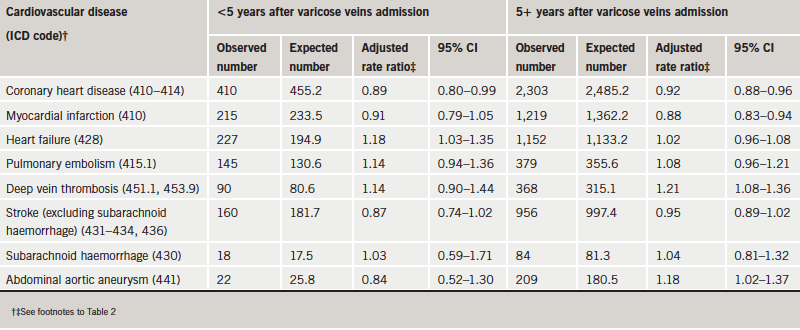
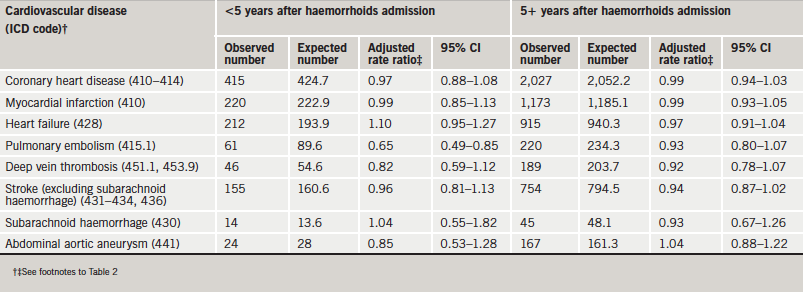
The great majority of admissions for circulatory disorders were remote in time after the admission for VV (table 3) or haemorrhoids (table 4). Following VV, the rate ratios for most circulatory disorders were very similar in the first five years after admission and at longer time intervals than that (table 3). The exception was abdominal aortic aneurysm, which showed a significantly high rate ratio more than five years after, but not in the earlier period. Following haemorrhoids, a few rate ratios that were a little low in the first five years, such as that for pulmonary embolism, became a little higher in the later period but not higher than expected from the rates in the reference cohort.

Table 3. Circulatory diseases in people with varicose veins, comparing occurrence of circulatory disease within five years of admission, and more than five years after admission: observed number of people with each disease, the expected number, the rate ratio compared with the reference cohort, and the 95% confidence intervals (CI) for the rate ratio
Table 4. Circulatory diseases in people with haemorrhoids, comparing occurrence of circulatory disease within five years of admission, and more than five years after admission: observed number of people with each disease, the expected number, the rate ratio compared with the reference cohort, and the 95% confidence intervals (CI) for the rate ratio

Discussion

Strengths and weaknesses

The ORLS is a large dataset containing data over a long period of time. The ‘outcome’ diagnoses, the circulatory diseases, were recorded independently of the diagnoses of VV or haemorrhoids, and only brought together by record linkage. This avoids possible biases that might arise from studies in which the observer of each condition is not ‘blind’ to the presence of other conditions. It also avoids the possibility of recall and reporting bias which might occur in retrospective interview-based studies of people who have experienced CHD, stroke or other circulatory disease. We considered the possibility of surveillance bias in which, because an individual is under care for one disease (e.g. VV), other diseases (e.g. other circulatory disorders) may be identified. The fact that the majority of the cases of circulatory diseases were remote in time – the majority occurred five years and more after VV or haemorrhoids (tables 3 and 4) – reduces the likelihood of any systematic biases related to the hospitalisation of people for VV or haemorrhoids.

Our findings were confined to people who received day-case hospital care, or who were admitted to hospital, with VV or haemorrhoids. Nonetheless, it seems reasonable to assume that those admitted are at the severe end of the clinical spectrum of VV or haemorrhoids; and that, if VV or haemorrhoids are aetiologically associated with other circulatory diseases, the associations are most likely to be evident in those with severe VV or haemorrhoids. We considered the possibility that there may be differences between males and females in indications for treatment – for example, cosmetic reasons for women and severe symptoms for men with VV – that might themselves be related to risk of other diseases. Accordingly, we analysed the data for males and females separately as well as together. However, differences between men and women were small.

We lack information about the characteristics of the patients, other than their clinical diagnoses, and therefore lack information about risk factors (such as smoking) and potential confounding for the circulatory disorders studied. Most associations were not significantly different from one, even though numbers were large and statistical power was high. Close clustering around one would not be found if the study were hampered by unmeasured confounding. Furthermore, the highest value, and the only high that was statistically significant, was the association between VV and DVT, which is also the only one where there is a reasonably strong a priori hypothesis indicating that a significant association might be found.

Varicose veins

The few previous studies of VV and CHD have produced conflicting results. The Kaiser-Permanente Epidemiologic Study of Myocardial Infarction reported that patients with VV and haemorrhoids were less likely than others to develop myocardial infarction.8 A more recent study found a reduced risk of CHD in men with VV.9 The prospective Framingham Study10 reported that, after adjusting for confounders, there were no significant associations between VV and CHD. Our study shows that in patients with pre-existing VV the risk of CHD was fractionally low.

Scott et al.9 have proposed that an inverse association between VV and CHD could be explained by increased oestrogen levels in people with VV. An alternative plausible explanation is that an inverse association may be due to differences in the smooth muscle component of the vasculature. In a histological study using VV samples from patients undergoing vein stripping, and controls from femoral-popliteal bypass operations, the former patients were demonstrated to have decreased smooth muscle in the tunica media but no difference in muscular content in other vascular wall layers.11 An in vitro study using venous samples from patients also showed decreased smooth muscle and disorganisation of the smooth muscle layers.12 In contrast to this change, it is well established that smooth muscle proliferation is a characteristic of the atherosclerotic disease process.13,14 Although it is plausible that in the above studies the controls may be unrepresentative of ‘normal’ veins, these histological changes should be considered as a potential mechanism. Future studies may be able to use control samples from young patients who have died of non-atherosclerotic related conditions.

Previous studies on the association between VV and DVT are few and, in particular, have focused on the post-operative risk of DVT in VV patients.15,16 Some case–control studies have demonstrated a positive association between VV and DVT, with similarly modest odds ratios to ours.17,18 An explanation for this association may relate to the alterations in blood flow and injuries to the vascular wall associated with VV. It is well established that one of the major complications of VV is superficial thrombophlebitis, usually with the presence of clots in the superficial venous system. It is possible, as one case series showed, that there is an increased risk of developing DVT (with or without VV) in patients with superficial vein thrombosis.19 An alternative explanation could be that some patients might develop VV subsequent to asymptomatic DVT and might thus be at elevated risk of further DVT.

Oral contraceptives have been contraindicated in patients with VV because of concerns about the possibility of an increased DVT risk, but the evidence on which this is based has been weak. A Royal College of General Practitioners study found a moderate additive effect of the presence of VV and the use of oral contraceptives on the risk of DVT, although there were only a small number of events.20 Our data provide some evidence to support a general increase in risk in people with VV. Further study is warranted to determine whether VV and other risk factors have multiplicative effects on the risk of venous thromboembolism.

Haemorrhoids

To our knowledge, this is the first large study of any association between haemorrhoids and circulatory disease. Burkitt21 in the 1970s suggested that high levels of haemorrhoids, DVT and VV in the developed world were attributable to common processes that underlie each, notably low fibre intake and lack of vigorous physical exercise. Additionally, external haemorrhoids are associated with blood stasis in the enlarged vessels, which may predispose to thromboembolic diseases. Further, in both DVT and haemorrhoids an increase in mast cells has been demonstrated,22,23 although these associations have not been adequately explored.

Conclusions

We found a statistically significant but numerically modest elevation of risk of DVT associated with VV, which is the one association studied by us that seems already to have a reasonably firm base in accepted clinical practice. Apart from this, there was no evidence that VV and haemorrhoids are associated with raised susceptibility to other circulatory diseases.

Acknowledgements

This work was supported by the English National Institute of Health Research Co-ordinating Centre for Research Capacity Development, which funds the Unit of Health Care Epidemiology to undertake research using the linked data. The Oxford Record Linkage Study dataset was built under the direction of Leicester Gill.

Conflict of interest

None declared.

Key messages

  • Varicose veins and haemorrhoids both involve the venous circulatory system, but it is unclear whether they are predictors of elevated rates of other circulatory diseases
  • There was a statistically significant, but numerically modest, elevated risk of deep vein thrombosis associated with varicose veins
  • None of the other circulatory diseases studied showed an elevated risk in people with varicose veins or haemorrhoids

References

  1. Kaidar-Person O, Person B, Wexner SD. Hemorrhoidal disease: a comprehensive review. J Am Coll Surg 2007;204:102–17.
  2. World Health Organization. ICD chapter 2. In: International statistical classification of diseases and related health problems. 10th revision. Geneva: WHO, 1992:509–10.
  3. Goldacre MJ, Kurina L, Yeates D, Seagroatt V, Gill L. Use of large medical databases to study associations between diseases. QJM 2000;93:669–75.
  4. Goldacre MJ, Wotton CJ, Seagroatt V, Yeates D. Cancer following hip and knee arthroplasty: record linkage study. Br J Cancer 2005;92:1298–301.
  5. Goldacre MJ, Kurina LM, Wotton CJ, Yeates D, Seagroatt V. Schizophrenia and cancer: an epidemiological study. Br J Psychiatry 2005;187:334–8.
  6. Fois A, Wotton CJ, Yeates D, Turner M, Goldacre MJ. Cancer in patients with motor neuron disease, multiple sclerosis and Parkinson’s disease: record linkage studies. J Neurol Neurosurg Psychiatry 2010;81:215–21.
  7. Breslow NE, Day NE. Statistical methods in cancer research. Volume II – the design and analysis of cohort studies. IARC Sci Publ 1987;82:1–406.
  8. Klatsky AL, Friedman GD, Siegelaub AB. Medical history questions predictive of myocardial infarction: results from the Kaiser-Permanente epidemiologic study of myocardial infarction. J Chronic Dis 1976;29:683–96.
  9. Scott TE, Mendez MV, LaMorte WW et al. Are varicose veins a marker for susceptibility to coronary heart disease in men? Results from the Normative Aging Study. Ann Vasc Surg 2004;18:459–64.
  10. Brand FN, Dannenberg AL, Abbott RD, Kannel WB. The epidemiology of varicose veins: the Framingham study. Am J Prev Med 1988;4:96–101.
  11. Travers JP, Brookes CE, Evans J et al. Assessment of wall structure and composition of varicose veins with reference to collagen, elastin and smooth muscle content. Eur J Vasc Endovasc Surg 1996;11:230–7.
  12. Lowell RC, Gloviczki P, Miller VM. In vitro evaluation of endothelial and smooth muscle function of primary varicose veins. J Vasc Surg 1992;16:679–86.
  13. Ross R, Glomset JA. Atherosclerosis and the arterial smooth muscle cell: proliferation of smooth muscle is a key event in the genesis of the lesions of atherosclerosis. Science 1973;180:1332–9.
  14. Rosenfeld M, Ross R. Macrophage and smooth muscle cell proliferation in atherosclerotic lesions of WHHL and comparably hypercholesterolemic fat-fed rabbits. Arteriosclerosis 1990;10:680–7.
  15. Crandon AJ, Peel KR, Anderson JA, Thompson V, McNicol GP. Postoperative deep vein thrombosis: identifying high-risk patients. BMJ 1980;281:343–4.
  16. Lowe GD, Osborne DH, McArdle BM et al. Prediction and selective prophylaxis of venous thrombosis in elective gastrointestinal surgery. Lancet 1982;319:409–12.
  17. Heit JA, Silverstein MD, Mohr DN, Petterson TM, O’Fallon WM, Melton LJ 3rd. Risk factors for deep vein thrombosis and pulmonary embolism: a population-based case-control study. Arch Intern Med 2000;160:809–15.
  18. Huerta C, Johansson S, Wallander MA, Garcia Rodriguez LA. Risk factors and short-term mortality of venous thromboembolism diagnosed in the primary care setting in the United Kingdom. Arch Intern Med 2007;167:935–43.
  19. Chengelis DL, Bendick PJ, Glover JL, Brown OW, Ranval TJ. Progression of superficial venous thrombosis to deep vein thrombosis. J Vasc Surg 1996;24:745–9.
  20. Royal College of General Practitioners. Oral contraceptives, venous thrombosis, and varicose veins: Royal College of General Practitioners’ Oral Contraception Study. J R Coll Gen Pract 1978;28:393–9.
  21. Burkitt DP. Varicose veins, deep vein thrombosis, and haemorrhoids: epidemiology and suggested aetiology. BMJ 1972;2:556–61.
  22. Bankl HC, Grossschmidt K, Pikula B, Bankl H, Lechner K, Valent P. Mast cells are augmented in deep vein thrombosis and express a profibrinolytic phenotype. Hum Pathol 1999;30:188–94.
  23. Taweevisit M, Wisadeopas N, Phumsuk U, Thorner PS. Increased mast cell density in haemorrhoid venous blood vessels suggests a role in pathogenesis. Singapore Med J 2008;49:977–97.