

HEART UK held its 39th Annual Medical and Scientific Conference in Nottingham in July 2026, turning its attention to the widening gap between therapeutic capability and clinical delivery. Delegates heard first-in-human data on permanent genetic inactivation of PCSK9, practice-changing results for apolipoprotein C-III (apoC-III) inhibition, and a sobering account of the disadvantage women face in cardiovascular care.
Hypertriglyceridaemia: apoC-III inhibition comes of age

Professor Maciej Banach (Medical University of Łódź, Poland) opened with Olezarsen, an antisense oligonucleotide targeting APOC3 messenger RNA that accelerates clearance of triglyceride-rich remnants. In ESSENCE-TIMI 73b (phase 3, n=1,349), it lowered triglycerides by around 60% at six months in moderate hypertriglyceridaemia, with most patients reaching a level below 1.7 mmol/L.1
In the separate CORE-TIMI 72a and CORE2-TIMI 72b trials in severe hypertriglyceridaemia, adjudicated acute pancreatitis was significantly less frequent with olezarsen (rate ratio 0.15; p<0.001), a first in this population.2 Yet the coronary CTA substudy tempered enthusiasm: despite a 72% fall in remnant cholesterol, non-calcified plaque volume was unchanged at 12 months.3 Professor Banach argued this reflects too short an exposure in patients already on intensive LDL-C lowering; whether triglyceride lowering yields cardiovascular benefit awaits outcome data.
In vivo base editing: a single infusion, a lifetime effect

Professor Handrean Soran (Manchester University NHS Foundation Trust, UK) traced an arc from Cohen and colleagues’ 2006 description of PCSK9 loss-of-function variants conferring lifelong low LDL-C and protection from coronary heart disease,4 to monoclonal antibody inhibition within a decade, and now to permanent genetic inactivation. VERVE-102 is a base-editing therapy that switches off the PCSK9 gene in the liver after a single infusion. In the phase 1 Heart-2 study, 35 adults with heterozygous familial hypercholesterolaemia (FH) or premature coronary disease received a single infusion across six dose cohorts. Mean PCSK9 reduction ranged from 51% to 88%, with LDL-C reductions of 9% to 62% (an absolute fall of 2.0 mmol/L at the highest dose), durable beyond one year in 15 participants. There were no dose-limiting toxic effects.5 ANGPTL3 and LPA editing programmes follow close behind. If durability holds, a single infusion could replace a lifetime of daily therapy, addressing the non-adherence that undermines even the most effective oral agents.
FH across the life course
Professor Dirk Blom (University of Cape Town, South Africa) noted that response to PCSK9 monoclonal antibodies in homozygous FH depends on residual LDL receptor function, and that waterfall plots of individual responses show a spread so wide that the group mean conveys little. Because response cannot be predicted from phenotype, the pragmatic approach is to trial a therapy and measure the effect. Agents acting independently of the receptor therefore fill a critical gap, notably lomitapide and evinacumab.6 Combination therapy is essential and should begin early.

Professor Albert Wiegman (Amsterdam University Medical Centres, The Netherlands) presented the new European Atherosclerosis Society consensus statement on FH in children, advocating lipid-lowering therapy before puberty and from six years of age where indicated.7 He framed this around the ASCVD threshold: cumulative LDL-C burden, the area under the LDL-C-times years, of approximately 175 mmol/L*years, at which risk of atherosclerotic events approximately doubles.7 An untreated individual with heterozygous FH reaches this point by about the age of 33, decades ahead of a normolipidaemic peer, which is what makes early treatment a mathematical necessity rather than a preference. The underlying principle is well supported: in pooled US cohorts (n=18,288, median 16 years’ follow-up), cumulative LDL-C exposure in young adulthood and middle age predicted incident coronary heart disease independently of midlife LDL-C (adjusted hazard ratio 1.57, 95% CI 1.10 to 2.23).8

Women and cardiovascular disease
Professor Kirsten Holven (Oslo University Hospital, Norway) quantified what reproduction costs women with FH. Pregnancy-related off-treatment time is not nine months: Norwegian and Dutch data give a mean of 2.3 to 2.9 years, with individual ranges extending beyond a decade.9 LDL-C rises by around 30% during pregnancy and pre-eclampsia risk is higher in FH. The contraindication to statins in pregnancy rests on the precautionary principle rather than adverse data, and transfer of atorvastatin into breastmilk is exceedingly low.10 Her conclusion was that this cumulative loss of treatment time is an under-recognised contributor to cardiovascular risk in women with FH, and one that current guidance does not adequately address.

Dr Sonya Babu-Narayan (Clinical Director of the British Heart Foundation, UK) set out the scale of disadvantage. One in three female deaths is cardiovascular, more than all cancers combined, yet premature cardiovascular mortality is rising. What is less common in women, she stressed, is not uncommon. The bias runs “from statins to stents to CPR”. Women are less likely to reach LDL-C targets, to receive high-intensity statins, to be given bystander resuscitation, or to attend cardiac rehabilitation, and are consistently under-recruited to cardiovascular trials relative to their disease burden. She cited the first European Society of Cardiology consensus statement on women’s heart centres, proposing a hub-and-spoke cardiovascular women’s heart health model embedded within existing services.11
Reframing risk: HDL dysfunction and lipoprotein(a)
Professor Kerry-Anne Rye (University of New South Wales, Australia) gave an elegant account of the HDL paradox. HDL promotes cholesterol efflux and dampens the inflammatory steps of atherogenesis, yet every attempt to exploit this by raising HDL concentration has failed: niacin added to statin therapy gave no benefit in AIM-HIGH12 or HPS2-THRIVE,13 and the cholesteryl ester transfer protein inhibitors fared no better: torcetrapib increased mortality through an off-target pressor effect14 while dalcetrapib, evacetrapib and anacetrapib, despite raising HDL cleanly and substantially, delivered no meaningful clinical benefit.15 HDL is rendered dysfunctional by inflammation, diabetes and chronic kidney disease, converting a protective particle into an inert or even harmful one.16 The lesson of two decades of failed trials is that it is HDL function, not the number on the lipid panel, that determines outcome.
Turning to lipoprotein(a), Dr Andreas Tridimas (Wirral University Teaching Hospital and the Countess of Chester Hospital, UK) set out what can be done before any Lp(a)-specific therapy is licensed, in line with the 2025 ESC/EAS focused update17 and the HEART UK consensus statement.18 Lower LDL-C more aggressively than the risk category alone would dictate; optimise every modifiable risk factor, since Lp(a) itself remains unmodifiable; and recognise that Lp(a) associates preferentially with non-calcified, higher-risk plaque, so a coronary calcium score of zero does not exclude atherosclerosis in these patients.19
Dr Jai Cegla (Imperial College Healthcare NHS Trust, UK) closed with the trial landscape. Lp(a)HORIZON, testing the antisense agent pelacarsen in 8,323 patients with established cardiovascular disease and Lp(a) ≥70 mg/dL, reports first,20 with several further cardiovascular outcomes trials of injectable and oral Lp(a)-lowering agents following close behind. A positive result, both speakers agreed, would sharply increase demand on NHS Lp(a) testing and referral pathways; services should prepare now.
Keynote Myant lecture: MASLD, a liver disease with implications far beyond the liver
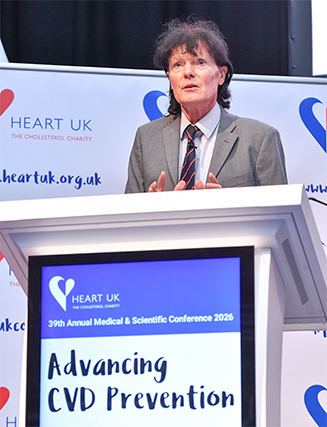
Professor Chris Byrne (University Hospitals Southampton, UK) delivered a masterful Myant lecture, tracing four decades in which cardiovascular attention moved from cholesterol alone to the cardio-renal-metabolic axis, from Time magazine’s 1984 cholesterol cover and the 4S trial to metabolic dysfunction-associated steatotic liver disease (MASLD). He illustrated it with a patient seen in 2003 whose HbA1c was 96 mmol/mol and ALT 69 U/L: the diabetes commanded all the attention, while the mildly raised transaminase, then dismissed, was the earliest marker of the hepatic fat now linked to cardiovascular, renal and metabolic risk.
MASLD is a multisystem disorder and an independent risk factor for type 2 diabetes, ASCVD, chronic kidney disease, atrial fibrillation and heart failure. Hepatic fat drives an atherogenic dyslipidaemia of raised VLDL, low HDL-C and small dense LDL, and mortality tracks the number of accompanying metabolic syndrome traits. The liver, he argued, is a barometer of general health and a driver of cardiovascular risk in its own right.
Conclusion
The 2026 conference made plain that our science has outpaced our systems. We can now inactivate PCSK9 permanently with a single infusion, yet England identifies only around one in ten people with FH, barely half of secondary prevention patients reach LDL-C target, and women remain under-diagnosed, under-treated and under-recruited to the trials that generate this evidence. The opportunity now lies less in discovery than in delivery: the tools to transform cardiovascular prevention increasingly exist, and the challenge is no longer inventing them but ensuring they reach the patients who need them.
Conflicts of interest
AT reports honoraria/fees from Novartis, Daiichi Sankyo, Menarini, Amgen, Recordati and Amarin, and institutional service support funded by Amgen.
Dr Andreas Tridimas
Consultant in Chemical Pathology & Metabolic Medicine
Wirral University Teaching Hospital and Countess of Chester Hospital, UK
References
1. Bergmark BA, Marston NA, Prohaska TA, et al. Targeting APOC3 with olezarsen in moderate hypertriglyceridemia. N Engl J Med 2025;393:1279-1291. https://doi.org/10.1056/nejmoa2507227
2. Marston NA, Bergmark BA, Prohaska TA, et al. Olezarsen for managing severe hypertriglyceridemia and pancreatitis risk. N Engl J Med 2026;394:429-441. https://doi.org/10.1056/NEJMoa2512761
3. Marston NA, Bergmark BA, Prohaska TA, et al. Effect of APOC3 inhibition with olezarsen on coronary atherosclerosis: Essence–TIMI 73b imaging study. Circulation 2026;153:1539–48. https://doi.org/10.1161/CIRCULATIONAHA.126.080012
4. Cohen JC, Boerwinkle E, Mosley TH Jr, Hobbs HH. Sequence variations in PCSK9, low LDL, and protection against coronary heart disease. N Engl J Med 2006;354:1264–72. https://doi.org/10.1056/NEJMoa054013
5. Vafai SB, Täubel J, Ashdown T, et al. In vivo base editing of PCSK9 with VERVE-102 for hypercholesterolemia. N Engl J Med 2026 (epub ahead of print). https://doi.org/10.1056/NEJMoa2601283
6. Cuchel M, Raal FJ, Hegele RA, et al. 2023 update on European Atherosclerosis Society consensus statement on homozygous familial hypercholesterolaemia: new treatments and clinical guidance. Eur Heart J 2023;44:2277–91. https://doi.org/10.1093/eurheartj/ehad197
7. Wiegman A, Bourbon M, Freiberger T, et al. Familial hypercholesterolaemia in children and adolescents: a European Atherosclerosis Society consensus statement. Eur Heart J 2026;47:3324–46. https://doi.org/10.1093/eurheartj/ehag382
8. Zhang Y, Pletcher MJ, Vittinghoff E, et al. Association between cumulative low-density lipoprotein cholesterol exposure during young adulthood and middle age and risk of cardiovascular events. JAMA Cardiol 2021;6:1406–13. https://doi.org/10.1001/jamacardio.2021.3508
9. Klevmoen M, Bogsrud MP, Retterstøl K, et al. Loss of statin treatment years during pregnancy and breastfeeding periods in women with familial hypercholesterolemia. Atherosclerosis 2021;335:8–15. https://doi.org/10.1016/j.atherosclerosis.2021.09.003
10. Holven KB, Raal FJ, Watts GF, Christensen JJ, Roeters van Lennep J. Challenges in the care of women with familial hypercholesterolaemia during the reproductive period – current evidence and practical guidance. Atherosclerosis 2026;415:120679. https://doi.org/10.1016/j.atherosclerosis.2026.120679
11. Grapsa J, Almeida AG, Sambola A, et al. Women’s heart centres: a clinical consensus statement of the EACVI, EAPCI, HFA and ACVC of the ESC. Eur Heart J 2026;47:3889–904. https://doi.org/10.1093/eurheartj/ehag350
12. AIM-HIGH Investigators. Niacin in patients with low HDL cholesterol levels receiving intensive statin therapy. N Engl J Med 2011;365:2255–67. https://doi.org/10.1056/nejmoa1107579
13. HPS2-THRIVE Collaborative Group. Effects of extended-release niacin with laropiprant in high-risk patients. N Engl J Med 2014;371:203–12. https://doi.org/10.1056/nejmoa1300955
14. Barter PJ, Caulfield M, Eriksson M, et al. Effects of torcetrapib in patients at high risk for coronary events. N Engl J Med 2007;357:2109–22. https://doi.org/10.1056/nejmoa0706628
15. Taheri H, Filion KB, Windle SB, et al. Cholesteryl ester transfer protein inhibitors and cardiovascular outcomes: a systematic review and meta-analysis of randomized controlled trials. Cardiology 2020;145:236–50. https://doi.org/10.1159/000505365
16. Rye KA, Barter PJ. Cardioprotective functions of HDLs. J Lipid Res 2014;55:168–79. https://doi.org/10.1194/jlr.R039297
17. Mach F, Koskinas KC, Roeters van Lennep JE, et al. 2025 focused update of the 2019 ESC/EAS guidelines for the management of dyslipidaemias. Eur Heart J 2025;46:4359–78. https://doi.org/10.1093/eurheartj/ehaf190
18. Cegla J, Neely RDG, France M, et al. HEART UK consensus statement on lipoprotein(a): a call to action. Atherosclerosis 2019;291:62–70. https://doi.org/10.1016/j.atherosclerosis.2019.10.011
19. Fisher R, Gurevitz C, Fisher EA, et al. Lipoprotein(a) selectively associates with vulnerable coronary plaque phenotypes in comparison with other established risk markers. Eur Heart J Cardiovasc Imaging 2026;27(5). https://doi.org/10.1093/ehjci/jeag024
20. Cho L, Nicholls SJ, Nordestgaard BG, et al. Design and rationale of Lp(a)HORIZON trial: assessing the effect of lipoprotein(a) lowering with pelacarsen on major cardiovascular events in patients with CVD and elevated Lp(a). Am Heart J 2025;287:1–9. https://doi.org/10.1016/j.ahj.2025.03.019


