

There is growing evidence for mortality with increasing age and comorbidities in implantable cardiac defibrillator receivers. We aimed to characterise how frailty and comorbidities impact mortality in patients receiving simple bradyarrhythmia device implants.
A retrospective cohort of 700 consecutive individuals who underwent novel bradyarrhythmia devices in a single centre were studied. Results were analysed using a multi-variate Cox regression model hazard ratios (HR) and Kaplan-Meier curves.
Mean implant age was 78.4 ± 10.3 years; 53.9% inpatient implants. All-cause mortality rate was 12.4% at one year. Mild-to-severe frailty measured by Rockwood frailty score (RFS) 5–9 was associated with mortality overall (HR 1.70, 95% confidence interval [CI] 1.30 to 2.21). Both inpatient (HR 1.57, 95%CI 1.19 to 2.08) and single-lead implants (HR 1.63, 95%CI 1.20 to 2.21) were associated with mortality.
Patient characteristics include male gender (HR 1.49, 95%CI 1.15 to 1.92) and age per 10-year increment (HR 1.75, 95%CI 1.46 to 2.09), heart failure syndrome (HR 1.52, 95%CI 1.13 to 2.05), valvular heart disease (HR 1.88, 95%CI 1.33 to 2.65), obesity (HR 2.97, 95%CI 1.42 to 6.21), chronic kidney disease (HR 1.34, 95%CI 1.00 to 1.79) and malignancy (HR 1.55, 95%CI 1.09 to 2.19) were associated with mortality.
In conclusion, higher RFS, male gender, heart failure syndrome, valvular heart disease, chronic kidney disease, obesity and malignancy were associated with mortality. Although advanced age does not preclude pacing, consideration should be given to frailty, which may detract from any perceived benefit bradyarrhythmia correction may offer.
Introduction
Cardiac pacing devices play a crucial role in the management of bradyarrhythmias and other cardiac conditions by providing electrical stimulation to maintain adequate heart rate and rhythm. These devices have significantly improved patient outcomes and quality of life.1,2 However, despite their effectiveness, there is considerable variability in mortality rates among patients with cardiac pacing devices. Understanding the factors that contribute to mortality in this population is of paramount importance for optimising patient care and outcomes.
With an increasingly ageing population, cardiologists are confronted with multi-morbid patients with cardiovascular disease and having to make decisions on implanting cardiovascular devices for bradyarrhythmia. As defined by the Ritcher et al.3 consensus document, frailty is defined as “a loss of functionality leading to an increased vulnerability to adverse stress and health events or as a medical syndrome with multiple causes and contributors that is characterised by diminished strength, endurance and reduced physiologic function that increases an individual’s vulnerability for independency loss and/or death.” Frailty is a complex syndrome characterised by decreased resilience, sarcopenia and heightened vulnerability, often associated with age-related changes in multiple physiological systems. The presence of frailty may reflect a state of diminished resilience, making patients more susceptible to adverse outcomes, including mortality.3-6 Clinicians have to make a balanced decision, taking into account individualised risks and benefits of device implantation, and, hence, often clinicians may over- or underestimate the benefit of bradyarrhythmia correction in older adults.
The objective of this study is to comprehensively analyse the various factors influencing mortality in patients with cardiac pacing device implants. Specifically, we examine the impact of indications for implantation, frailty, as measured by the Rockwood frailty score (RFS), and comorbidities on mortality.3,4 By elucidating these factors, we aimed to provide valuable insights that can guide clinical decision-making and enhance patient risk assessment during the informed consent process.
Method
Consecutive individuals who underwent implantation of de novo standard, non-conduction system, bradyarrhythmia pacemakers for all indications between 1 January 2016 and 28 February 2021 were retrospectively studied. Generator replacements, conduction-system pacing, upgrades and other complex devices were excluded. A total of 700 adult individuals in a single centre (Walsall Manor Hospital, UK) had their individual admission notes, intra-operative notes, discharge summaries, letters and online patient record system used to gather data on demographics, admission type, comorbidities, frailty (RFS) and death.
The primary outcome was all-cause mortality at 12 months. The secondary outcome was all-cause mortality during the studied period.
Data were analysed from 14 February 2023, allowing at least a two-year minimum follow-up period for studied patients. Kaplan-Meier survival curves were generated to assess the overall survival rates over time. A multi-variate Cox-regression model was used to assess the association between patient and implantation-related factors with all-cause mortality, the output is presented as hazard ratios (HR) with 95% confidence intervals (CI). Internal validation of the model was conducted using bootstrapping (2,000 resamples) to optimise the model performance and adjust the C-statistic. We used SPSS version 31 and Excel 2021 for analysis and to produce graphical results.
Results
Baseline characteristics
A total of 700 patients who underwent implantation of novel standard bradyarrhythmia cardiac devices between 1 January 2016 and 28 February 2021 were included in the analysis. The mean age at the time of implantation was 78.4 ± 10.3 years, with 272 (38.8%) being female. In total, 461 dual-lead (DDD) and 239 single-lead (235 VVI and four AAI) pacemakers were implanted. Implant-related complications were infrequent with only two pneumothoraces and three post-procedural pericardial effusions observed. Post-implant-related complications included 17 lead displacements, eight pocket haematomas or site bleeding (one which required re-intervention), nine device-related infections and three upper-limb deep vein thromboses observed. Baseline characteristics are summarised in table 1.
Table 1. Patient characteristics comparing low versus high Rockwood frailty score (RFS)
| Characteristic | RFS 1–4 | RFS 5–9 | Total |
| n | 382 | 318 | 700 |
| Mean age ± SD, years | 76.0 ± 11.2 | 81.3 ± 8.2 | 78.4 ± 10.3 |
| Female, n (%) | 115 (30.1) | 182 (37.0) | 272 (38.8) |
| Co-morbidities, n (%) | |||
| Heart failure syndrome | 33 (8.64) | 62 (19.5) | 95 (13.6) |
| Valvular heart disease | 32 (8.38) | 45 (14.2) | 77 (11) |
| Ischaemic heart disease | 87 (22.8) | 92 (28.9) | 179 (25.6) |
| Atrial fibrillation or atrial flutter | 129 (33.8) | 120 (37.7) | 249 (35.6) |
| Hypertension | 206 (53.9) | 180 (56.6) | 386 (55.1) |
| Cerebrovascular disease | 39 (10.2) | 45 (14.2) | 84 (12) |
| Pulmonary disease | 49 (12.8) | 50 (15.7) | 99 (14.1) |
| Diabetes | 87 (22.8) | 74 (23.3) | 161 (23) |
| Chronic kidney disease | 59 (15.4) | 59 (18.6) | 118 (16.9) |
| Malignancy | 24 (6.28) | 37 (11.6) | 61 (8.71) |
| Obesity | 13 (3.4) | 3 (0.94) | 16 (2.29) |
| Cognitive impairment or known dementia | 7 (1.83) | 43 (13.5) | 50 (7.14) |
| Mean number of comorbidities ± SD | 3.2 ± 2.1 | 4.2 ± 2.3 | 3.7 ± 2.3 |
| Mean RFS ± SD | 3.1 ± 0.9 | 5.9 ± 0.9 | 4.4 ± 1.6 |
| Indication for pacing, n (%) | |||
| Complete heart block | 103 (27) | 103 (32.4) | 206 (29.4) |
| High-degree or second-degree heart block | 54 (14.1) | 27 (8.49) | 81 (11.6) |
| Sinus node dysfunction/tachy–brady syndrome | 114 (29.8) | 83 (26.1) | 197 (28.1) |
| Reflex mediated syncope – carotid sinus hypersensitivity or cardioinhibitory | 36 (9.42) | 26 (8.18) | 62 (8.86) |
| Bradycardia associated with atrial fibrillation/flutter | 47 (12.3) | 54 (17) | 101 (14.4) |
| Symptomatic patients with bundle-branch block or trifascicular block | 18 (4.71) | 17 (5.35) | 35 (5) |
| Asystole/bradycardia-related PEA arrest | 10 (2.62) | 6 (1.89) | 16 (2.29) |
| Unknown | 1 (0.26) | 1 (0.31) | 2 (0.29) |
| Implantation type, n (%) | |||
| Inpatient | 181 (47.2) | 191 (60.1) | 377 (53.7) |
| DDD implant | 290 (75.9) | 171 (53.8) | 461 (65.9) |
| VVI implant | 88 (23) | 147 (46.2) | 235 (33.6) |
| AAI implant | 4 (1.05) | 0 | 4 (0.57) |
| Key: AAI = atrial pacing, atrial sensing, inhibited response; DDD = dual pacing, dual sensing, dual response; PEA = pulseless electrical activity; SD = standard deviation; VVI = ventricular pacing, ventricular sensing, inhibited response | |||
During the follow-up period, a total of 87 out of 700 patients (12.4%) died within one year of device implantation. The total mortality rate increased to 282 patients (40.3%) by the end of the follow-up period.
Patient characteristics, effect of frailty and comorbidities
Mild or greater frailty, defined as a RFS of 5 or more, was associated with an increased risk of mortality (HR 1.70, 95%CI 1.30 to 2.21, p<0.001). Figure 1A demonstrates the Kaplan-Meier curve comparing RFS 1–4 and RFS 5–9. We assessed the actual RFS score and found each increase in RFS was associated with a 40% increased hazard for mortality (HR 1.40, 95%CI 1.27 to 1.54, p<0.001). To validate the Cox-regression model, calibration was conducted for survival at one year. We found RFS remained highly significant for mortality at one year (HR 2.32, 95%CI 1.39 to 3.87, p=0.001). Figure 1B demonstrates the one-year survival and early divergence of the curves between high and low RFS.
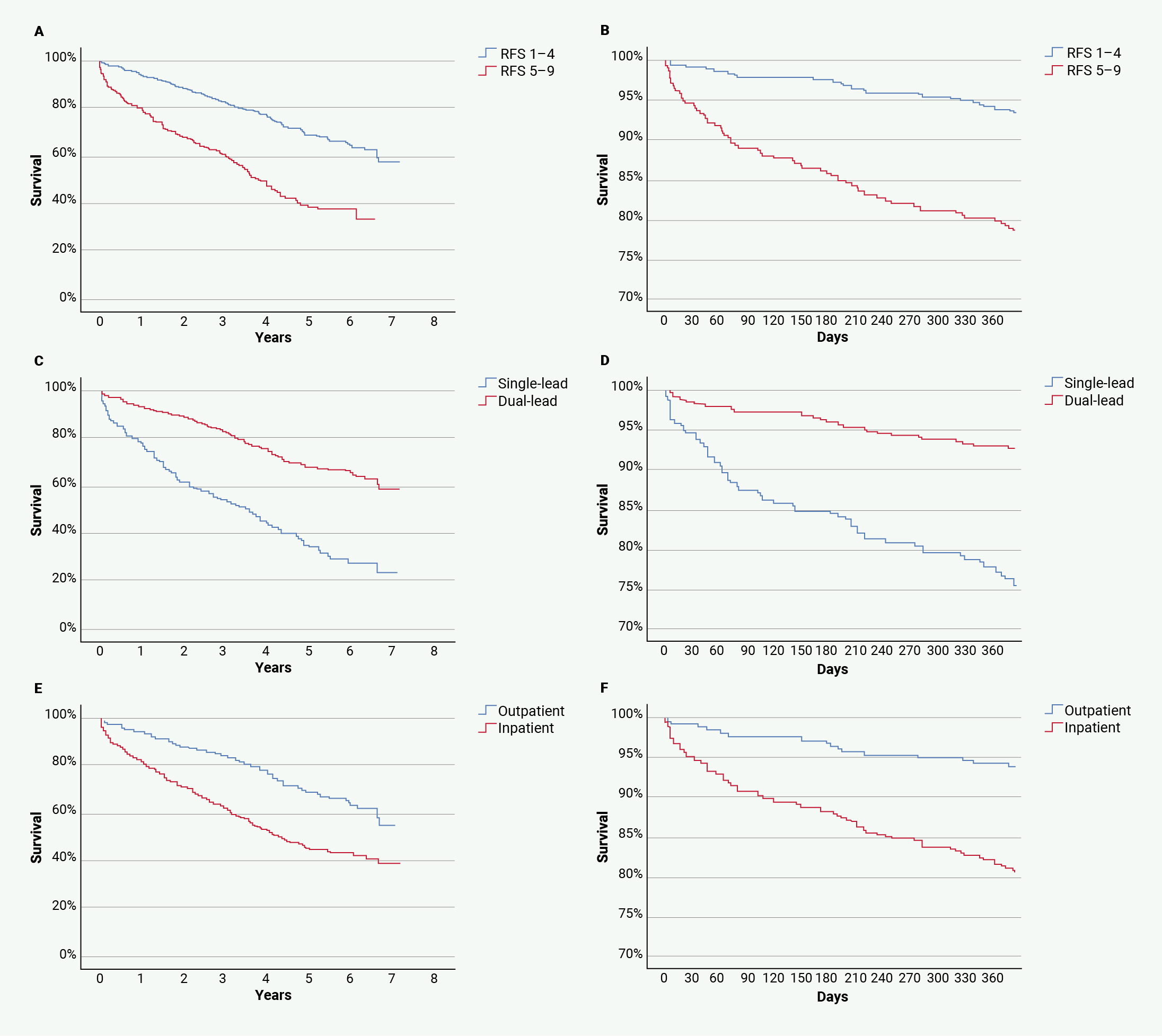
| Key: RFS = Rockwood frailty scale |
Interestingly, male gender was associated with increased mortality (HR 1.49, 95%CI 1.15 to 1.92, p=0.002). Subgroup analysis of these two groups showed there were not significant differences in age, overall RFS, or overall comorbidity burden between the two genders. There was a slightly higher incidence of ischaemic heart disease in male patients (28% vs. 21%, p=0.041). We noted excess male mortality in men under 80 years of age, men with higher RFS score and men who received an inpatient device implantation, which may explain the higher mortality in this gender, and may be a result of the sex–age convergence seen in cardiovascular disease.
Increasing age was associated with mortality and was assessed per 10 years (HR 1.75, 95%CI 1.46 to 2.09), such that for each decade the hazard for mortality increased by 75%.
Several comorbidities were also found to be associated with higher mortality, including valvular heart disease (HR 1.88, 95%CI 1.33 to 2.65, p<0.001), heart failure syndrome (HR 1.52, 95%CI 1.13 to 2.05, p=0.006), chronic kidney disease (HR 1.34, 95%CI 1.00 to 1.79, p=0.047), malignancy (HR 1.55, 95%CI 1.09 to 2.19, p=0.015) and obesity (HR 2.97, 95%CI 1.42 to 6.21, p=0.004). The multi-variate Cox-regression model HR findings for patient characteristics are summarised in the figure 2A Forest plot.
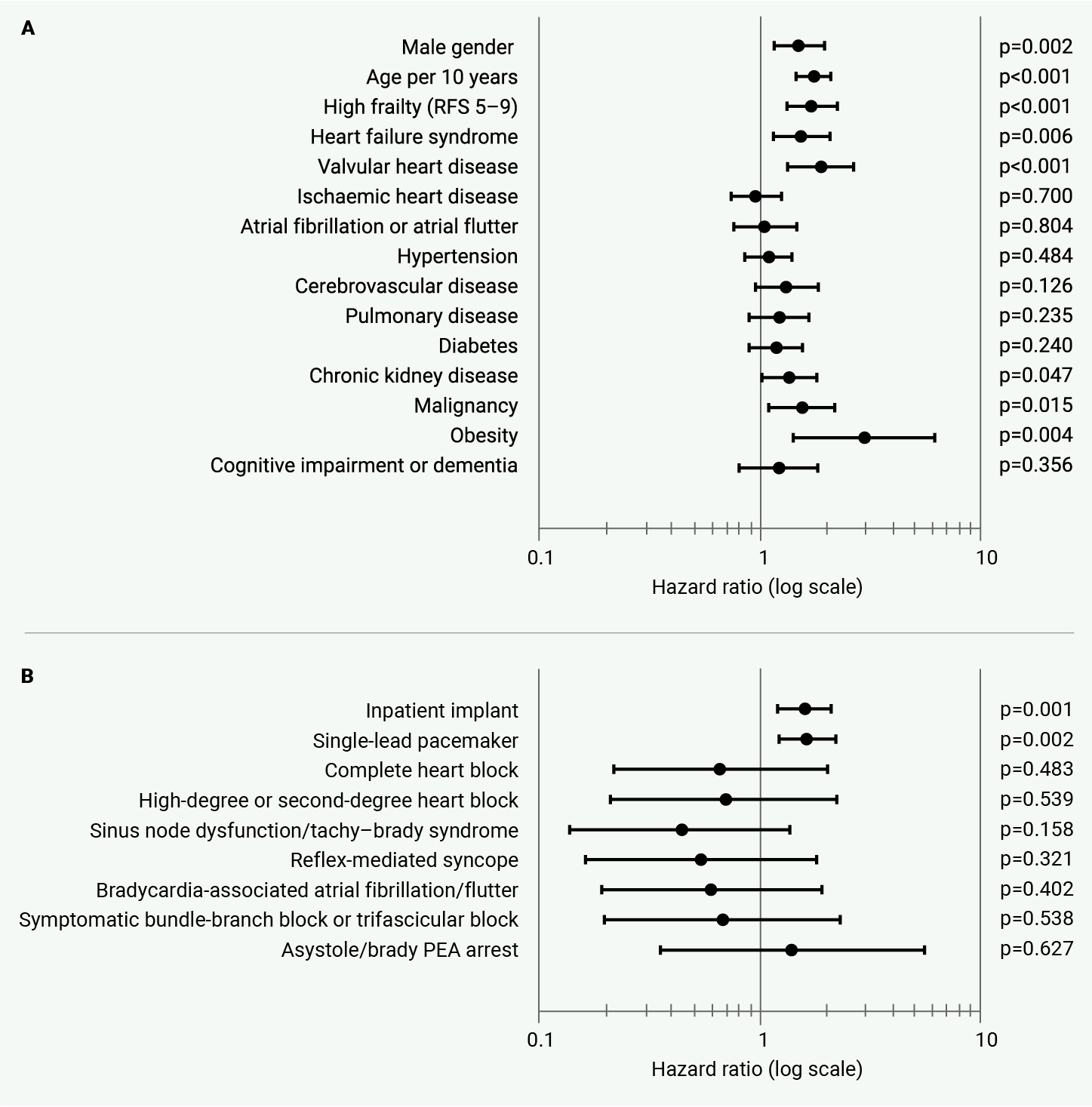
| Key: PEA = pulseless electrical activity; RFS = Rockwood frailty scale |
Calibration of the Cox-regression model at one-year follow-up showed age per 10 years (HR 1.65, 95%CI 1.18 to 2.31, p=0.004), valvular heart disease (HR 3.59, 95%CI 2.13 to 6.05, p<0.001) and high RFS, as mentioned above, were the only factors associated with mortality.
Implant-associated factors
Both inpatient implantation (HR 1.57, 95%CI 1.19 to 2.08, p=0.001) and single-lead device implantation (HR 1.63, 95%CI 1.20 to 2.21, p=0.002) were associated with mortality. Calibration at one year showed both of these factors remained important indicators for mortality (inpatient implantation HR 2.00, 95%CI 1.13 to 3.54, p=0.018; single-lead implantation HR 1.99, 95%CI 1.17 to 3.41, p=0.012). Kaplan-Meier curves in figure 1C-1F demonstrate these findings with early divergence of the curves.
Given the large difference between the single-lead and dual-lead device implantations, we conducted a subgroup analysis to assess why single-lead implantations had worse outcomes. Of 235 patients who received VVI implants, 77 (32.8%) patients had a conventional guideline-recognised indication for a DDD pacemaker implantation including sinus rhythm with complete heart block, high-degree atrioventricular block or sinus node dysfunction without atrial fibrillation (AF) being recorded as a comorbidity – the ‘unconventional VVI group’. The ‘unconventional VVI group’ had higher mortality than other VVI recipients (68.8% vs. 58.1%, p=0.068, not statistically significant, but with a trend towards significance) and included frailer patients (RFS 5.4 vs. 4.8, p=0.003) and more inpatient implants (80.5% vs. 61.9%, p=0.005). The pattern was consistent with an acute presentation of a frail patient having a pragmatic VVI implantation, hence, after adjustment, frailty and inpatient status explained the difference in mortality. When comparing both groups, they had a far worse mortality than DDD implantation (29.5%), which is suggestive of a class effect of having a VVI device rather than a specific penalty for inappropriate device selection that would result in atrioventricular desynchrony.
We assessed indication for implantation and did not find any association of implant indication with mortality at follow-up (figure 2B), however, when calibrating for one-year follow-up, asystole- or bradycardia-related pulseless electrical activity (PEA) indication was associated with increased mortality (HR 9.48, 95%CI 1.03 to 87.29, p=0.047). We found no association with implant, acute or longer-term device complication with mortality.
Discussion
Frailty emerged as a significant predictor of mortality in our study. Patients with mild or greater frailty, as assessed by the RFS, had a substantially higher risk of death within one year after device implantation.3 These findings underscore the importance of assessing frailty as part of the pre-implantation evaluation to identify high-risk patients who may require tailored care strategies and closer follow-up. Moreover, this introduces questions of whether any prognostic benefit obtained from pacing is offset in individuals with RFS of ≥4, or whether simple bradycardia pacing in these patients should be offered as symptomatic relief therapy or a form of palliation to allow hospital discharge, rather than prognosis-altering treatment. We used the RFS, which has been validated by Ritt et al., as a predictor of mortality after discharge from hospital.7
Inpatient implantation was identified as an independent risk factor for mortality in our study. Patients who underwent inpatient implantation had a significantly higher risk of death within the first year compared with those who underwent outpatient implantation. This finding may be attributed to the underlying acuity and severity of the patients’ conditions that necessitated inpatient procedures. Inpatient implantation often occurs in the context of acute cardiac events or exacerbation of underlying comorbidities, which may contribute to increased mortality rates. Additionally, most of these patients had secondary renal and cardiac impairment from acute hypoperfusion states or other sequelae from acute bradycardia in the form of fragility fractures.
One of the interesting findings of our study is the association between the specific indications for implantation and mortality, from non-implant-related causes. Patients with asystole or bradycardia-related PEA arrest were found to have a higher risk of mortality within the first year after device implantation. These findings are consistent with previous early studies that have demonstrated the adverse prognostic implications of complete heart block and arrhythmias, such as sinus arrest.1 Longer follow-up could differentiate further associations between implant indication and mortality.
Comorbidities also played a significant role in predicting mortality in our study. Several specific comorbid conditions, including heart failure syndrome, valvular heart disease, malignancy and obesity were associated with an increased risk of death. These findings highlight the impact of multi-morbidity on patient outcomes and the need for a holistic approach to patient care. Comprehensive pre-implantation assessment should consider comorbid conditions and their potential impact on prognosis, as these data can inform risk stratification and guide informed decision-making with the individual undergoing the procedure.
Albeit, this study is novel in identifying how frailty impacts outcomes in patients undergoing simple pacer device implantation, similar outcomes are noted in previous work. The retrospective examination of a province-wide database by Lee et al. demonstrated older age, peripheral vascular disease, pulmonary disease and renal disease were associated with death with implantable cardioverter-defibrillator implantation.8 Unsurprisingly, a greater number of non-cardiac comorbidities was associated with greater mortality.
Interestingly, our findings showed worse outcomes for VVI pacemaker implant, in contrast to the UKPACE (United Kingdom Pacing and Cardiovascular Events), CTOPP (Canadian Trial of Physiological Pacing) and PASE (Pacemaker Selection In The Elderly) trials, which showed no significant differences in pacing comparing DDD and VVI.9-11 These are older studies and pacemaker technology has improved significantly, such that there were similar findings of worse outcomes for VVI inpatient pacemaker implantation in nonagenarians with complete heart block.12
In the retrospective study by Edhag and Swahn, they demonstrated that patients with bradyarrhythmia device implantation for complete heart block or arrhythmic syncope did better than those who did not, even with multi-morbid states.1 However, the prognosis was worse for patients aged over 80 years.
Krzemień-Wolska et al. demonstrated that in DDD implantations, female gender was a positive prognostic indicator, which is similar to our findings, while comorbidities of diabetes requiring insulin (HR 2.83), CKD (HR 1.005) and age (HR 1.11) in females were associated with death.13 Their main finding was that a non-apical right ventricle (RV) lead implantation had a significant mortality reduction (18.9%), especially in the male group.
The prospective observational study by Blanco et al. demonstrated an increased all-cause mortality in patients presenting with acute coronary syndrome with an Edmonton frail scale (EFS) of 4–6 (HR 1.53, 95%CI 0.74 to 3.16) and EFS ≥7 (HR 3.60, 95%CI 1.70 to 7.63).14 A similar study by Sanchis et al. compared several geriatric indices and found the Green score (a frailty assessment score) was the strongest predictor of mortality, this was even stronger than the GRACE (Global Registry of Acute Coronary Events) score.15 Interestingly, Núñez et al. found that greater Fried score, another frailty score, was independently associated with mortality in elderly males, but not in females, with acute coronary syndrome.16
The 30-day patient admission analysis by Romero-Ortuno et al. demonstrated patients with greater CFS (HR 2.10, 95%CI 2.27 to 3.62 comparing CFS 1–4 with CFS 7–8) were associated with greater mortality independent of the acute illness severity.17 Interestingly, Charlson comorbidity index and dementia were independent predictors of survival time. Similarly, Juma et al. showed severe frailty was associated with longer lengths of stay and readmission to hospital, irrespective of reason for admission.18
In the survey conducted by Fumagalli et al., they recommended that an integrated multi-disciplinary approach was needed for the use of complex cardiac implantable electrical devices in frail patients.4 These patients had comorbidities including renal failure, dementia, disability, atrial fibrillation, heart failure, falls, and malignancy.
Limitations
It is important to acknowledge the limitations of our study. First, the retrospective nature of the study introduces inherent biases and limitations associated with data collection and availability. Second, the study was conducted at a single medium-sized centre, albeit with multiple senior implanters, which may limit the generalisability of the findings to other populations. Third, we did not examine or analyse pacing parameters in this cohort of patients. Furthermore, there may be unmeasured confounding factors that influence mortality outcomes, and the study’s sample size may have restricted the detection of certain associations.
Although all efforts were made to obtain a cause of death by contacting the responsible general practitioner, we were not able to obtain this for all patients. The authors did not feel it would be appropriate to contact family members to obtain this information. The latter part of the study overlapped with the Covid-19 pandemic; hence, patients were screened prior to implant. However, we acknowledge that deaths occurring in the community as a result of Covid-19 during the pandemic timeline may have not been captured.
Implications and clinical considerations
Despite the limitations of our study, we believe the findings of this study have important implications for clinical practice and patient management in the context of bradyarrhythmia cardiac device implants. Understanding the factors that influence mortality outcomes can guide healthcare professionals in risk stratification, and shared decision-making with patients and their relatives to optimise patient care.
The following implications and clinical considerations can be drawn from our study:
- Risk assessment: the study highlights the importance of comprehensive pre-implantation risk assessment. Factors, such as indications for implantation, rationale for inpatient implantation, RFS and comorbidities, should be carefully evaluated to identify patients who are less likely to benefit.
- Shared decision-making: the findings underscore the significance of shared decision-making in the implantation of cardiac pacing devices. Healthcare professionals should engage in thorough discussions with patients, considering the identified risk factors, potential benefits, and expected outcomes. Clear communication regarding the implications of indications, inpatient procedures, and comorbidities can help patients make informed decisions about device implantation.
- Multi-disciplinary approach: given the complexity of factors influencing mortality outcomes, a multi-disciplinary approach is essential in the care of patients with cardiac pacing device implants. Collaboration among cardiologists, geriatricians, and other relevant healthcare professionals can provide a comprehensive assessment of patients, incorporating diverse expertise. Multi-disciplinary team discussions can help identify high-risk patients, optimise management strategies, and develop individualised care plans.
- Future research directions: the study paves the way for further research in this field. Larger, multi-centre prospective studies are warranted to validate and expand upon these findings, allowing for more robust risk stratification models. In particular, it may be worthwhile re-investigating VVI and DDD pacemaker implantation to inform routine clinical decision-making.
Conclusion
In conclusion, this study provides valuable insights into the factors influencing mortality in patients with cardiac pacing device implantation that largely disrupt the perceived notion of its unchallenged prognostic benefit. The findings emphasise the significance of indications for implantation, inpatient implantation, frailty, and comorbidities in predicting mortality outcomes. Advanced frailty should not be seen as a reason to withhold treatment, but rather to highlight the need for a holistic and multi-disciplinary approach to optimise patient outcomes.19
Key messages
- Frailty is one of the strongest predictors of mortality after pacemaker implantation, while inpatient pacemaker implantation identifies a particularly high-risk group
- Mortality following pacemaker implantation is driven, not only by the underlying rhythm disorder, but also by the patient’s age, frailty, and burden of comorbid disease
- Clinical decision-making for pacemaker implant should focus on holistic patient assessment rather than rhythm correction alone
Conflicts of interest
None declared.
Funding
None.
Study approval
We adhered to the ethical principles of our institution and the Declaration of Helsinki. Consent was obtained for all clinical procedures, but additional consent for anonymised, retrospective case review was not required, in accordance with our Trust’s ethics board guidelines.
Editors’ note
Please also see the editorial by Joanne K Taylor from this issue at https://doi.org/10.5837/bjc.2026.051.
References
1. Edhag O, Swahn A. Prognosis of patients with complete heart block or arrhythmic syncope who were not treated with artificial pacemakers. A long-term follow-up study of 101 patients. Acta Med Scand 1976;200:457–63. https://doi.org/10.1111/j.0954-6820.1976.tb08264.x
2. Ferrer MI. The sick sinus syndrome. Circulation 1973;47:635–41. https://doi.org/10.1161/01.CIR.47.3.635
3. Rockwood K, Song X, MacKnight C et al. A global clinical measure of fitness and frailty in elderly people. CMAJ 2005;173:489–95. https://doi.org/10.1503/cmaj.050051
4. Fumagalli S, Potpara TS, Bjerregaard Larsen T et al. Frailty syndrome: an emerging clinical problem in the everyday management of clinical arrhythmias. The results of the European Heart Rhythm Association survey. Europace 2017;19:1896–902. https://doi.org/10.1093/europace/eux288
5. Richter D, Guasti L, Walker D et al. Frailty in cardiology: definition, assessment and clinical implications for general cardiology. A consensus document of the Council for Cardiology Practice (CCP), Association for Acute Cardio Vascular Care (ACVC), Association of Cardiovascular Nursing and Allied Professions (ACNAP), European Association of Preventive Cardiology (EAPC), European Heart Rhythm Association (EHRA), Council on Valvular Heart Diseases (VHD), Council on Hypertension (CHT), Council of Cardio-Oncology (CCO), Working Group (WG) Aorta and Peripheral Vascular Diseases, WG e-Cardiology, WG Thrombosis, of the European Society of Cardiology, European Primary Care Cardiology Society (EPCCS). Eur J Prev Cardiol 2022;29:216–27. https://doi.org/10.1093/eurjpc/zwaa167
6. Savelieva I, Fumagalli S, Kenny RA et al. EHRA expert consensus document on the management of arrhythmias in frailty syndrome, endorsed by the Heart Rhythm Society (HRS), Asia Pacific Heart Rhythm Society (APHRS), Latin America Heart Rhythm Society (LAHRS), and Cardiac Arrhythmia Society of Southern Africa (CASSA). Europace 2023;25:1249–76. https://doi.org/10.1093/europace/euac123
7. Ritt M, Schwarz C, Kronawitter V et al. Analysis of Rockwood et al’s Clinical Frailty Scale and Fried et al’s frailty phenotype as predictors of mortality and other clinical outcomes in older patients who were admitted to a geriatric ward. J Nutr Health Aging 2015;19:1043–8. https://doi.org/10.1007/s12603-015-0667-9
8. Lee DS, Tu JV, Austin PC et al. Effect of cardiac and noncardiac conditions on survival after defibrillator implantation. J Am Coll Cardiol 2007;49:2408–15. https://doi.org/10.1016/j.jacc.2007.02.058
9. Toff WD, Camm AJ, Skehan JD. Single-chamber versus dual-chamber pacing for high-grade atrioventricular block. N Engl J Med 2005;353:145–55. https://doi.org/10.1056/NEJMoa042283
10. Lamas GA, Lee KL, Sweeney MO et al. Ventricular pacing or dual-chamber pacing for sinus-node dysfunction. N Engl J Med 2002;346:1854–62. https://doi.org/10.1056/NEJMoa013040
11. Lamas GA, Orav EJ, Stambler BS et al. Quality of life and clinical outcomes in elderly patients treated with ventricular pacing as compared with dual-chamber pacing. N Engl J Med 1998;338:1097–104. https://doi.org/10.1056/NEJM199804163381602
12. Maclean E, Mahtani K, Parker M et al. Emergency pacemaker implantation in nonagenarians with CHB: single- versus dual-chamber pacing. Br J Cardiol 2024;31:024. https://doi.org/10.5837/bjc.2024.024
13. Krzemień-Wolska K, Tomasik A, Nowalany-Kozielska E, Jacheć W. Prognosis of patients with implanted pacemakers in 4‑year follow-up: impact of right ventricular pacing site. Herz 2018;43:315–24. https://doi.org/10.1007/s00059-017-4561-6
14. Blanco S, Ferrières J, Bongard V et al. Prognosis impact of frailty assessed by the Edmonton frail scale in the setting of acute coronary syndrome in the elderly. Can J Cardiol 2017;33:933–9. https://doi.org/10.1016/j.cjca.2017.03.026
15. Sanchis J, Bonanad C, Ruiz V et al. Frailty and other geriatric conditions for risk stratification of older patients with acute coronary syndrome. Am Heart J 2014;168:784.e2–791.e2. https://doi.org/10.1016/j.ahj.2014.07.022
16. Núñez J, Palau P, Sastre C et al. Sex-differential effect of frailty on long-term mortality in elderly patients after an acute coronary syndrome. Int J Cardiol 2020;302:30–3. https://doi.org/10.1016/j.ijcard.2019.12.068
17. Romero-Ortuno R, Wallis S, Biram R, Keevil V. Clinical frailty adds to acute illness severity in predicting mortality in hospitalized older adults: an observational study. Eur J Intern Med 2016;35:24–34. https://doi.org/10.1016/j.ejim.2016.08.033
18. Juma S, Taabazuing M-M, Montero-Odasso M. Clinical frailty scale in an acute medicine unit: a simple tool that predicts length of stay. Can Geriatr J 2016;19:34–9. https://doi.org/10.5770/cgj.19.196
19. Afilalo J, Alexander KP, Mack MJ et al. Frailty assessment in the cardiovascular care of older adults. J Am Coll Cardiol 2014;63:747–62. https://doi.org/10.1016/j.jacc.2013.09.070


