

Iron deficiency (ID) is common in patients with heart failure (HF) and is independently associated with poor outcomes, such as reduced functional capacity and quality of life, increased frailty and increased risk of HF hospitalisations and mortality. Intravenous iron has been shown to be an effective and well-tolerated therapy in patients with HF with reduced and mildly reduced ejection fraction and ID, improving quality of life and functional status and reducing the risk of HF hospitalisations. This review aims to summarise the evidence behind intravenous iron therapy in HF from recent key randomised-controlled trials. This review will also discuss the evidence for intravenous iron therapy in patients with HF with preserved ejection fraction. Ultimately, we also aim to review remaining uncertainties, such as sex-specific differences in outcomes, the optimal iron repletion and maintenance strategies, and the most accurate measures of ID in HF.
Introduction
Heart failure (HF) is a clinical syndrome characterised by signs and symptoms that result from reduced cardiac output and/or elevated cardiac pressures. The European Society of Cardiology (ESC) classifies HF by left ventricular (LV) ejection fraction (EF) into reduced (HFrEF; LVEF <40%), mildly reduced (HFmrEF; LVEF 41–49%) and preserved (HFpEF; LVEF ≥50%).1
Iron is an essential micronutrient involved in systemic oxygen delivery and utilisation. Iron deficiency (ID) can either result from depleted iron stores (absolute ID) or impaired iron usage despite normal stores (functional ID) and can exist in the absence of anaemia. In patients with HF, absolute ID may occur due to malabsorption, malnutrition or gastrointestinal blood loss secondary to use of anticoagulants or non-steroidal anti-inflammatory drugs (NSAIDs). On the other hand, functional ID occurs due to chronic systemic inflammation associated with HF, which increases hepcidin production by the liver, leading to impaired iron mobilisation from storage sites.2 Furthermore, pre-existing comorbidities, such as renal dysfunction, may also contribute to ID in HF patients. Figure 1 summarises some of the mechanisms behind ID in patients with HF.
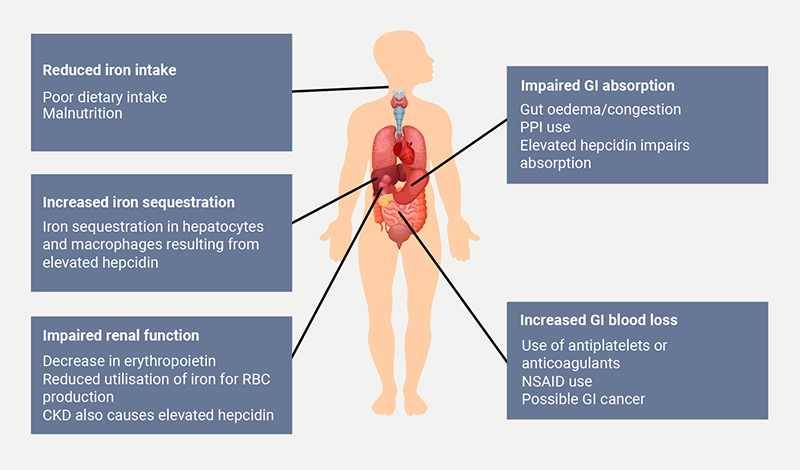
| Key: CKD = chronic kidney disease; GI = gastrointestinal; NSAID = non-steroidal anti-inflammatory drug; PPI = proton-pump inhibitors; RBC = red blood cells Originally created in Biorender.com |
ID is present in around half of HF patients,3,4 and in up to 80% of those admitted to hospital with decompensated HF.5 ID not only impairs erythropoiesis,6 predisposing to anaemia, but also limits the availability of iron for proteins essential to cellular processes, such as oxygen storage and oxidative energy metabolism. ID is independently associated with reduced functional capacity and quality of life, frailty, skeletal muscle dysfunction and an increased risk of HF hospitalisations and mortality.3
In patients with HF, ID is defined, as per ESC guidelines, as either a serum ferritin concentration of <100 ng/ml or 100–299 ng/ml with a transferrin saturation (TSAT) of <20%.1 This definition of ID was first proposed in the FAIR-HF (Ferinject Assessment in Patients with Iron Deficiency and Chronic Heart Failure) trial,7 and has since been widely adopted in subsequent intravenous (IV) iron studies.
In recent years, several large randomised-controlled trials (RCTs) have demonstrated that IV iron therapy is well tolerated, leads to an improved quality of life and functional status, and reduces HF hospitalisations in patients with HFrEF or HFmrEF and ID.7–13 Current guidelines, therefore, recommend routine iron screening and correction in patients with HFrEF and HFmrEF, with a class I recommendation for improving quality of life and a class IIa recommendation for reducing the risk of HF hospitalisation.1 Despite this, real-world studies have found poor implementation of iron screening and treatment in clinical practice.14 This review will summarise key findings from clinical trials of iron therapy in HF and explore remaining uncertainties, including sex-specific differences in outcomes, optimal iron repletion and maintenance strategies, the role of iron in HFpEF and the most accurate measures of ID in HF.
IV iron therapy in HFrEF and HFmrEF
Since 2009, several well-conducted RCTs have evaluated IV iron therapy in patients with HFrEF and ID (figure 2). The FAIR-HF trial7 was the first RCT to evaluate IV iron therapy in HFrEF. The study demonstrated that ferric carboxymaltose (FCM) improved patient self-reported global assessment scores (odds ratio [OR] 2.51, 95% confidence interval [CI] 1.75 to 3.61), HF symptoms assessed using New York Heart Association (NYHA) class (OR 2.40, 95%CI 1.55 to 3.71), and quality of life assessed via Kansas City Cardiomyopathy Questionnaire (KCCQ) (mean difference [MD] 7 ± 2, p<0.001) and European Quality of life Five Dimensions (EQ-5D) (MD 7 ± 2, p<0.001) over a 24-week period in patients with EF ≤45% and ID, regardless of anaemia status. Improvements were also seen in six-minute walk distance (6MWD).
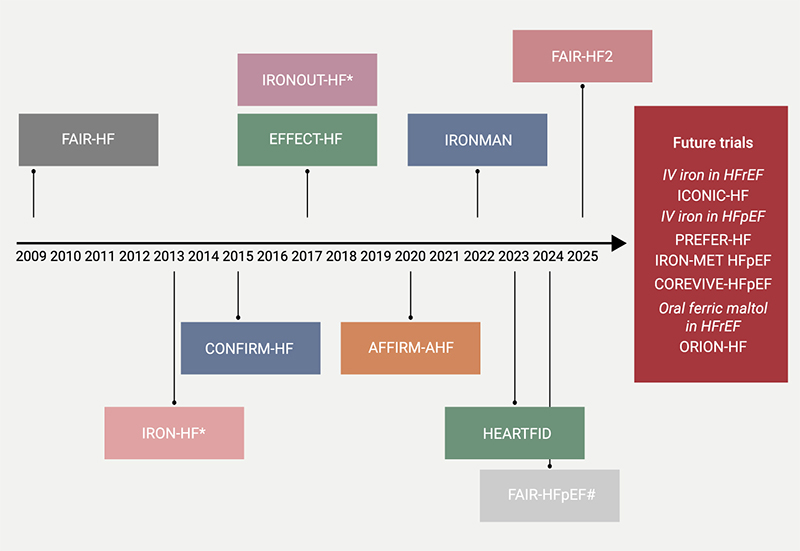
| * Denotes trials of oral iron therapy in HFrEF # Denotes trials of IV iron therapy in HFpEF Key: HFpEF = heart failure with preserved ejection fraction; HFrEF = heart failure with reduced ejection fraction; IV = intravenous Originally created in Biorender.com |
These findings were replicated in the CONFIRM-HF (Ferric Carboxymaltose Evaluation on Performance in Patients with Iron Deficiency in Chronic Heart Failure) RCT,9 where IV FCM increased 6MWD compared with placebo in patients with LVEF ≤45% at 24 weeks (MD 33 ± 11 m, p=0.002), with sustained improvement up to 52 weeks (MD 36 ± 11 m, p<0.001). Secondary analyses also demonstrated improvements in NYHA class, quality of life and fatigue score, as well as reduced time to hospitalisation for worsening HF (hazard ratio [HR] 0.39, 95%CI 0.19 to 0.82, p=0.009) with IV iron. Collectively, these studies established that IV iron improves exercise capacity, alleviates HF symptoms and improves quality of life, while potentially reducing hospitalisation risk in patients with HFrEF and HFmrEF.
Subsequently, larger outcome-driven trials aimed to assess the effect of iron therapy on definitive, event-driven clinical end points. AFFIRM-AHF (A Randomized, Double-blind, Placebo-controlled Trial Comparing the Effect of Intravenous Ferric Carboxymaltose on Hospitalizations and Mortality in Iron Deficient Subjects Admitted for Acute Heart Failure)11 was the first to examine IV iron in the acute HF setting. FCM administered before discharge in iron-deficient patients reduced subsequent HF hospitalisations (risk ratio [RR] 0.74, 95%CI 0.58 to 0.95, p=0.013), but the primary end point (composite of total HF hospitalisation and cardiovascular [CV] death) approached, but did not achieve, statistical significance (RR 0.79, 95%CI 0.62 to 1.01, p=0.059). Notably, AFFIRM-AHF recruited patients with LVEF ≤50%, differing from other trials and providing evidence for all patients with HFmrEF. Subgroup analysis comparing HFrEF (EF ≤40%) with HFmrEF (EF 41–49%) patients found no significant interaction based on EF category. Further subgroup analyses demonstrated treatment heterogeneity with HF aetiology; with a reduction in HF hospitalisation and CV death in those with ischaemic cardiomyopathy (RR 0.60, 95%CI 0.43 to 0.84), but not in non-ischaemic cardiomyopathy (RR 1.11, 95%CI 0.77 to 1.6). Furthermore, there was a trend towards a larger treatment effect in men compared with women, although this difference did not reach statistical significance.
IRONMAN (Randomised Trial of Intravenous Iron in Heart Failure with Reduced Ejection Fraction)13 assessed another form of IV iron, ferric derisomaltose, in a RCT with the longest follow-up out of all the studies to date (median 2.7 years). Although the trial demonstrated an 18% relative risk reduction in CV death or HF hospitalisation in the IV iron group, the result did not reach statistical significance (p=0.07). However, in a pre-specified sensitivity analysis, excluding patients enrolled during the COVID-19 period, the benefit became statistically significant (HR 0.76, 95%CI 0.58 to 1.00, p=0.047). It is important to note that IRONMAN used a different definition of ID compared with other trials: TSAT <20% or serum ferritin <100 ng/ml, with patients with a ferritin >400 ng/ml being excluded. Consequently, this trial studied a slightly broader population of patients by including those with ferritin 300–399 ng/ml and low TSAT, who would not have met eligibility criteria in prior trials. Subgroup analysis for this cohort, however, was not presented.
The most recent trial is FAIR-HF2 (Ferric Carboxymaltose Assessment of Morbidity and Mortality in Patients with Iron Deficiency and Chronic Heart Failure),8 which enrolled 1,105 patients with HFrEF with an EF ≤45% and ID across 70 European sites. Iron repletion and maintenance differed from previous trials: patients received an initial dose of either 1 or 2 g (differing from previous trials which capped doses at 1 g) followed by proactive maintenance dosing of 500 mg every four months, regardless of iron status. The trial had three co-primary end points: time to first HF hospitalisation or CV death; total HF hospitalisations; and time to first HF hospitalisation or CV death in patients with TSAT ≤20%. Although the first end point reached statistical significance (HR 0.79, 95%CI 0.63 to 0.99, p=0.04), the other two did not, and, hence, the overall result was considered nonsignificant. As the outcomes in FAIR-HF2 mirrored those of earlier trials that re-dosed only when ID recurred, this suggests that routine maintenance therapy may not be necessary; instead, re-dosing can be guided by laboratory measures of iron status. Notably, there was no treatment benefit observed in women, once again raising important questions about sex-based differences in iron handling and HF pathophysiology.
HEART-FID (Heart Failure Patients With Iron Deficiency Treated With Ferric Carboxymaltose) was a US-based RCT, which enrolled 3,000 patients with HFrEF and ID, making it the largest study to date in this field. Unlike previous studies, the HEART-FID trial12 did not demonstrate a statistically significant difference in the rate of HF hospitalisation with FCM compared with placebo at one year, although there were modest improvements in functional capacity. Several factors may explain this result: HEART-FID recruited stable, ambulatory HF patients, unlike prior trials that enrolled higher-risk HF populations, e.g. AFFIRM-AHF where patients had recent HF hospitalisation and IRONMAN where 15% were enrolled while hospitalised. This lower-risk population was demonstrated by a lower number of events in the placebo group (17.3 hospitalisation or CV death per 100 patient-years in HEART-FID vs. 47.1 in AFFIRM-AHF). This lower number of events decreases statistical power, making it harder to demonstrate a significant treatment effect. Patients were also younger, fewer were in NYHA class III or IV, and a lower proportion of patients had a baseline TSAT <20% compared with other studies (42% in the control group in HEART-FID, 60% in the control group in CONFIRM-HF and 82% in the control group in AFFIRM-HF). The trial may also have been affected by the COVID-19 pandemic, as was observed in the IRONMAN trial.
The latest meta-analysis of the six IV iron RCTs to date,15 found a reduction in the primary composite end point of total HF hospitalisations and CV mortality (RR 0.72, 95%CI 0.55 to 0.89, p=0.007) at one year, and at complete length of follow-up. Benefits tended to be greater in the first year of therapy, possibly due to subsequent underdosing of maintenance iron therapy. There was a trend towards lower rates of CV (HR 0.80, 95%CI 0.61 to 1.03, p=0.073) and all-cause mortality (HR 0.83, 95%CI 0.69 to 1.01, p=0.060) in the IV iron group, however, both results were not significant. IV iron was noted to reduce hospitalisation and CV death in men (RR 0.76, 95%CI 0.56 to 0.95) but not women (RR 0.98, 95%CI 0.75 to 1.26), although this finding was not consistently replicated across all trials. Subgroup analyses of this outcome found no significant treatment interactions when patients were categorised based on age, ischaemic versus non-ischaemia aetiology, NYHA class, or TSAT value <20%, although there appeared to be a trend to lower rates based on TSAT <20% versus in patients with a TSAT ≥20%.
However, subgroup analyses in this meta-analysis were based on trial-level data, meaning they could not adjust for other covariates and are, hence, susceptible to confounding. In contrast, a meta-analysis by Ponikowski et al.16 was able to perform subgroup analysis based on individual patient data for studies looking at FCM, and found that patients in the lowest TSAT tertile (<15%) experienced a greater reduction in total CV hospitalisations and CV death compared with those with a higher baseline TSAT. Moreover, Cleland et al.17 analysed the IRONMAN trial and found, in exploratory analyses, that patients with TSAT <20% and ferritin >100 µg/L appeared to derive greater benefit from IV ferric derisomaltose, although these were not statistically significant and were described as hypothesis generating.
In summary, IV iron improves symptoms and functional status, and overall has been shown to reduce HF-related hospitalisations. Further research is needed on sex-specific differences, optimal measures of ID, as well as the optimal strategy of iron maintenance post-repletion.
Table 1. Summary of the main randomised-controlled trials of intravenous iron therapy in heart failure with reduced and mildly reduced ejection fraction
| Trial | Year | N | EF cut-off | Initial dose of iron | Maintenance dose | Median follow-up | Primary outcome | Primary outcome result | Key secondary outcomes | Key secondary outcome result |
| FAIR-HF7 | 2009 | 459 | ≤45% | 200 mg FCM weekly until repletion | 200 mg per month as needed | 24 weeks | PGA | ↑ PGA | Change in 6MWD, and QoL by KCCQ and EQ5D | ↑ 6MWD, ↑ KCCQ, ↑ EQ5D |
| CONFIRM-HF9 | 2015 | 304 | ≤45% | Up to 1 g of FCM (15 mg/kg) |
Up to 1 g at 6, 12, 24, 36 weeks as needed | 1 year | Change in 6MWT | ↑ 6MWD | NYHA class, QoL, time to HF hospitalisation | ↓ HF hospitalisation, ↑ NYHA class, ↑ QoL |
| EFFECT‑HF10 | 2017 | 172 | ≤45% | Up to 1 g (15 mg/kg) of FCM |
Up to 1 g at 12 and 24 weeks as needed | 24 weeks | Change in VO2 | ↑ peak VO2 | NYHA class, PGA | ↑ PGA and ↑ NYHA class |
| AFFIRM-AHF11 | 2020 | 1,132 | <50% | 1 g of FCM | 1 g of FCM at 6, 12, 24 weeks as needed | 1 year | Composite of HF hospitalisation and CV death | Nonsignificant ↓ HF hospitalisation or CV death | Composite of CV hospitalisation or CV death, CV death, HF hospitalisation, time to HF hospitalisation or CV death | No difference in CV death, significant ↓ HF hospitalisation |
| IRONMAN13* | 2022 | 1,137 | ≤45% | 1 g of FDM | 1 g of FDM every 4 months as needed | 2.7 years | Composite of HF hospitalisation and CV death | Nonsignificant ↓ HF hospitalisation or CV death | HF hospitalisation, CV death, all-cause mortality. Primary and secondary outcomes with COVID-19 sensitivity analysis | Overall HF hospitalisation nonsignificant ↓ COVID-19 sensitivity analysis: primary outcome significant ↓, HF hospitalisation nonsignificant ↓ |
| HEART-FID12 | 2023 | 3,065 | ≤40% | 1 g of FCM | 1 g at 6 and 12 months as needed | 12 months | Hierarchical composite of death, HF hospitalisation or change in 6MWD | No difference in primary outcome | Composite of CV death or HF hospitalisation, each of the composite of primary outcomes | No ↓ HF hospitalisation or mortality or HF hospitalisation |
| FAIR-HF28 | 2025 | 1,105 | ≤45% | Either 1 g or 2 g of FCM | 500 mg every 4 months§ | 16.6 months | 1. Time to first HF hospitalisation or CV death 2. Total HF hospitalisation 3. Time to first HF hospitalisation or CV death in patients with TSAT ≤20% |
1. Significant ↓ 2. Nonsignificant ↓ 3. Nonsignificant ↓ |
Safety end points | No difference in adverse events |
| * IRONMAN used a slightly different definition of iron deficiency in recruitment. § FAIR-HF2 maintenance was given routinely – not based on if patients became iron deficient again. Key: 6MWT = six-minute walk test; CV = cardiovascular; EF = ejection fraction; FCM = ferric carboxymaltose; FDM = ferric decarboxymaltose; HF = heart failure; HR = hazard ratio; MD = mean difference; NYHA = New York Heart Association; OR = odds ratio; PGA = patient global assessment; QoL = quality of life; TSAT = transferrin saturation; VO2 = peak oxygen |
||||||||||
Oral iron therapy in HFrEF
Due to the relative expense and logistical challenges in administering IV iron, oral iron has also been studied in ID and HF. Two RCTs have investigated the effect of oral iron in patients with HFrEF: IRON-HF (Randomized Trial to Assess the Effects of Iron in Heart Failure Patients with Anaemia)18 and IRONOUT-HF (Iron Repletion Effects on Oxygen Uptake in Heart Failure).19
IRON-HF18 compared the effects of IV iron (iron sucrose 200 mg once weekly for five weeks), oral iron (ferrous sulfate 200 mg three times daily for eight weeks) and placebo on exercise capacity in HF patients with LVEF <40%, anaemia (Hb 9–12 g/dL) and TSAT <20% with ferritin <500 µg/L. Although ferritin and TSAT levels increased in both IV and oral iron groups, the increment in peak VO2 was only seen in the IV iron group and not the oral iron group.
IRONOUT19 evaluated the impact of oral iron polysaccharide (150 mg twice daily for 16 weeks) compared with placebo on exercise capacity in HF patients with EF <40% and ID. While oral iron improved indices of ID, it did not improve peak VO2 at 16 weeks, 6MWD, natriuretic peptide levels or quality of life compared with placebo.
Current evidence, therefore, does not support the use of oral iron in patients with HFrEF and ID.1 Clinically, several factors may limit the use of oral iron in this population. First, oral iron is poorly tolerated in HF patients, with gastrointestinal side effects occurring in up to 60% of patients.20 Second, HF patients also have high hepcidin levels, which limits iron absorption and utilisation from the gastrointestinal tract. In patients with HF, oral absorption of iron may be so slow that it is readily sequestered in hepatocytes or macrophages by the heightened action of hepcidin, limiting its delivery to target sites.
Novel formalisations of oral iron, such as ferric maltol, are being investigated in trials, such as ORION HF (NCT05697211), which is currently recruiting and will investigate its effects on functional capacity and quality of life, as well as repletion of iron stores in HFrEF. Ferric maltol has been shown to reliably increase haemoglobin levels and iron values, while having fewer gastrointestinal related side effects and lower discontinuation rates compared with traditional ferrous iron. Moreover, its effectiveness has also been demonstrated in chronic disease states, such as inflammatory bowel disease and chronic kidney disease,21 which like HF, are characterised by high levels of hepcidin.
IV iron therapy in HFpEF
While the evidence for IV iron therapy in HFrEF and HFmrEF is well established, its role in HFpEF is less clear. Studies have shown ID is as common in HFpEF as in other forms of HF, and similarly associated with poor functional outcomes and quality of life.22
The only published RCT in this area is FAIR-HFpEF (Ferinject Assessment in Patients with Iron Deficiency and Heart Failure with Preserved Ejection Fraction).23 FAIR-HFpEF found a significantly greater increase in 6MWD in patients with HFpEF randomised to FCM compared with placebo at 24 weeks (MD 49 m, 95%CI 5 to 93, p=0.029). The difference at 32 weeks appeared larger than the one observed in the FAIR-HF7 trial (MD 35 ± 8 m), but did not persist at one-year follow-up (treatment effect MD 13 ± 23 m, p=0.57). The authors suggest this may be due to underdosing of maintenance iron therapy, but could also have been due to a weaning effect over time. There were also no significant differences in quality-of-life measures between the groups. However, it is important to note that this was a considerably underpowered study, with only 39 of the planned 200 patients recruited, due to slow recruitment and early study termination. As a result, the findings may be subject to type 2 error. There was, however, a potential early signal that CV hospitalisations may be reduced by repletion of ID in HFpEF. However, as the study was not powered to assess this outcome, these findings should be interpreted with caution and require confirmation in larger, adequately powered RCTs. To date, three RCTs in HFpEF and ID are either currently recruiting or have been completed but remain unpublished: PREFER-HF (NCT03833336), IRON-MET HFpEF (NCT04945707) and COREVIVE-HFpEF (NCT05991128). These studies are expected to provide further insight into the role of IV iron in HFpEF.
Optimal measures of ID in HF
Ferritin and TSAT are commonly used blood markers for assessing iron status. Ferritin is an intracellular protein that stores iron, and is released by iron-storing tissues, so serum ferritin concentration reflects the body’s iron reserves. In contrast, TSAT indicates the proportion of transferrin bound to iron and serves as a marker of circulating iron available for cellular metabolism. Current ESC guidelines define ID in HF using either a serum ferritin concentration of <100 ng/ml (absolute ID) or 100–299 ng/ml with a TSAT <20% (functional ID).1 However, its applicability and accuracy in patients with HF has been criticised.24 This dual-parameter definition was originally developed to guide iron therapy for patients with chronic kidney disease (CKD).25
Traditionally, a serum ferritin of <15–20 µg/L is used to define absolute ID. However, as ferritin is an acute phase protein, its levels can be elevated in chronic inflammatory conditions, such as HF and CKD. To account for this, the diagnostic threshold for ID was, therefore, increased five- to 15-fold arbitrarily, to its current definition in HF. However, this was not based on findings from bone marrow iron examinations, the gold-standard measure of ID. One study of bone marrow iron stores in patients with HF26 demonstrated that patients with a serum ferritin level <100 µg/L and TSAT >20% do not have iron depletion, while those with TSAT <20% have iron depletion regardless of ferritin level; questioning the diagnostic value of the current definition of ID. Among 19 serum markers used in the assessment of ID, including haemoglobin, mean corpuscular volume, iron, hepcidin, soluble transferrin receptor (sTfR) etc., TSAT <19.8% and serum iron ≤13 µmol/L demonstrated the greatest diagnostic accuracy (sensitivity 94%, specificity 84–88%) in identifying bone marrow ID, outperforming the current definition of ID (sensitivity 82%, specificity 72%). Both TSAT ≤19.8% and serum iron ≤13 µmol/L, but not ferritin, were independent predictors of mortality and were associated with positive responses to IV iron compared with those with low ferritin but TSAT >19.8% or those with serum iron >13 µmol/L. A recently published secondary analysis of HEART-FID (Heart Failure Patients With Iron Deficiency Treated With Ferric Carboxymaltose)27 also found similar conclusions. Serum iron concentrations, however, can exhibit large diurnal variations, and some question its suitability for assessment of iron status as a standalone marker.28
In a meta-analysis of 10 RCTs studying IV iron in HF,29 patients with TSAT <20% appeared to experience a greater reduction in combined total HF hospitalisation and CV death (OR 0.67, 95%CI 0.49 to 0.92) after IV iron compared with those with TSAT >20% (OR 0.99, 95%CI 0.74 to 1.30), although the test for heterogeneity was not statistically significant (p=0.07). This finding was also noted in the 2023 meta-analysis by Ponikowski et al.,16 but was not replicated in the most recent meta-analysis,15 however, there was a trend towards a greater effect in TSAT <20% (RR 0.77, 95%CI 0.6 to 0.94) versus TSAT ≥20% (RR 0.96, 95%CI 0.72 to 1.26), although this was not significant (relative risk reduction 0.85, 95%CI 0.61 to 1.16).
In conclusion, while TSAT <20% appears to more reliably demonstrate ID on bone marrow examination, its ability to predict improvement in definitive clinical outcomes following IV iron therapy remains variable. Whether it alone could serve as a more reliable alternative to the current ferritin-centred definition of ID for HF patients still requires validation through further research. The ongoing ICONIC-HF trial (NT06929806), which has defined ID solely as TSAT <20%, aims to shed further light on this.
Markers obtained from full blood count, such as mean corpuscular volume or haemoglobin, have been shown to be unreliable markers of ID in HF.30 Soluble transferrin receptor (sTfR) has been proposed as a useful biomarker for ID, with serum levels increasing when iron stores are depleted, and high levels reflecting depleted iron stores in bone marrow and predicting elevated three-year mortality in HF patients.31 However, sTfR assays are not well standardised or routinely available clinically. Further research is needed to assess the prognostic significance of sTfR in comparison with other iron biomarkers, as well as their respective responses to iron therapy.
Whichever measure of ID prevails as the most reliable, it is important to recognise iron status in HF patients is dynamic32 and requires regular assessment. Graham et al.32 noted that both incident and resolving ID are common at one year, and carry prognostic significance.
Conclusion
In summary, IV iron therapy improves quality of life and functional capacity, and reduces HF hospitalisations in patients with HFrEF or HFmrEF and ID. Future research is needed to clarify its use in female HF patients and those with HFpEF, the optimal dosing strategies in maintenance of iron repletion, and how to most accurately diagnose ID in HF.
Key messages
- Iron deficiency is prevalent in patients with heart failure and is associated with poor outcomes
- Intravenous iron has been established as a well-tolerated, cost-effective therapy that improves quality of life, functional status and reduces heart failure hospitalisations in patients with heart failure with reduced or mildly reduced ejection fraction and iron deficiency
- The role of intravenous iron is being studied in patients with heart failure with preserved ejection
- Further research is needed to explore sex-specific differences in outcomes, the optimal iron repletion and maintenance strategies, and the most accurate definition of iron deficiency in heart failure
Conflicts of interest
None declared.
Funding
None.
References
1. McDonagh TA, Metra M, Adamo M et al.; ESC Scientific Document Group. 2023 focused update of the 2021 ESC guidelines for the diagnosis and treatment of acute and chronic heart failure. Eur Heart J 2023;44:3627–39. https://doi.org/10.1093/eurheartj/ehad195
2. Packer M, Anker SD, Butler J et al. Identification of three mechanistic pathways for iron-deficient heart failure. Eur Heart J 2024;45:2281–93. https://doi.org/10.1093/eurheartj/ehae284
3. Klip IT, Comin-Colet J, Voors AA et al. Iron deficiency in chronic heart failure: an international pooled analysis. Am Heart J 2013;165:575.e3–582.e3. https://doi.org/10.1016/j.ahj.2013.01.017
4. Becher PM, Schrage B, Benson L et al. Phenotyping heart failure patients for iron deficiency and use of intravenous iron therapy: data from the Swedish Heart Failure Registry. Eur J Heart Fail 2021;23:1844–54. https://doi.org/10.1002/ejhf.2338
5. Cohen-Solal A, Damy T, Terbah M et al. High prevalence of iron deficiency in patients with acute decompensated heart failure. Eur J Heart Fail 2014;16:984–91. https://doi.org/10.1002/ejhf.139
6. Beard JL. Iron biology in immune function, muscle metabolism and neuronal functioning. J Nutr 2001;131:568S–579S. https://doi.org/10.1093/jn/131.2.568S
7. Anker SD, Colet JC, Filippatos G et al. Ferric carboxymaltose in patients with heart failure and iron deficiency. N Engl J Med 2009;361:2436–48. https://doi.org/10.1056/NEJMoa0908355
8. Anker SD, Friede T, Butler J et al. Intravenous ferric carboxymaltose in heart failure with iron deficiency: the FAIR-HF2 DZHK05 randomized clinical trial. JAMA 2025;333:1965. https://doi.org/10.1001/jama.2025.3833
9. Ponikowski P, van Veldhuisen D, Comin-Colet J et al. Beneficial effects of long-term intravenous iron therapy with ferric carboxymaltose in patients with symptomatic heart failure and iron deficiency. Eur Heart J 2015;36:657–68. https://doi.org/10.1093/eurheartj/ehu385
10. van Veldhuisen D, Ponikowski P, van der Meer P et al. Effect of ferric carboxymaltose on exercise capacity in patients with chronic heart failure and iron deficiency. Circulation 2017;136:1374–83. https://doi.org/10.1161/CIRCULATIONAHA.117.027497
11. Ponikowski P, Kirwan BA, Anker SD et al. Ferric carboxymaltose for iron deficiency at discharge after acute heart failure: a multicentre, double-blind, randomised, controlled trial. Lancet 2020;396:1895–904. https://doi.org/10.1016/S0140-6736(20)32339-4
12. Mentz RJ, Garg J, Rockhold FW et al. Ferric carboxymaltose in heart failure with iron deficiency. N Engl J Med 2023;389:975–86. https://doi.org/10.1056/NEJMoa2304968
13. Kalra PR, Cleland JGF, Petrie MC et al. Intravenous ferric derisomaltose in patients with heart failure and iron deficiency in the UK (IRONMAN): an investigator-initiated, prospective, randomised, open-label, blinded-endpoint trial. Lancet 2022;400:2199–209. https://doi.org/10.1016/S0140-6736(22)02083-9
14. Graham FJ, Friday JM, Pellicori P, Greenlaw N, Cleland JG. Assessment of haemoglobin and serum markers of iron deficiency in people with cardiovascular disease. Heart 2023;109:1294–301. https://doi.org/10.1136/heartjnl-2022-322145
15. Anker SD, Karakas M, Mentz RJ et al. Systematic review and meta-analysis of intravenous iron therapy for patients with heart failure and iron deficiency. Nat Med 2025;31:2640–6. https://doi.org/10.1038/s41591-025-03671-1
16. Ponikowski P, Mentz RJ, Hernandez AF et al. Efficacy of ferric carboxymaltose in heart failure with iron deficiency: an individual patient data meta-analysis. Eur Heart J 2023;44:5077–91. https://doi.org/10.1093/eurheartj/ehad586
17. Cleland JGF, Kalra PA, Pellicori P et al. Intravenous iron for heart failure, iron deficiency definitions, and clinical response: the IRONMAN trial. Eur Heart J 2024;45:1410. https://doi.org/10.1093/eurheartj/ehae243
18. Beck-da-Silva L, Piardi D, Soder S et al. IRON-HF study: a randomized trial to assess the effects of iron in heart failure patients with anemia. Int J Cardiol 2013;168:3439–42. https://doi.org/10.1016/j.ijcard.2013.04.181
19. Lewis G, Malhotra R, Hernandez A et al. Effect of oral iron repletion on exercise capacity in patients with heart failure with reduced ejection fraction and iron deficiency: the IRONOUT HF randomized clinical trial. JAMA 2017;317:1958–66. https://doi.org/10.1001/jama.2017.5427
20. McDonagh T, Macdougall IC. Iron therapy for the treatment of iron deficiency in chronic heart failure: intravenous or oral? Eur J Heart Fail 2015;17:248–62. https://doi.org/10.1002/ejhf.236
21. Pergola PE, Kopyt NP. Oral ferric maltol for the treatment of iron-deficiency anemia in patients with CKD: a randomized trial and open-label extension. Am J Kidney Dis 2021;78:846.e1–856.e1. https://doi.org/10.1053/j.ajkd.2021.03.020
22. Beale AL, Warren JL, Roberts N, Meyer P, Townsend NP, Kaye D. Iron deficiency in heart failure with preserved ejection fraction: a systematic review and meta-analysis. Open Heart 2019;6:e001012. https://doi.org/10.1136/openhrt-2019-001012
23. von Haehling S, Doehner W, Evertz R et al. Ferric carboxymaltose and exercise capacity in heart failure with preserved ejection fraction and iron deficiency: the FAIR-HFpEF trial. Eur Heart J 2024;45:3789–800. https://doi.org/10.1093/eurheartj/ehae479
24. Packer M, Anker SD, Butler J et al. Redefining iron deficiency in patients with chronic heart failure. Circulation 2024;150:151–61. https://doi.org/10.1161/CIRCULATIONAHA.124.068883
25. [No authors listed]. IV. NKF-K/DOQI clinical practice guidelines for anemia of chronic kidney disease: update 2000. Am J Kidney Dis 2001;37:S182–S238. https://doi.org/10.1016/S0272-6386(01)70008-X
26. Grote Beverborg N, Klip IjT, Meijers WC et al. Definition of iron deficiency based on the gold standard of bone marrow iron staining in heart failure patients. Circ Heart Fail 2018;11:e004519. https://doi.org/10.1161/CIRCHEARTFAILURE.117.004519
27. Lewis GD, Giczewska A, Mentz RJ et al. Functional and prognostic implications of different iron deficiency definitions in heart failure: insights from HEART-FID. JACC Heart Fail 2025;13:102661. https://doi.org/10.1016/j.jchf.2025.102661
28. Cohen-Solal A, Leclercq C, Mebazaa A et al. Diagnosis and treatment of iron deficiency in patients with heart failure: expert position paper from French cardiologists. Arch Cardiovasc Dis 2014;107:563–71. https://doi.org/10.1016/j.acvd.2014.07.049
29. Graham FJ, Pellicori P, Kalra PR, Ford I, Bruzzese D, Cleland JGF. Intravenous iron in patients with heart failure and iron deficiency: an updated meta-analysis. Eur J Heart Fail 2023;25:528–37. https://doi.org/10.1002/ejhf.2810
30. Tkaczyszyn M, Comín-Colet J, Voors AA et al. Iron deficiency and red cell indices in patients with heart failure. Eur J Heart Fail 2018;20:114–22. https://doi.org/10.1002/ejhf.820
31. Sierpinski R, Josiak K, Suchocki T et al. High soluble transferrin receptor in patients with heart failure: a measure of iron deficiency and a strong predictor of mortality. Eur J Heart Fail 2021;23:919–32. https://doi.org/10.1002/ejhf.2036
32. Graham FJ, Masini G, Pellicori P et al. Natural history and prognostic significance of iron deficiency and anaemia in ambulatory patients with chronic heart failure. Eur J Heart Fail 2022;24:807–17. https://doi.org/10.1002/ejhf.2251


