

Cardiovascular–kidney–metabolic (CVKM) care is increasingly recognised as a more realistic way to understand and manage chronic disease. Cardiovascular disease, chronic kidney disease (CKD), type 2 diabetes, obesity, and metabolic dysfunction-associated steatotic liver disease (MASLD) frequently co-exist, share major risk factors, and influence one another biologically and clinically. Yet care delivery across the National Health Service (NHS) remains largely organised around separate pathways, disease-specific targets, and professional silos. This creates a practical mismatch between integrated disease biology and fragmented service delivery.1–3
A coherent CVKM approach is, therefore, not simply a new label for existing practice. It is a shift in clinical reasoning and system design: away from isolated disease management and towards integrated risk reduction, prioritisation, and patient-centred decision-making.4,5 The challenge is no longer only to identify effective therapies, but to deliver them in ways that are meaningful, equitable, and sustainable across real-world primary and secondary care.6–8
Why a CVKM approach is needed
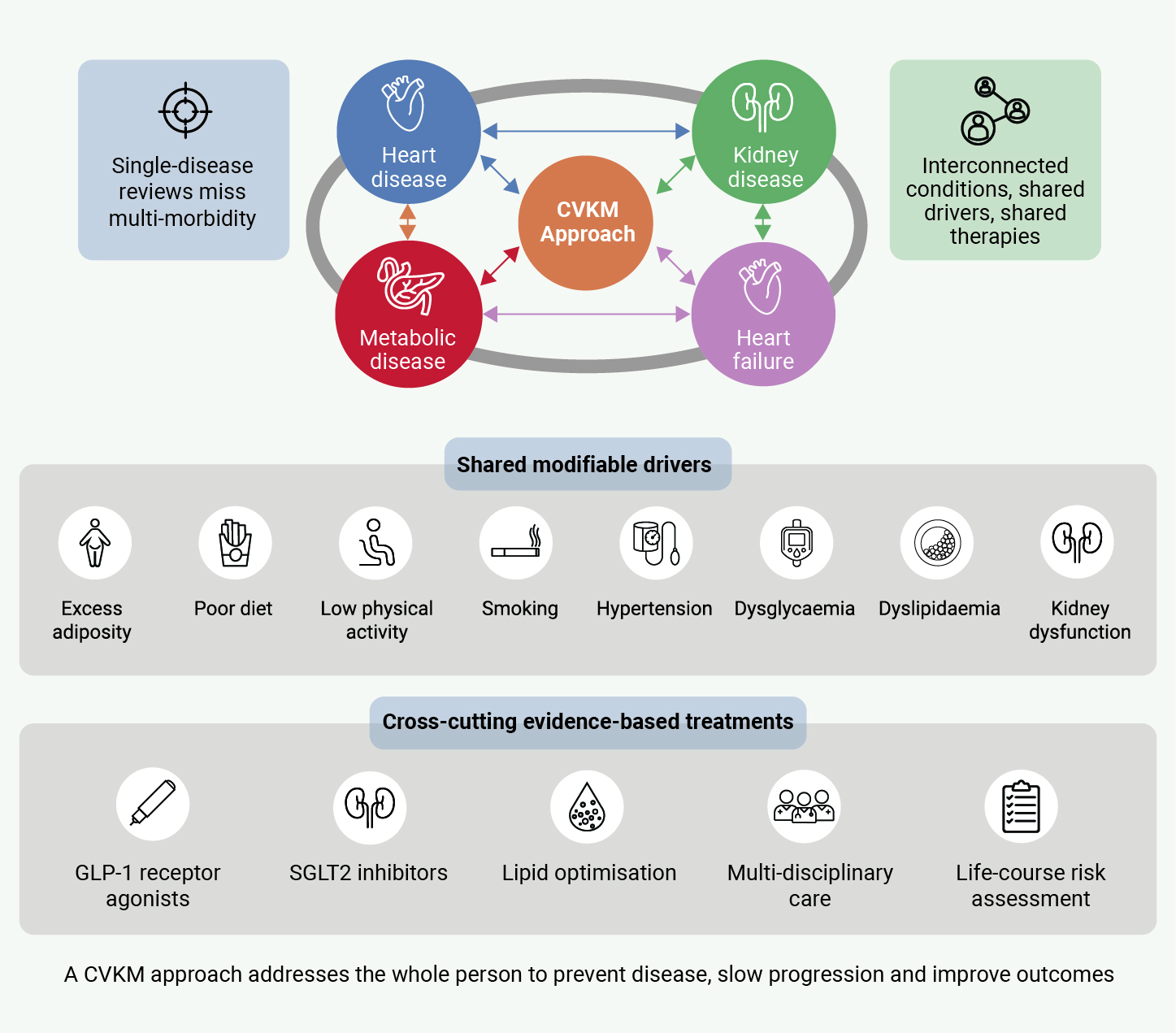
The rationale for a CVKM approach rests on three linked observations. First, the underlying conditions are strongly interconnected. The American Heart Association (AHA) has formalised cardiovascular–kidney–metabolic (CKM) health as a unified construct, reflecting the biological continuum between atherosclerotic disease, kidney dysfunction, metabolic disease, and heart failure.1 Likewise, European prevention guidance emphasises the overlap between cardiovascular risk factors and long-term multi-system disease burden.2 The recently published Department of Health and Social Care and NHS England’s Cardiovascular Disease Modern Service Framework (CVD MSF) adopts and advocates a CVKM approach within national policy. It recognises that these conditions and risk factors share determinants, cluster within individuals and should be identified and managed together.9
Second, these conditions share common modifiable drivers. Excess adiposity, poor diet, low physical activity, smoking, hypertension, dysglycaemia, dyslipidaemia, and kidney dysfunction all contribute across the CVKM spectrum.3,9 For this reason, focusing on one condition in isolation often misses a broader opportunity for prevention. A patient presenting with coronary disease may also have undiagnosed dysglycaemia, CKD, obesity, or fatty liver disease; conversely, a patient reviewed for diabetes or CKD, may in fact be on a trajectory towards major cardiovascular events.10,11
Third, treatments increasingly transcend specialty boundaries. Glucagon-like peptide-1 receptor agonists (GLP-1 RA) and sodium-glucose cotransporter 2 inhibitors (SGLT2i) are the clearest examples of therapies first associated with glycaemic control, but now valued for broader cardiovascular, renal, and metabolic benefits.12,13 National Institute for Health and Care Excellence (NICE) and NHS England policy developments, including updated diabetes treatment pathways and national lipid optimisation programmes, increasingly reflect this cross-cutting therapeutic landscape.6,14–16
Taken together, these developments justify a CVKM framework. They also expose the inadequacy of service models built around single-disease reviews, separate clinics, and narrow performance indicators. This direction of travel has recently been reinforced by the first multi-society AHA/American College of Cardiology (ACC)/American Diabetes Association (ADA)/American Society of Nephrology (ASN) guideline on CKM syndrome, which moves beyond conceptual recognition of interconnected disease towards a life-course framework for risk assessment, prevention, staging and coordinated multi-disciplinary management.17 Figure 1 summarises the rationale.
| The original version of this figure was generated with the assistance of Perplexity AI. Key: CVKM = cardiovascular–kidney–metabolic; GLP-1 = glucagon-like peptide-1; SGLT2 = sodium-glucose cotransporter 2 |
The problem with fragmented delivery
Primary care is where most CVKM risk is identified, monitored, and managed. It is, therefore, the natural home for integrated prevention. However, current delivery often remains fragmented.5,18 Patients may undergo repeated reviews for hypertension, diabetes, lipids, kidney function, obesity, and cardiovascular symptoms in parallel, rather than through one coherent assessment. The result can be duplication, conflicting advice, therapeutic inertia in some domains, overtreatment in others, and a growing burden of appointments and self-management tasks.
This fragmentation matters because guideline-based ‘optimal’ care is usually constructed disease by disease. While the evidence underpinning such guidance is robust, patients in routine practice rarely resemble the selected populations on which many recommendations are based. Multi-morbidity, frailty, polypharmacy, psychological distress, and social vulnerability complicate standardised implementation.4,8,19,20 In this setting, the accumulation of multiple disease-specific targets can obscure the more important question: what matters most for this individual patient, now and over time.21
That question is especially relevant in overstretched systems. Clinicians are often asked to deliver comprehensive prevention, acute care, chronic disease management, and administrative tasks, simultaneously. Performance frameworks can unintentionally reinforce a culture of completion, rather than prioritisation.21 Yet prioritisation is central to good generalist medicine. The issue is not whether evidence-based targets matter; it is that they need to be interpreted through the lens of clinical judgement, proportionality, and likely net benefit.22
From completeness to prioritisation
A more coherent CVKM model requires a shift from completeness towards prioritisation. This does not mean abandoning guidelines or lowering standards. It means applying evidence with greater integration, deciding which interventions are most likely to improve outcomes, reducing treatment burden, and aligning with patient goals.4,21,23 In more practical terms, this also supports a more explicit shared decision-making process, in which clinicians and patients agree which domains should be addressed first, which can reasonably be deferred, and which interventions offer the greatest likely net benefit at a given stage of illness.
Such an approach is particularly important in people living with multi-morbidity. The literature on multi-morbidity and treatment burden has long shown that healthcare systems often create work for patients through poorly coordinated disease-specific pathways.4,8,21,23 A more useful model would assess overall CVKM risk in one consultation framework, while incorporating frailty, mental health, symptom burden, quality of life, and social context.19,20,23,24 In practice, this resembles the logic of comprehensive geriatric assessment, but extended beyond older age alone and adapted to broader cardiometabolic complexity.25
This mindset also supports a more meaningful definition of quality. Traditional markers, such as blood pressure thresholds, lipid targets, and process completion, remain important, but they do not fully capture whether care is coherent, tolerable, or equitable.6,7,16 Good CVKM care should also consider the proportionality of interventions, the extent to which patients understand and can sustain treatment, and whether the model of care improves coherence across the patient journey.5,21 As the therapeutic armamentarium continues to expand, the ability to integrate and prioritise interventions may become as important as the interventions themselves.
Equity, mental health, and sex-specific gaps
Any serious CVKM framework must address factors that are often treated as peripheral, but are, in fact, central to outcomes. Mental health conditions are strongly associated with poorer cardiometabolic outcomes and higher mortality, yet they remain inconsistently integrated into cardiovascular pathways.19 Similarly, health inequalities related to deprivation, ethnicity, and structural access to care, continue to shape disease exposure, diagnosis, treatment uptake, and outcomes.20,24
Sex and gender also deserve explicit attention. Women remain under-recognised in some cardiovascular pathways, and historically underrepresented in parts of the evidence-base.26,27 If CVKM models are developed without considering these dimensions, integrated care may improve efficiency on paper, while leaving inequities untouched in practice.19,24,27
For that reason, CVKM should not be viewed simply as the aggregation of multiple conditions into a single framework. Rather, it represents a broader shift towards integrated, person-centred care that acknowledges the biological and social complexity of long-term disease. It should, therefore, mean widening the clinical frame to include social determinants of health, mental health, and populations who are poorly served by conventional pathway design.18
Service redesign and the multi-disciplinary opportunity
Delivering a CVKM approach does not require a single model. Local pathways should reflect workforce, training, case mix and existing service architecture.16,18,28 What matters more is a shared clinical orientation, in which clinicians across primary and specialist care can recognise overlapping CVKM risk, initiate appropriate optimisation and refer complex cases through clear pathways.16,18 In England, the CVD MSF now provides a national framework for this shift. It defines 12 priorities for earlier prevention, diagnosis and treatment. It promotes neighbourhood-based care, care closer to home and national metrics to reduce unwarranted variation.9 Local systems should, therefore, develop integrated reviews, shared protocols and targeted approaches for populations at increased risk. Delivery should remain responsive to local workforce, capacity and population need.
Early experience suggests this is achievable. Cardiodiabetes and broader cardiometabolic services have improved screening, prescribing and care coordination, while reducing the risk that patients fall between specialty boundaries.16,29–31 Such models allow pharmacists, specialist nurses, allied health professionals and physicians to contribute to a shared preventive agenda, rather than duplicating parallel reviews.
Nonetheless, while multi-disciplinary clinics have demonstrated the feasibility of integrated cardiovascular, kidney and metabolic care, sustainable implementation is unlikely to depend on reproducing highly specialised services in every setting. Emerging implementation frameworks also emphasise coordinated systems of care, supported by shared pathways, clinical-decision support, workforce development and equitable access to evidence-based therapies. In this context, primary care is likely to play a central coordinating role. Neighbourhood-based models may provide a particularly relevant framework. They bring together pharmacists, nurses, dietitians, mental health practitioners, allied health professionals, social prescribing services and wider community resources, around the needs of defined populations. Such models enable cardiovascular, renal and metabolic risk to be considered alongside frailty, mental health, symptom burden, quality of life and wider social determinants of health. This supports a more coherent hierarchy of priorities for patients with multi-morbidity. At the same time, they maintain access to specialist cardiology, nephrology, diabetology and hepatology expertise when required.
However, multi-disciplinary working alone is insufficient. Effective coordination requires clear ownership of the care plan by an individual with appropriate CVKM expertise, responsible for synthesising risk across disease domains, establishing priorities, coordinating follow-up and facilitating specialist input when needed. The critical issue is, therefore, not simply who delivers care, but how responsibility for prioritisation, coordination and accountability is distributed across professional and organisational boundaries.
Such an approach may generate benefits beyond those demonstrated in early clinic-based studies.32–35 For patients, integrated models may support more coherent and convenient care. For healthcare systems, potential gains include reduced duplication, more efficient deployment of specialist expertise and improved allocation of limited resources. In primary care, the opportunity is not simply to create another clinic model, but to redesign reviews around a single risk-focused conversation. Although the emerging economic evidence-base remains relatively immature, current data suggest that the value of integrated care is lucrative, and likely to extend beyond traditional disease-specific outcome measures, and should be considered alongside wider system benefits.36,37
The role of digital tools
Digital systems and artificial intelligence may support this shift, if used carefully. They can help identify high-risk patients, prompt evidence-based prescribing, stratify follow-up, and support population-level prevention.38 Used well, they may help clinicians convert fragmented data into a coherent picture of need.38
However, technology is not a substitute for service redesign or clinical judgement. If layered onto already fragmented pathways, digital tools can simply add more alerts, more tasks, and more administrative complexity.38 Their value depends on whether they support integration, rather than reproducing siloed care in digital form.18,38
Implementation barriers
A more integrated CVKM model is conceptually attractive, but implementation will not be automatic. Workforce capacity remains a limiting factor, particularly where primary-care teams are already managing large volumes of demand with constrained appointment time. Training is another barrier: if clinicians are expected to manage overlapping cardiometabolic disease, they need clear competency frameworks, simple referral thresholds, and access to specialist support. Without these, the burden of integration may simply be shifted onto frontline teams without the tools to deliver it safely.18,23
Data and information systems also matter. Integrated care depends on access to shared records, meaningful decision support, and a common language for risk. Fragmented IT systems can make it difficult to see the full picture, while poorly designed digital prompts can increase noise rather than clarity.38 For this reason, digital transformation should be judged by whether it reduces fragmentation in practice, not by whether it adds more functionality on paper.
There is also a cultural barrier. Disease-specific pathways are familiar, measurable, and embedded in existing commissioning structures. CVKM care requires a more relational form of medicine, one that values judgement, conversation, and coordination. That can feel less neat than target-driven management, but it better reflects the reality of multi-morbidity and the needs of patients who live with it.4,5,8,21
This shift also has implications for how success is defined and measured. Traditional models of care, commissioning and economic evaluation, remain largely organised around individual diseases and disease-specific targets. However, patients experience cardiovascular, kidney and metabolic disease as overlapping manifestations of multi-morbidity, rather than as separate conditions. Recent CVKM health-economic modelling has highlighted the limitations of evaluating interventions within isolated disease silos. Conventional approaches may, therefore, underestimate the value of therapies and care models that deliver benefits across multiple organ systems simultaneously. The value of integrated care should be assessed against both clinical outcomes and system efficiency, rather than assuming that additional coordination inevitably increases cost.
The 2026 CVD MSF strengthens the economic case for ‘CVKM’ systematic implementation. Modelling cited within the framework estimates that four NICE-recommended treatments could prevent more than 60,000 cardiovascular events over three years. The estimated benefits include £1.2 billion in health and social care savings and £1.3 billion in productivity gains. These estimates do not establish the cost-effectiveness of a specific integrated CVKM service model. They indicate the potential population-level value of consistent delivery of evidence-based cardiovascular, kidney and metabolic interventions.9
Therefore, integrated CVKM care should be evaluated against both patient outcomes and system performance. Potential benefits include lower treatment burden, improved care coordination and more efficient use of specialist expertise. This may be particularly relevant in resource-constrained health systems, where reducing fragmentation could be as important as achieving further incremental gains in disease-specific targets.
A practical way forward
In practical terms, the CVKM model changes the consultation. Rather than asking whether every individual target has been addressed, clinicians ask which intervention will most improve overall prognosis, symptom burden, and treatment sustainability. That may mean intensifying lipid lowering in one patient, simplifying polypharmacy in another, or prioritising weight, kidney protection, and behavioural support in a third. The approach is, therefore, not anti-guideline; it is guideline-informed but context-sensitive.4,5 Indeed, the challenge for the next decade may be as much about prioritisation as implementation, requiring clinicians to determine, not only what can be done, but what is most likely to deliver meaningful benefit for a given individual.
Translating CVKM concepts into routine practice will require several key principles:
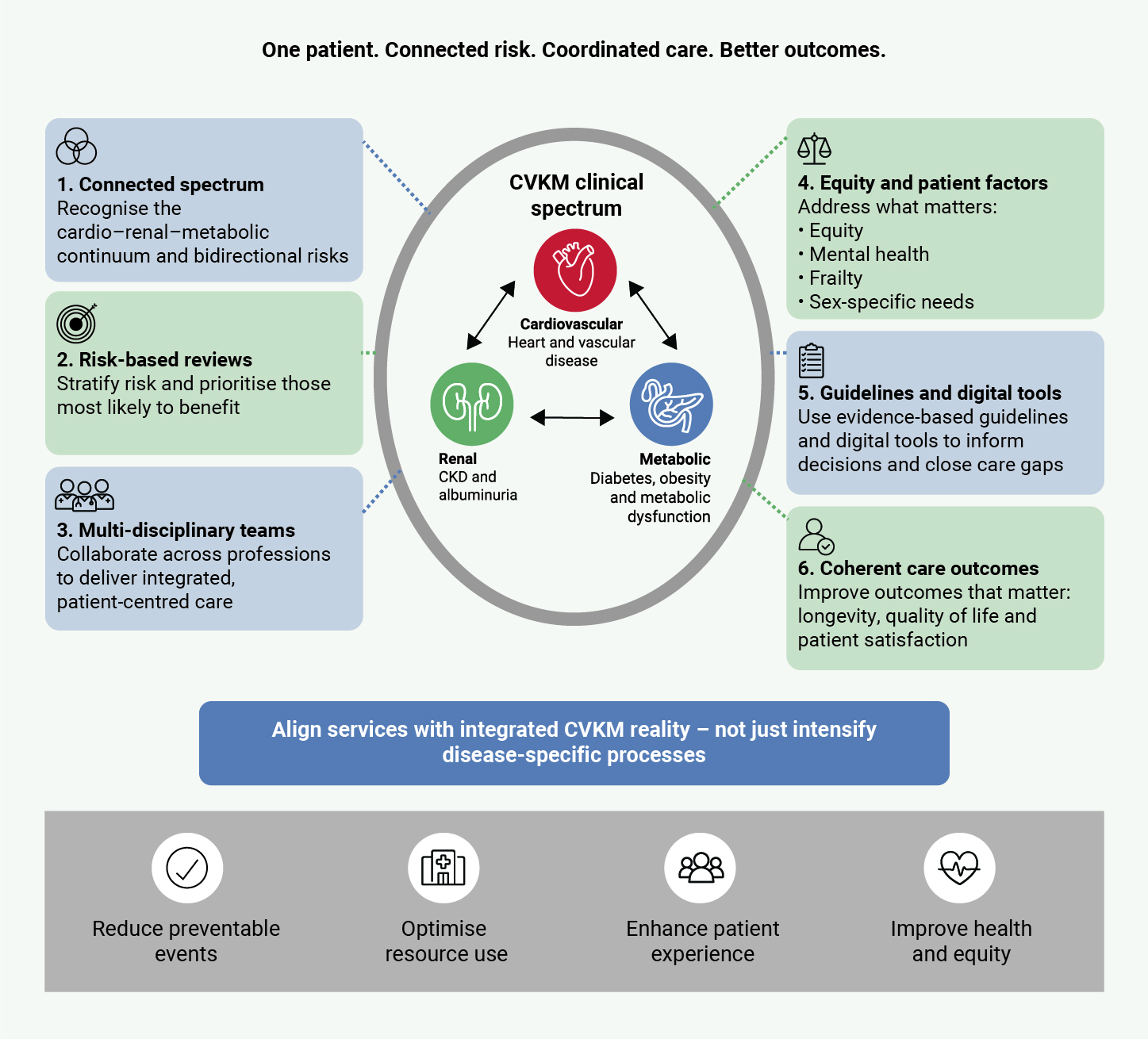
- View cardiovascular, kidney, and metabolic disease as a connected clinical spectrum, rather than separate risk domains.
- Organise reviews around overall risk, priorities, and patient goals, not only around disease-specific checklists.
- Equip multi-disciplinary teams to manage overlapping conditions within agreed competencies and referral criteria.
- Embed equity, mental health, frailty, and sex-specific considerations into routine CVKM assessment.
- Use guidelines and digital tools to support, rather than replace, clinical judgement.
- Evaluate success, not only by target attainment, but by coherence of care, reduction in treatment burden, and patient-relevant outcomes.
The central message is simple. Modern CVKM science has moved faster than the way care is delivered. If the NHS is serious about reducing cardiovascular morbidity and premature mortality, the next step is not merely to intensify existing disease-specific processes. It is to align services, consultations, and professional mindsets with the integrated reality of CVKM disease (figure 2). This will be most credible if supported by clear incentives, measurable quality indicators, and commissioning structures that reward joined-up care rather than isolated activity volumes.
| The original version of this figure was generated with the assistance of Perplexity AI. Key: CKD = chronic kidney disease; CVKM = cardiovascular–kidney–metabolic |
Conflicts of interest
None declared.
Funding
None.
References
1. Ndumele CE, Neeland IJ, Tuttle KR et al. A synopsis of the evidence for the science and clinical management of cardiovascular-kidney-metabolic (CKM) syndrome: a scientific statement from the American Heart Association. Circulation 2023;148:1636–64. https://doi.org/10.1161/CIR.0000000000001186
2. Visseren F, Mach F, Smulders YM et al. 2021 ESC guidelines on cardiovascular disease prevention in clinical practice. Eur Heart J 2021;42:3227–337. https://doi.org/10.1093/eurheartj/ehab484
3. Yusuf S, Rangarajan S, Teo K et al. Cardiovascular risk and events in 17 low-, middle-, and high-income countries. N Engl J Med 2014;371:818–27. https://doi.org/10.1056/NEJMoa1311890
4. Tinetti ME, Fried TR, Boyd CM. Designing health care for the most common chronic condition – multimorbidity. JAMA 2012;307:2493. https://doi.org/10.1001/jama.2012.5265
5. Säemann M, Biesiada A, Smatana M, Liebermann N. Cardio-renal-metabolic (CRM): call for action for European guidelines for primary care physicians. J Prim Care Community Health 2025;16:21501319251379732. https://doi.org/10.1177/21501319251379732
6. National Institute for Health and Care Excellence. Type 2 diabetes in adults: management. NG28. London: NICE, 2015. Available from: https://www.nice.org.uk/guidance/ng28
7. Cardiovascular Disease Prevention Audit (CVDPREVENT). Regional & ICS Insights. Available at: https://data.cvdprevent.nhs.uk/insights?period=31&level=1&area=1&group=0 [accessed 14 May 2026].
8. Barnett K, Mercer SW, Norbury M, Watt G, Wyke S, Guthrie B. Epidemiology of multimorbidity and implications for health care, research, and medical education: a cross-sectional study. Lancet 2012;380:37–43. https://doi.org/10.1016/S0140-6736(12)60240-2
9. Department of Health and Social Care, and NHS England. Cardiovascular disease (CVD) modern service framework (MSF): a cardiovascular-kidney-metabolic approach. The strategic vision and delivery model. London: NHS England, 2026. Available from: https://www.gov.uk/government/publications/cardiovascular-disease-modern-service-framework
10. Vijay K, Neuen BL, Lerma EV. Heart failure in patients with diabetes and chronic kidney disease: challenges and opportunities. Cardiorenal Med 2022;12:1–10. https://doi.org/10.1159/000520909
11. Chen H, Liu L, Wang Y et al. Burden of cardiovascular disease attributable to metabolic risks in 204 countries and territories from 1990 to 2021. Eur Heart J Qual Care Clin Outcomes 2025;11:467–76. https://doi.org/10.1093/ehjqcco/qcae090
12. West L, Patolia H, Chapman B et al. Beyond diabetes: a review of emerging indications for glucagon-like peptide-1 receptor agonists. Rev Cardiovasc Med 2026;27:44528. https://doi.org/10.31083/RCM44528
13. Wu Q, Zhang J, Zhang F, Li D. SGLT2 inhibitors as metabolic modulators: beyond glycemic control in type 2 diabetes. Front Endocrinol 2025;16:1601633. https://doi.org/10.3389/fendo.2025.1601633
14. NHS England. Funding and supply of inclisiran (Leqvio®). London: NHS England, 2025. Available from: https://www.england.nhs.uk/long-read/funding-supply-inclisiran-leqvio/
15. National Institute for Health and Care Excellence. Semaglutide for reducing the risk of major adverse cardiovascular events in people with cardiovascular disease and overweight or obesity. TA1152. London: NICE, 2026. Available from: https://www.nice.org.uk/guidance/ta1152
16. Shah MU, Roebuck A, Srinivasan B et al. Optimisation of care among patients with diabetes mellitus and acute coronary syndrome through a specialised cardiodiabetes service: a registry study. Diabet Med 2025;42:e70030. https://doi.org/10.1111/dme.70030
17. Ndumele CE, Rodriguez F, Dixon DL et al. 2026 AHA/ACC/ADA/ASN guideline for the prevention, detection, evaluation, and management of cardiovascular-kidney-metabolic syndrome: a report of the American College of Cardiology/American Heart Association Joint Committee on Clinical Practice Guidelines. Circulation 2026;154:e50–e158. https://doi.org/10.1161/CIR.0000000000001453
18. Thakkar R. Integrated working in cardiovascular care. Br J Cardiol 2024;31:039. https://doi.org/10.5837/bjc.2024.039
19. Walker ER, McGee RE, Druss BG. Mortality in mental disorders and global disease burden implications: a systematic review and meta-analysis. JAMA Psychiatry 2015;72:334–41. https://doi.org/10.1001/jamapsychiatry.2014.2502
20. Stringhini S, Carmeli C, Jokela M et al. Socioeconomic status and the 25 × 25 risk factors as determinants of premature mortality: a multicohort study and meta-analysis of 1·7 million men and women. Lancet 2017;389:1229. https://doi.org/10.1016/S0140-6736(16)32380-7
21. Reuben DB, Tinetti ME. Goal-oriented patient care: an alternative health outcomes paradigm. N Engl J Med 2012;366:777–9. https://doi.org/10.1056/NEJMp1113631
22. Reeve J. Interpretive medicine: supporting generalism in a changing primary care world. Occas Pap R Coll Gen Pract 2010;(88):1–20. Available from: https://pmc.ncbi.nlm.nih.gov/articles/pmid/21805819/
23. May CR, Eton DT, Boehmer K et al. Rethinking the patient: using burden of treatment theory to understand the changing dynamics of illness. BMC Health Serv Res 2014;14:281. https://doi.org/10.1186/1472-6963-14-281
24. British Heart Foundation. Bridging hearts: addressing inequalities in cardiovascular health and care. London: BHF, 2025. Available from: https://www.bhf.org.uk/what-we-do/our-research/heart-statistics/health-inequalities-research/bridging-hearts-addressing-inequalities-in-cardiovascular-health-and-care
25. Veronese N, Custodero C, Demurtas J et al. Comprehensive geriatric assessment in older people: an umbrella review of health outcomes. Age Ageing 2022;51:afac104. https://doi.org/10.1093/ageing/afac104
26. Ji H, Sabanayagam C, Matsushita K et al. Sex differences in cardiovascular-kidney-metabolic syndrome: 30-year US trends and mortality risks-brief report. Arterioscler Thromb Vasc Biol 2024;45:157. https://doi.org/10.1161/ATVBAHA.124.321629
27. Lashkarinia SS, Lee AWC, Baptiste TMG et al. Representation of women in cardiovascular disease management: a systematic analysis of ESC guidelines. Open Heart 2025;12:e003320. https://doi.org/10.1136/openhrt-2025-003320
28. Morris L, Baird B, Charles A. What is neighbourhood health? London: The King’s Fund, 2026. Available from: https://www.kingsfund.org.uk/insight-and-analysis/long-reads/what-is-neighbourhood-health
29. Modarressi T. Role and impact of a specialized cardiometabolic clinic in managing high-risk patients with type 2 diabetes and atherosclerotic cardiovascular disease. Am J Prev Cardiol 2024;19:100706. https://doi.org/10.1016/j.ajpc.2024.100706
30. Neeland IJ, Arafah A, Bourges-Sevenier B et al. Second-year results from CINEMA: a novel, patient-centered, team-based intervention for patients with type 2 diabetes or prediabetes at high cardiovascular risk. Am J Prev Cardiol 2024;17:100630. https://doi.org/10.1016/j.ajpc.2023.100630
31. Dubrofsky L, Lee JF, Hajimirzarahimshirazi P et al. A unique multi- and interdisciplinary cardiology-renal-endocrine clinic: a description and assessment of outcomes. Can J Kidney Health Dis 2022;9:20543581221081207. https://doi.org/10.1177/20543581221081207
32. Baxter S, Johnson M, Chambers D, Sutton A, Goyder E, Booth A. The effects of integrated care: a systematic review of UK and international evidence. BMC Health Serv Res 2018;18:350. https://doi.org/10.1186/s12913-018-3161-3
33. Yang Y, Hoo J, Tan J, Lim L. Multicomponent integrated care for patients with chronic heart failure: systematic review and meta-analysis. ESC Heart Fail 2022;10:791–807. https://doi.org/10.1002/ehf2.14207
34. Murtagh S, McCombe G, Broughan J et al. Integrating primary and secondary care to enhance chronic disease management: a scoping review. Int J Integr Care 2021;21:4. https://doi.org/10.5334/ijic.5508
35. Zhang Y, Stokes J, Anselmi L, Bower P, Xu J. Can integrated care interventions strengthen primary care and improve outcomes for patients with chronic diseases? A systematic review and meta-analysis. Health Res Policy Syst 2025;23:5. https://doi.org/10.1186/s12961-024-01260-1
36. Nichols GA, Amitay EL, Chatterjee S, Steubl D. Health care costs associated with the development and combination of cardio-renal-metabolic diseases. Kidney360 2023;4:1382–8. https://doi.org/10.34067/KID.0000000000000212
37. University Hospitals of Derby and Burton NHS Foundation Trust. Innovative cardiometabolic service ensuring faster access to transformative care for patients. 20 November 2025. Available at: https://www.uhdb.nhs.uk/latest-news/innovative-cardiometabolic-service-ensuring-faster-access-to-transformative-care-for-patients-20234 [accessed 22 June 2026].
38. Topol EJ. High-performance medicine: the convergence of human and artificial intelligence. Nat Med 2019;25:44–56. https://doi.org/10.1038/s41591-018-0300-7


